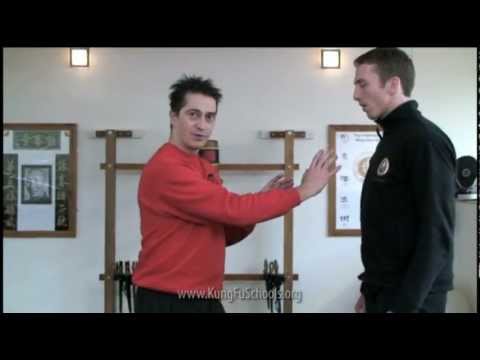
Self Defence - Essential Tips for Self Protection - Crawley Kung Fu School - Clip 1
0
Kung Fu Defence·Kung Fu Schools Crawley
http://www.KungFuSchools.org Self Defence tips from Sifu Paul Hawkes - Chief instructor at the Premier Martial Arts Scho…
Translation: Kung fu defence
The Kung Fu Defence family covers defensive blocking, deflecting, and intercepting techniques from Chinese martial arts (kung fu/wushu) systems — the most diverse collection of defensive hand techniques in any martial arts tradition. [1] Chinese martial arts developed fundamentally different defensive approaches from Western boxing: rather than absorbing strikes on a passive guard, many Chinese systems emphasise redirecting attacks using minimal force (four ounces deflects a thousand pounds — the Tai Chi principle) or simultaneously blocking and striking (pak sao/simultaneous block-strike in Wing Chun). [1],[2] The major Chinese defensive systems include Wing Chun's centreline trapping (pak sao, bong sao, tan sao), Tai Chi's yielding redirections, Shaolin's hard external blocks, and Bagua's evasive circle-walking. [2],[3] These systems reflect the Chinese martial philosophy of using the opponent's force against them rather than meeting force with force. [3]
Chinese martial arts defensive techniques have been developed over thousands of years across hundreds of styles. [1] Wing Chun's trapping system (pak sao, bong sao, tan sao) is attributed to the legendary Ng Mui and was refined through the Ip Man lineage in the 20th century. [1],[2] Tai Chi's yielding defensive principles were codified by the Chen family (17th century) and popularised by Yang Luchan (19th century). [2],[3] Bruce Lee studied Wing Chun under Ip Man and incorporated its defensive concepts into Jeet Kune Do, bringing Chinese defensive principles to worldwide attention. [3]
Chinese defensive techniques offer unique capabilities not found in other systems — Wing Chun's simultaneous block-strike is theoretically more efficient than the block-then-counter approach of boxing, and Tai Chi's yielding redirections work against larger, stronger opponents. [1] However, these techniques have had mixed results in modern full-contact competition (MMA, kickboxing), where the speed and pressure of trained fighters make traditional trapping sequences difficult to apply. [2] Their greatest effectiveness may be in self-defence scenarios where the attacker is untrained and the close-range trapping opportunities are more available. [3]
No images yet for this technique.
Sign in to suggest an image.
http://www.KungFuSchools.org Self Defence tips from Sifu Paul Hawkes - Chief instructor at the Premier Martial Arts Scho…
No instructional courses yet for this technique.
Sign in to suggest a course.
Risk of injury to the person this technique is applied to
Chinese defensive techniques are designed to be safe for the defender; soft deflections in particular minimise impact on the blocking limbs; the main risk is an untrained practitioner misjudging distance or timing
Skill level needed to execute this technique reliably
Whether this technique is allowed under major competition rule sets
Tao of Jeet Kune Do (Bruce Lee, 1975)
Description sources — [1] Wing Chun technical curriculum [2] Tai Chi push hands tradition [3] Bruce Lee and Jeet Kune Do development
History sources — [1] Ip Man and Wing Chun lineage [2] Chen family Tai Chi history [3] Bruce Lee biography
Description sources — [1] Wing Chun technical curriculum [2] Tai Chi push hands tradition [3] Bruce Lee and Jeet Kune Do development
History sources — [1] Ip Man and Wing Chun lineage [2] Chen family Tai Chi history [3] Bruce Lee biography
sensitivity (feeling the opponent's intention through touch), relaxation (tension prevents soft redirection), quick reflexes
fast hands, good proprioception, the ability to remain relaxed under pressure
forearms (deflection and control), intrinsic hand muscles (maintaining hand positions), core (stability during deflections), legs (maintaining stance)
Every move, in any martial art, shares a few universal traits. Mix and match below to pinpoint the right tool — or compare equivalents across styles.
The Hop-Gar Crane Wing Block uses a sweeping wing-like motion of the forearm to deflect wide attacks, mimicking the crane spreading its wings for protection. [1]
The Hop-Gar Inside Block deflects incoming attacks from the inside line using a circular motion that redirects force rather than opposing it directly, following Taoist principles of yielding. [1]
Kung fu defensive techniques include unique concepts not found in Western martial arts: iron shirt (body conditioning to absorb strikes), chi sao (Wing Chun sensitivity drill for trapping and redirecting), and the centerline theory (defending the center while attacking from the periphery). (Chinese martial arts texts in corpus; Wing Chun manuals)
Put your hands forward in a protective way to control the other person's area while signaling that you're not a threat. This keeps you feeling in control of yourself and gives you defensive options.
If you're in a less public environment or genuinely feel your life is threatened or that the situation will immediately escalate, there's nothing wrong with being more proactive in your defence rather than staying purely passive.
The Kung Fu Defence family covers defensive blocking, deflecting, and intercepting techniques from Chinese martial arts (kung fu/wushu) systems — the most diverse collection of defensive hand techniques in any martial arts tradition. Chinese martial arts developed fundamentally different defensive approaches from Western boxing: rather than absorbing strikes on a passive guard, many Chinese systems emphasise redirecting attacks using minimal force (four ounces deflects a thousand pounds — the Tai Chi principle) or simultaneously blocking and striking (pak sao/simultaneous block-strike in Wing Chun).
Chinese martial arts defensive techniques have been developed over thousands of years across hundreds of styles. Wing Chun's trapping system (pak sao, bong sao, tan sao) is attributed to the legendary Ng Mui and was refined through the Ip Man lineage in the 20th century.
Unified MMA: legal — Legal defensive technique; IBJJF: legal — Legal; IJF: legal — Legal defensive action; WBC/Boxing: legal — Legal; WKF: legal — Legal; WT: legal — Legal
Danger rating 2/10. Low — Chinese defensive techniques are designed to be safe for the defender; soft deflections in particular minimise impact on the blocking limbs; the main risk is an untrained practitioner misjudging distance or timing
The standard setup chain: Maintain Guard → Sense the Attack → Deflect → Trap or Redirect → Counter → Follow Up.
Standard counters include: Pressure Fighting — aggressive forward pressure prevents the defender from establishing trapping range / Boxing Combinations — rapid combinations overwhelm single-deflection responses / Wrestling/Takedowns — shooting for takedowns bypasses the standing trapping exchange / Maintaining Distance — staying at boxing range prevents the close-range trapping that Chinese defence requires.
Common variants: Pak sao (slapping block) (Wing Chun's simultaneous deflection and counter-strike [1]); Bong sao (wing arm) (Wing Chun deflection that redirects attacks using the for…); Tan sao (dispersing hand) (palm-up centreline deflection in Wing Chun); Lap sao (grabbing hand) (seizing the opponent's wrist after a deflection to contro…); Peng/Lu/Ji/An (ward off, roll back, press, push) (the four fundamental Tai Chi energies used for defence an…); Shaolin hard blocks (similar to karate blocks but with distinct hand positions…); Bagua circle walking (evasive footwork-based defence unique to Baguazhang); Crane defence (Wing-like arm movements that deflect and redirect in Cran…).
Chinese defensive techniques are used in wushu sanda and Wing Chun competition formats. In MMA and kickboxing, they have had limited competitive success against trained boxing and Muay Thai defences.
Top errors to watch for: Trying to use chi sao techniques against trained boxers at boxing speed without modification — Wing Chun trapping req… / Relying on soft deflections against powerful attacks — very powerful strikes can overwhelm soft deflections; sometime… / Training only solo forms without partner work — defensive techniques must be tested against live, unpredictable attacks / Believing chi sao is fighting — chi sao is a sensitivity drill, not a fight simulation; it develops skills that must ….
The Kung Fu Defence is also known as Kanfū Difensu, Chinese Martial Arts Defence, Wushu Defence, Kung Fu Block.