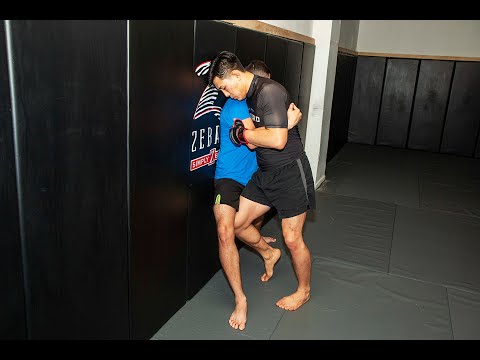
MMA Cage Wall Training - Dominating Strikes from the Clinch with Rene Dreifuss
0
Underhook Cage Clinch·Stuart Tomlinson
| MMA Cage Wall Training - Dominating Strikes from the Clinch | The cage wall is not only an iconic part of MMA fights …
Translation: underhook cage clinch
The Underhook Cage Clinch subfamily covers cage clinch positions where the attacker controls the opponent against the fence using one or both underhooks as the primary clinch tie. [1] The combination of underhook inside position and cage contact creates one of the strongest control configurations in MMA — the underhooks provide body access for takedowns while the cage prevents the opponent from creating space or circling away. [1],[2] The underhook cage clinch is the most common offensive cage clinch position and the primary platform for cage wrestling takedown attempts. [2],[3]
The underhook cage clinch became the dominant cage wrestling position as wrestlers entered MMA and adapted their underhook-based offence to the fence environment. [1] Fighters like Khabib Nurmagomedov, Daniel Cormier, and Colby Covington have demonstrated the position's effectiveness at the highest levels of MMA competition. [2],[3]
The underhook cage clinch uses one or both underhooks to pin the opponent against the cage, providing a stable platform for takedowns, dirty boxing, and positional control. [1] Couture describes this as the most commonly used cage clinch position in MMA because it combines wrestling fundamentals with cage-specific tactics. [1]
The underhook cage clinch uses single or double underhooks with the opponent against the cage. [1]
Khabib Nurmagomedov's dominant UFC lightweight championship reign (2018–2020) was built significantly on underhook cage clinch work. [1] His ability to pin opponents against the cage with underhooks and grind them down before executing takedowns was statistically his most frequently used positional strategy. [1]
No images yet for this technique.
Sign in to suggest an image.
| MMA Cage Wall Training - Dominating Strikes from the Clinch | The cage wall is not only an iconic part of MMA fights …
No instructional courses yet for this technique.
Sign in to suggest a course.
Risk of injury to the person this technique is applied to
Cage clinch work involves grinding pressure; rib/facial abrasion risk
Skill level needed to execute this technique reliably
Whether this technique is allowed under major competition rule sets
Mastering Jujitsu (Renzo Gracie & John Danaher, 2003)
Alias sources — [1] Clinch Fighting for MMA (Couture, 2011) [2] MMA Instruction Manual (UFC, 2008) [3] Wrestling for Fighting (Velasquez, 2012)
Effectiveness sources — [1] Clinch Fighting for MMA (Couture, 2011)
Standard katakana transliteration of Western martial arts terminology (外来語) — used in Japanese MMA, boxing, and BJJ communities
Alias sources — [1] Clinch Fighting for MMA (Couture, 2011) [2] MMA Instruction Manual (UFC, 2008) [3] Wrestling for Fighting (Velasquez, 2012)
Effectiveness sources — [1] Clinch Fighting for MMA (Couture, 2011)
swimming speed for inside position, shoulder drive, hip pressure
strong shoulders and low centre of gravity
deltoids, pectorals, core, quadriceps
Every move, in any martial art, shares a few universal traits. Mix and match below to pinpoint the right tool — or compare equivalents across styles.
According to Stuart Tomlinson, one of the most important principles from judo is maintaining balance and breaking your opponent's balance; if you hit someone who is off balance, you're much more likely to be effective with your strikes.
Stuart Tomlinson notes that sometimes you cannot execute certain techniques the same way if your opponent is much shorter than you, requiring adjustments to your approach.
The Underhook Cage Clinch subfamily covers cage clinch positions where the attacker controls the opponent against the fence using one or both underhooks as the primary clinch tie. The combination of underhook inside position and cage contact creates one of the strongest control configurations in MMA — the underhooks provide body access for takedowns while the cage prevents the opponent from creating space or circling away.
The underhook cage clinch became the dominant cage wrestling position as wrestlers entered MMA and adapted their underhook-based offence to the fence environment. Fighters like Khabib Nurmagomedov, Daniel Cormier, and Colby Covington have demonstrated the position's effectiveness at the highest levels of MMA competition.
Unified MMA: legal — Legal — clinching is integral to MMA; IJF: legal — Legal — kumi-kata (grip fighting) is fundamental to judo; IBJJF: legal — Legal — standing grip fighting and clinch work permitted; IFMA: legal — Legal — the clinch is a core element of Muay Thai, clinch dominance is highly…; WBC/Boxing: restricted — Holding is technically a foul — referee breaks clinch, excessive holding resu…; K: restricted — 1/GLORY — One attack from clinch allowed, then referee breaks; WAKO: restricted — Clinch generally broken by referee — limited or no clinch fighting in most fo…; UWW: legal — Legal — clinch is fundamental to wrestling, the primary position in Greco-Roman
Danger rating 4/10. Moderate — cage clinch work involves grinding pressure; rib/facial abrasion risk
The standard setup chain: Close Distance → Swim Inside → Hip Position → Head Position.
Standard counters include: Pummeling — fight for inside position by swimming arms under opponent's grips / Frame and Push — create distance using forearm frames against the chest or neck / Overhook (Whizzer) — trap the underhook arm with an overhook to neutralize it / Arm Drag — pull the underhooking arm past to take the back.
Common variants: Single underhook (one arm inside for angle and control); Double underhooks (both arms inside for maximum inside position); Underhook with collar tie (combining the underhook with head control).
Khabib Nurmagomedov's dominant UFC lightweight championship reign (2018–2020) was built significantly on underhook cage clinch work. His ability to pin opponents against the cage with underhooks and grind them down before executing takedowns was statistically his most frequently used positional strategy.
Top errors to watch for: Getting the underhook against the cage but not driving forward — forward pressure is what makes the cage clinch work / Standing flat against the cage with the opponent — angle off to the underhook side for better leverage / Not using the free hand — post, strike, or control with the non-underhook hand / Holding the underhook cage clinch without taking down — attack within 10-15 seconds or the referee may separate.
The Underhook Cage Clinch is also known as Andāfukku Kēji Kurinchi, Underhook Fence Clinch, Cage Underhook, Fence Under Tie.