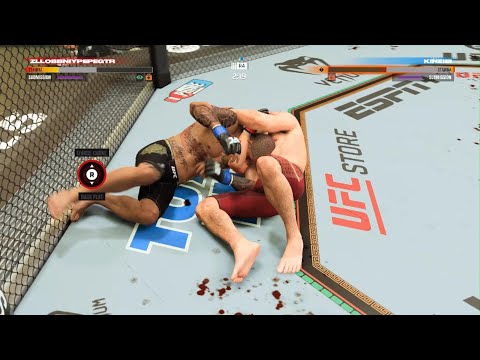
Cage clinch cheese at the end
0
Cage Clinch·ZllobbniyPepeg
Translation: cage clinch
The Cage Clinch family covers clinch positions specific to the MMA cage environment, where one fighter has the other pressed against the cage fence and uses the structure to maintain control and set up offence. [1] The cage clinch leverages the fence as a 'third arm' — it holds the opponent in place, absorbs backward force, and prevents disengagement, allowing the controlling fighter to work for takedowns, strikes, or positional advancement with less concern about the opponent creating distance. [1],[2] Cage clinch positions are defined by the grip configuration (underhooks, body lock, collar tie) combined with the cage contact that modifies the standard clinch dynamics. [2],[3]
Cage clinch fighting developed rapidly in MMA from the mid-1990s onward as wrestlers and clinch fighters recognised the tactical advantages provided by the fence. [1] The systematic development of cage clinch techniques accelerated during the 2000s as MMA coaching became more sophisticated and specialised. [2],[3]
The cage clinch represents a category of positions unique to MMA that exploit the cage wall as an additional control surface. [1] Couture describes cage clinch techniques as 'the third dimension of MMA grappling,' noting that the cage fundamentally changes the physics of clinch fighting by eliminating backward retreat. [1]
Cage clinch techniques were pioneered in MMA by wrestlers like Randy Couture, who used the cage as a 'third hand' for control. [1]
Randy Couture's cage clinch techniques became a defining element of MMA strategy in the 2000s. [1]
No images yet for this technique.
Sign in to suggest an image.
No instructional courses yet for this technique.
Sign in to suggest a course.
Risk of injury to the person this technique is applied to
Cage clinch work involves grinding pressure; rib/facial abrasion risk
Skill level needed to execute this technique reliably
Whether this technique is allowed under major competition rule sets
Mastering Jujitsu (Renzo Gracie & John Danaher, 2003)
Alias sources — [1] Wrestling for Fighting (Couture, 2007) [2] MMA Instruction Manual (UFC, 2008) [3] MMA Instruction Manual (UFC, 2008)
Effectiveness sources — [1] Clinch Fighting for MMA (Couture, 2011)
Standard katakana transliteration of Western martial arts terminology (外来語) — used in Japanese MMA, boxing, and BJJ communities
Alias sources — [1] Wrestling for Fighting (Couture, 2007) [2] MMA Instruction Manual (UFC, 2008) [3] MMA Instruction Manual (UFC, 2008)
Effectiveness sources — [1] Clinch Fighting for MMA (Couture, 2011)
swimming speed for inside position, shoulder drive, hip pressure
strong shoulders and low centre of gravity
deltoids, pectorals, core, quadriceps
Every move, in any martial art, shares a few universal traits. Mix and match below to pinpoint the right tool — or compare equivalents across styles.
The Double Collar Cage Clinch subfamily positions the attacker with both hands gripping behind the opponent's neck (double collar tie) while the opponent's back is pressed against the cage fence. [1] The cage prevents the opponent from stepping back to relieve the collar tie pressure, amplifying the effectiveness of the double collar tie by eliminating the primary escape route. [1,2] From the double collar cage clinch, the attacker can deliver devastating knee strikes (as in the Muay Thai plum), snap the opponent down along the fence, or transition to underhooks and body locks for cage takedowns. [2,3]
The Underhook Cage Clinch subfamily covers cage clinch positions where the attacker controls the opponent against the fence using one or both underhooks as the primary clinch tie. [1] The combination of underhook inside position and cage contact creates one of the strongest control configurations in MMA — the underhooks provide body access for takedowns while the cage prevents the opponent from creating space or circling away. [1,2] The underhook cage clinch is the most common offensive cage clinch position and the primary platform for cage wrestling takedown attempts. [2,3]
Cage-work appears in over 1,200 passages across our corpus. The cage wall fundamentally changes clinch fighting compared to open-mat grappling — fighters can use the wall for support, wall-walks, and cage-assisted takedowns. Unique to MMA competition conducted in a cage/ring with walls. (200+ books; MMA training manuals)
The Cage Clinch family covers clinch positions specific to the MMA cage environment, where one fighter has the other pressed against the cage fence and uses the structure to maintain control and set up offence. The cage clinch leverages the fence as a 'third arm' — it holds the opponent in place, absorbs backward force, and prevents disengagement, allowing the controlling fighter to work for takedowns, strikes, or positional advancement with less concern about the opponent creating distance.
Cage clinch fighting developed rapidly in MMA from the mid-1990s onward as wrestlers and clinch fighters recognised the tactical advantages provided by the fence. The systematic development of cage clinch techniques accelerated during the 2000s as MMA coaching became more sophisticated and specialised.
Unified MMA: legal — Legal — clinching is integral to MMA; IJF: legal — Legal — kumi-kata (grip fighting) is fundamental to judo; IBJJF: legal — Legal — standing grip fighting and clinch work permitted; IFMA: legal — Legal — the clinch is a core element of Muay Thai, clinch dominance is highly…; WBC/Boxing: restricted — Holding is technically a foul — referee breaks clinch, excessive holding resu…; K: restricted — 1/GLORY — One attack from clinch allowed, then referee breaks; WAKO: restricted — Clinch generally broken by referee — limited or no clinch fighting in most fo…; UWW: legal — Legal — clinch is fundamental to wrestling, the primary position in Greco-Roman
Danger rating 4/10. Moderate — cage clinch work involves grinding pressure; rib/facial abrasion risk
The standard setup chain: Close Distance → Establish Primary Grip → Position the Hips → Apply Pressure.
Standard counters include: Pummeling — fight for inside position by swimming arms under opponent's grips / Frame and Push — create distance using forearm frames against the chest or neck / Grip Break — systematically strip the opponent's controlling grips / Posture Up — straighten the spine and drive the hips forward to break clinch control.
Common variants: Single collar tie (one hand on the nape controlling the head); Double collar tie (plum) (both hands behind the head for maximum control); Collar tie with wrist control (one hand on the nape, other controlling the wrist).
Randy Couture's cage clinch techniques became a defining element of MMA strategy in the 2000s.
Top errors to watch for: Pinning the opponent against the cage without attacking — cage stalling loses rounds and frustrates referees / Using only the cage pin without clinch grips — you need underhooks, body locks, or collar ties alongside the cage pre… / Leaning your full weight on the opponent — they duck under or spin off; maintain active control, not passive leaning / Not using the cage for takedowns — the cage removes the sprawl option, making takedowns much higher-percentage.
The Cage Clinch is also known as Kēji Kurinchi, Fence Clinch, Cage Work Clinch, Cage Press.