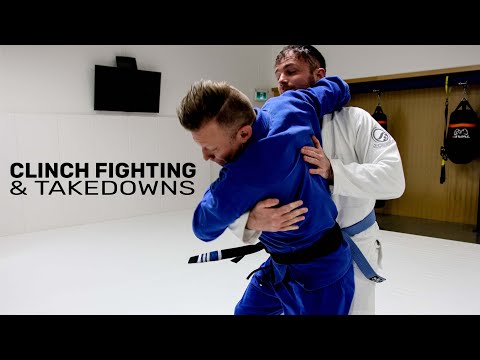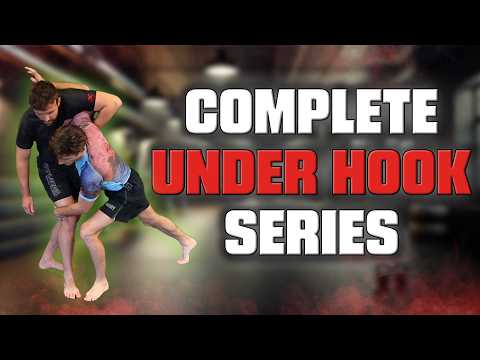
Learn to Underhook Like a Wrestler | Wrestling for BJJ
0
Standard Single Underhook·Wrestling University - Takedowns for Jiu Jitsu
🔥 BIG ANNOUNCEMENT 🔥 My next instructional "The Easiest Way to Takedown a Bigger Opponent" drops this fall 👀 🗣️ Ge…
Translation: standard single underhook
The Standard Single Underhook threads one arm under the opponent's armpit, hooking up and around the shoulder or lat, while the other hand establishes a collar tie, wrist control, or elbow cup on the opposite side. [1] The underhook arm provides inside position and body access on one side, while the free hand manages the opposite side of the clinch. [1],[2] From the standard single underhook, the attacker can drive for single-leg takedowns on the underhook side, transition to body locks, or use the underhook to off-balance the opponent for throws and trips. [2],[3]
The standard single underhook is a foundational clinch grip used across wrestling, judo, and MMA. [1] It provides inside control on one side while leaving the other hand free for additional attacks or defensive frames. [1],[2] Fighters use it to set up hip throws, body lock transitions, and cage takedowns. [2]
A core wrestling position taught from youth level. [1]
No images yet for this technique.
Sign in to suggest an image.
🔥 BIG ANNOUNCEMENT 🔥 My next instructional "The Easiest Way to Takedown a Bigger Opponent" drops this fall 👀 🗣️ Ge…
Eli Knight is one of the most recognized faces on youtube for jiujitsu. The reason is his ability to take the complexiti…
From Issue #5 of JiuJitsu Magazine At the start of a match there's the immediate desire to hook up and get down to busi…
The standard single underhook is a foundational clinch control established from the upper-body position, taught consistently across wrestling and mixed martial arts instruction. Wrestling University emphasizes the underhook's mechanics: the elbow must point toward the ceiling with the hand clasping down to trap the opponent's escape, preventing them from circling out by placing their bicep to their ear. Three primary setups are identified: the shoulder slip (executed when the opponent gives a collar tie), the horizontal punch to clear a thumb block at the elbow using a C-clamp grip, and the inside wrist grip transition when the opponent tightens their elbow to their body. JiuJitsuMag stresses the deep underhook as the foundational control in clinch work, with fingers positioned in the crease of the opponent's back and the shoulder positioned just below the opponent's shoulder to prevent them from dropping their level and achieving dominance. Budo Brothers frames the single underhook within broader clinch taxonomy, noting that arm control varies by clinch type (front, side, rear) and positioning; they emphasize controlling the wrist and forearm with either a C-clamp grip on the elbow or a mixed thumb-and-thumbless grip. All three instructors agree the underhook provides access to high-percentage takedowns—single legs, knee picks, and snap downs—and that proper arm positioning relative to shoulder alignment determines control superiority. Wrestling University and JiuJitsuMag both warn against lazy positioning that allows escape; Budo Brothers adds that clinch control requires reading and responding to opponent energy rather than forcing predetermined techniques.
Synthesized from 3 instructors
No instructional courses yet for this technique.
Sign in to suggest a course.
Risk of injury to the person this technique is applied to
Upper body clinch positions for control and transitions
Skill level needed to execute this technique reliably
Whether this technique is allowed under major competition rule sets
Freestyle Wrestling: A Complete Guide for Coaches and Wrestlers (Petrov, 1977)
Alias sources — [1] Wrestling Physical Conditioning Encyclopedia (Welker, 2010) [2] NCAA Wrestling Rules and Interpretations (NCAA, 2020) [3] Clinch Fighting for MMA (Couture, 2011)
Lineage sources — [1] Wrestling Physical Conditioning Encyclopedia (Petrov, 1977)
Standard katakana transliteration of Western martial arts terminology (外来語) — used in Japanese MMA, boxing, and BJJ communities
Alias sources — [1] Wrestling Physical Conditioning Encyclopedia (Welker, 2010) [2] NCAA Wrestling Rules and Interpretations (NCAA, 2020) [3] Clinch Fighting for MMA (Couture, 2011)
Lineage sources — [1] Wrestling Physical Conditioning Encyclopedia (Petrov, 1977)
swimming speed for inside position, shoulder drive, hip pressure
strong shoulders and low centre of gravity
deltoids, pectorals, core, quadriceps
According to Wrestling University, your elbow should be pointed towards the ceiling and as high as possible, with your hand clasping down to trap your opponent's escape. If you leave the underhook lazy with a low elbow that isn't properly attached, your opponent can put their bicep to their ear and circle out.
Per JiuJitsuMag, the key to all clinch work is a deep underhook—you want to control your opponent's back by placing your fingers right into the crease of their back. This deep positioning, combined with controlling the real estate between their legs, prevents your opponent from getting angles to compromise your shoulder.
JiuJitsuMag notes that most people keep their hips back or post their far leg forward instead of properly engaging, which gives the opponent easy opportunities for takedowns. You need to maintain hip engagement and pressure on your opponent's leg to control the position effectively.
The Standard Single Underhook threads one arm under the opponent's armpit, hooking up and around the shoulder or lat, while the other hand establishes a collar tie, wrist control, or elbow cup on the opposite side. The underhook arm provides inside position and body access on one side, while the free hand manages the opposite side of the clinch.
The standard single underhook is the most fundamental clinch position in wrestling and has been the primary target of clinch engagement since the sport's origins. Establishing the first underhook is considered the opening move of the clinch fight in modern wrestling and MMA coaching.
Unified MMA: legal — Legal — clinching is integral to MMA; IJF: legal — Legal — kumi-kata (grip fighting) is fundamental to judo; IBJJF: legal — Legal — standing grip fighting and clinch work permitted; IFMA: legal — Legal — the clinch is a core element of Muay Thai, clinch dominance is highly…; WBC/Boxing: restricted — Holding is technically a foul — referee breaks clinch, excessive holding resu…; K: restricted — 1/GLORY — One attack from clinch allowed, then referee breaks; WAKO: restricted — Clinch generally broken by referee — limited or no clinch fighting in most fo…; UWW: legal — Legal — clinch is fundamental to wrestling, the primary position in Greco-Roman
Danger rating 4/10. Moderate — upper body clinch positions for control and transitions
The standard setup chain: Close Distance → Swim Inside → Hip Position → Head Position.
Standard counters include: Pummeling — fight for inside position by swimming arms under opponent's grips / Frame and Push — create distance using forearm frames against the chest or neck / Overhook (Whizzer) — trap the underhook arm with an overhook to neutralize it / Arm Drag — pull the underhooking arm past to take the back.
Common variants: Single collar tie (one hand on the nape controlling the head); Double collar tie (plum) (both hands behind the head for maximum control); Collar tie with wrist control (one hand on the nape, other controlling the wrist).
The single underhook is one of the most common grips in MMA clinch exchanges, used extensively by wrestlers in UFC and Bellator to initiate takedown sequences against the cage. In freestyle wrestling, underhook battles are a constant feature of World Championship and Olympic competition.
Top errors to watch for: Keeping the underhook shallow (elbow at the opponent's ribcage) — drive it deep past the armpit / Putting your head on the opposite side from the underhook — head must match underhook side / Not posting with the other hand — a dangling free arm is wasted / Standing upright with the underhook — maintain a slight forward lean for pressure.
The Standard Single Underhook is also known as Sutandādo Shinguru Andāfukku, Basic Single Underhook, Fundamental Inside Tie, Standard Single Under Position.