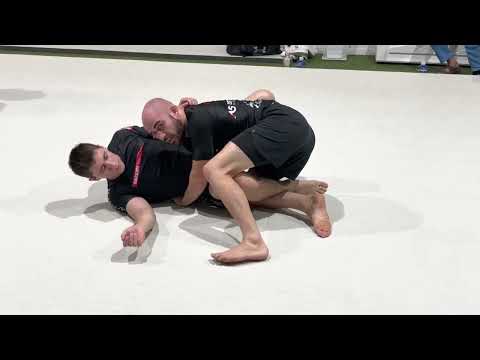
Advanced Body lock passing with James Woonton
0
High Front Body Lock·Arte Suave - BJJ Brisbane·Added by Admin
James breaks down his famous body lock pass with incredible troubleshooting details versus stiff arms, half butterfly pl…
Translation: high front body lock
The High Front Body Lock positions the locked grip high on the opponent's torso, around the upper back or ribcage area, with the attacker's arms encircling above the opponent's waist. [1] The high grip position provides superior control of the opponent's upper body and posture but sacrifices some ability to control the hips. [1],[2] The high front body lock is particularly effective for initiating chest-to-chest throws and for controlling opponents who maintain a tall, upright posture in the clinch. [2],[3]
The high front body lock positions the grip at the upper back or shoulder level, providing maximum control for lifting throws and suplex-style attacks. [1] Petrov notes this grip position is the standard for Greco-Roman lifting attacks because it maximises the attacker's ability to elevate the opponent. [1]
The high front body lock grips around the opponent's upper torso, common in Greco-Roman wrestling. [1]
No images yet for this technique.
Sign in to suggest an image.
James breaks down his famous body lock pass with incredible troubleshooting details versus stiff arms, half butterfly pl…
🏆 We Transform Jiu Jitsu Practitioners Into Takedown Pros↴ Start your transformation today with our zero-cost, takedow…
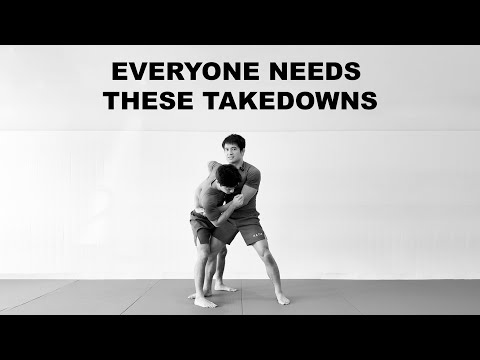
When building skills in the standing position, the first place every practitioner should start is the body lock takedown…
The high front body lock is a dominant clinching position emphasized across multiple grappling contexts—both standing takedowns and ground passing. Kata Jiu Jitsu identifies the double underhook front body lock as "the king of all takedowns," highlighting that the underhook is the strongest grip available in the clinch, superior to collar ties or wrist control. Establishment requires closing distance via hip-driven movement rather than chest-forward reaching, which creates vulnerability to counter throws. Once locked (using either S-grip or gable grip), the position demands immediate hip crowding to prevent opponent escape or separation. Kata Jiu Jitsu teaches three primary finish sequences: (1) a hips-in, pop-and-bump hip toss for upright opponents; (2) a step-pull leg scoop when the opponent folds their chest forward; and (3) a penetration-step into rotation/power twist when the opponent steps back to create space. Wrestling University's Greco-Roman approach, presented by a national champion, emphasizes pulling the opponent's head to one side to create a gap for underhook entry, then securing face-to-chest contact before manipulating feet positioning and executing a controlled descent. Arte Suave—BJJ Brisbane focuses on the front body lock in ground passing scenarios from half guard, where the lock bypasses the typical knee shield problem and enables chest-to-chest flattening. Their technical approach centers on clearing the half-guard hook through pummeling, S-grip control, and either stepping over or sprawling the leg while maintaining cross-face pressure. All three instructors agree on the fundamental principle: establish underhooks, lock the grip securely, maintain chest-to-chest connection, and control opponent posture through hip positioning and pressure.
Synthesized from 3 instructors
No instructional courses yet for this technique.
Sign in to suggest a course.
Risk of injury to the person this technique is applied to
Body clinch positions enable throws and takedowns; rib compression risk
Skill level needed to execute this technique reliably
Whether this technique is allowed under major competition rule sets
Mastering Jujitsu (Renzo Gracie & John Danaher, 2003)
Alias sources — [1] Greco-Roman Wrestling (Petrov, 1987) [2] Wrestling Physical Conditioning Encyclopedia (Welker, 2010) [3] Clinch Fighting for MMA (Couture, 2011)
Effectiveness sources — [1] Greco-Roman Wrestling (Petrov, 1987)
Standard katakana transliteration of Western martial arts terminology (外来語) — used in Japanese MMA, boxing, and BJJ communities
Alias sources — [1] Greco-Roman Wrestling (Petrov, 1987) [2] Wrestling Physical Conditioning Encyclopedia (Welker, 2010) [3] Clinch Fighting for MMA (Couture, 2011)
Effectiveness sources — [1] Greco-Roman Wrestling (Petrov, 1987)
arm length to wrap the torso, squeeze strength, hip drive
long arms and strong grip, powerful lower back
biceps, pectorals, forearms, erector spinae, glutes
Kata Jiu Jitsu recommends using an S-grip rather than a gable grip because it puts less strain on your forearms while still allowing you to lock up your partner's upper back effectively.
The biggest mistake is reaching your chest forward into your partner, which creates danger—if they shuck and step in front, they can blast you. Instead, keep your chest upright and pull yourself into them rather than pulling them to you.
Bring your hips in close to your partner by pulling yourself to them (not pulling them to you), then pop with your hips and bump their leg forward with your rear leg. Once their feet lift off the ground, shelf them onto your rear leg and release your hand so they don't fall on the lock.
No—only practice takedowns with partners who are trained in takedowns and can fall safely. It's critical that your partner (uke) learns how to fall properly and stay relaxed, not stiff, as this is the primary reason people get injured during takedown training.
The High Front Body Lock positions the locked grip high on the opponent's torso, around the upper back or ribcage area, with the attacker's arms encircling above the opponent's waist. The high grip position provides superior control of the opponent's upper body and posture but sacrifices some ability to control the hips.
The high front body lock has been a standard Greco-Roman wrestling position used for upper-body throws and lifts. Its application in MMA is common when the attacker achieves the clinch with an opponent pressed against the cage in an upright posture.
Unified MMA: legal — Legal — clinching is integral to MMA; IJF: legal — Legal — kumi-kata (grip fighting) is fundamental to judo; IBJJF: legal — Legal — standing grip fighting and clinch work permitted; IFMA: legal — Legal — the clinch is a core element of Muay Thai, clinch dominance is highly…; WBC/Boxing: restricted — Holding is technically a foul — referee breaks clinch, excessive holding resu…; K: restricted — 1/GLORY — One attack from clinch allowed, then referee breaks; WAKO: restricted — Clinch generally broken by referee — limited or no clinch fighting in most fo…; UWW: legal — Legal — clinch is fundamental to wrestling, the primary position in Greco-Roman
Danger rating 4/10. Moderate — body clinch positions enable throws and takedowns; rib compression risk
The standard setup chain: Close Distance → Secure Both Arms → Clasp Hands → Hip Drive.
Standard counters include: Pummeling — fight for inside position by swimming arms under opponent's grips / Frame and Push — create distance using forearm frames against the chest or neck / Grip Break — systematically strip the opponent's controlling grips / Posture Up — straighten the spine and drive the hips forward to break clinch control.
Common variants: Front body lock (locked hands around the torso face-to-face); Rear body lock (hands locked around the torso from behind); Side body lock (angled body lock for trips and throws); Over-arms body lock (locking over both arms to pin the opponent's arms to thei…).
The high front body lock is a dominant clinch position in Greco-Roman wrestling, used to set up chest-wrap throws and lifts at Olympic level. In MMA, fighters use it to prevent separation and set up trips or drives against the cage.
Top errors to watch for: Treating the high lock as equivalent to the low lock — it has less throwing leverage, so adjust your attack selection / Trying to suplex from a high lock — the high position gives poor mechanical advantage for backward throws / Not attempting to transition to a lower lock — always try to slide the grip to the waist / Squeezing the opponent's ribs for control instead of using hip and body pressure — squeezing fatigues your arms.
The High Front Body Lock is also known as Hai Furonto Bodi Rokku, High Chest Lock, Upper Front Body Lock, High Bear Hug Lock.