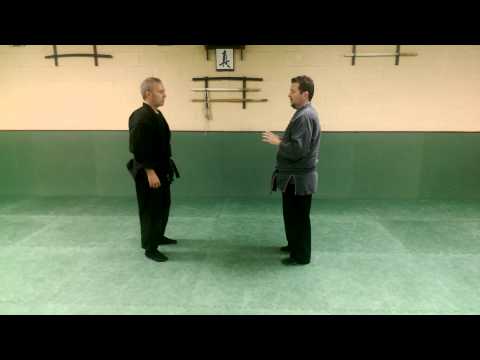
Single Wrist Grab Defense - Katate Dori
0
Standard Single Wrist Control·Torashin·Added by Admin
Important details for a wrist grab escape from a Bujinkan Budo and Danzan Ryu Jujutsu perspective. Thank you Kevin Geasl…
Translation: standard single wrist control
The Standard Single Wrist Control positions one hand on the opponent's wrist with a firm C-grip, controlling that arm while the free hand works for position — establishing collar ties, pummelling for underhooks, or preparing strikes. [1] The grip allows the controller to steer the opponent's arm, preventing it from being used offensively while creating openings on the controlled side. [1],[2] Standard single wrist control is the default opening position in most clinch engagements and the starting point for more advanced arm control sequences. [2],[3]
The standard single wrist control grip isolates one wrist, creating an asymmetric advantage that allows the controller to dictate the exchange. [1]
Taught across all grappling and striking disciplines as a basic control skill. [1]
Single wrist control is a fundamental grip used across MMA, wrestling, and judo competition to control one of the opponent's arms and create openings for attacks. [1]
No images yet for this technique.
Sign in to suggest an image.
Important details for a wrist grab escape from a Bujinkan Budo and Danzan Ryu Jujutsu perspective. Thank you Kevin Geasl…
No instructional courses yet for this technique.
Sign in to suggest a course.
Risk of injury to the person this technique is applied to
Arm control positions limit opponent's offense; low direct injury risk
Skill level needed to execute this technique reliably
Whether this technique is allowed under major competition rule sets
Freestyle Wrestling: A Complete Guide for Coaches and Wrestlers (Petrov, 1977)
Alias sources — [1] Wrestling Physical Conditioning Encyclopedia (Welker, 2010) [2] Clinch Fighting for MMA (Couture, 2011) [3] No-Gi Grappling Fundamentals (Danaher, 2010)
Effectiveness sources — [1] Mastering Jujitsu (Gracie & Danaher, 2003)
Aikido technique naming conventions
Mixed Japanese-Western terminology — combines traditional Japanese terms with katakana loanwords
Alias sources — [1] Wrestling Physical Conditioning Encyclopedia (Welker, 2010) [2] Clinch Fighting for MMA (Couture, 2011) [3] No-Gi Grappling Fundamentals (Danaher, 2010)
Effectiveness sources — [1] Mastering Jujitsu (Gracie & Danaher, 2003)
swimming speed for inside position, shoulder drive, hip pressure
strong shoulders and low centre of gravity
deltoids, pectorals, core, quadriceps
If you're late with your escape, you'll have to use too much muscle and tire yourself out quickly. According to Torashin, you need to create tension immediately and feel your opponent's movement so you can respond before they commit fully to their attack.
Turn your wrist away from the attacker's thumb—this is the fundamental escape mechanic. Torashin emphasizes you should turn your wrist while pushing with your elbow and checking their hand to complete the escape.
Apply tension on their elbow—not too low (they can roll under) and not too high (their hand stays free). Torashin stresses keeping steady connection at the elbow point to maintain control without giving them escape options.
Stepping at 45 degrees moves you away from their opposite-side weapons and forces them to reposition if they want to attack with that side. This defensive footwork, used in the Bujinkan approach, keeps you out of multiple threat lines simultaneously.
The Standard Single Wrist Control positions one hand on the opponent's wrist with a firm C-grip, controlling that arm while the free hand works for position — establishing collar ties, pummelling for underhooks, or preparing strikes. The grip allows the controller to steer the opponent's arm, preventing it from being used offensively while creating openings on the controlled side.
Standard single wrist control is the most basic and universal clinch grip, present in every documented martial arts tradition from ancient wrestling to modern MMA. It is the first clinch skill taught to beginners across all grappling disciplines.
Unified MMA: legal — Legal — clinching is integral to MMA; IJF: legal — Legal — kumi-kata (grip fighting) is fundamental to judo; IBJJF: legal — Legal — standing grip fighting and clinch work permitted; IFMA: legal — Legal — the clinch is a core element of Muay Thai, clinch dominance is highly…; WBC/Boxing: restricted — Holding is technically a foul — referee breaks clinch, excessive holding resu…; K: restricted — 1/GLORY — One attack from clinch allowed, then referee breaks; WAKO: restricted — Clinch generally broken by referee — limited or no clinch fighting in most fo…; UWW: legal — Legal — clinch is fundamental to wrestling, the primary position in Greco-Roman
Danger rating 3/10. Moderate — arm control positions limit opponent's offense; low direct injury risk
The standard setup chain: Close Distance → Establish Primary Grip → Position the Hips → Apply Pressure.
Standard counters include: Pummeling — fight for inside position by swimming arms under opponent's grips / Frame and Push — create distance using forearm frames against the chest or neck / Grip Break — systematically strip the opponent's controlling grips / Posture Up — straighten the spine and drive the hips forward to break clinch control.
Common variants: Single collar tie (one hand on the nape controlling the head); Double collar tie (plum) (both hands behind the head for maximum control); Collar tie with wrist control (one hand on the nape, other controlling the wrist).
Single wrist control is a fundamental grip used across MMA, wrestling, and judo competition to control one of the opponent's arms and create openings for attacks.
Top errors to watch for: Gripping on top of the wrist instead of around it — the C-grip must wrap the sides for rotational control / Extending the arm fully — a straight arm has no leverage and is easily broken / Pointing the elbow outward — keep the elbow close to your body for structural strength / Holding without an immediate plan — single wrist control must lead somewhere within 2 seconds.
The Standard Single Wrist Control is also known as Sutandādo Kata-tekubi Seigyo, Basic Single Wrist Grip, Fundamental Wrist Tie, Single-Hand Wrist Control Position.