Wrestling Takedowns - Russian Tie Series
0
High Crotch Russian Tie·ZOOM WRESTLING
A series of Russian tie up take-down technique, depending on your opponents defense. Please like or subscribe if you wou…
Translation: high crotch Russian tie
The High Crotch Russian Tie subfamily covers the variation of the two-on-one position where the controlling grip is positioned high on the opponent's arm near the shoulder, with the attacker's body close to the opponent, facilitating high-crotch takedown entries. [1] This elevated grip placement allows the attacker to drive into the opponent's hip while maintaining arm control, combining upper-body dominance with lower-body attacking. [1],[2] The high crotch Russian tie is a transitional position that bridges arm control and leg attack, making it particularly dangerous in freestyle wrestling. [2],[3]
The high crotch variation of the Russian tie emerged as wrestlers sought to combine the arm control advantages of the two-on-one with direct leg attack entries. [1] It became a common technique in freestyle wrestling where the ability to chain upper-body clinch work into leg attacks is essential for competitive success. [2],[3]
The high crotch Russian tie combines two-on-one arm control with inside leg positioning, creating a powerful platform for single-leg and high-crotch takedown entries. [1]
This variation developed within American freestyle wrestling as wrestlers combined Russian tie control with leg attack entries. [1]
The high crotch Russian tie is commonly seen in NCAA Division I and Olympic freestyle competition. [1]
No images yet for this technique.
Sign in to suggest an image.
A series of Russian tie up take-down technique, depending on your opponents defense. Please like or subscribe if you wou…
PLEASE Click this link to SUPPORT the TeachMeGrappling Channel!!! https://www.patreon.com/TeachMeGrappling or https:/…
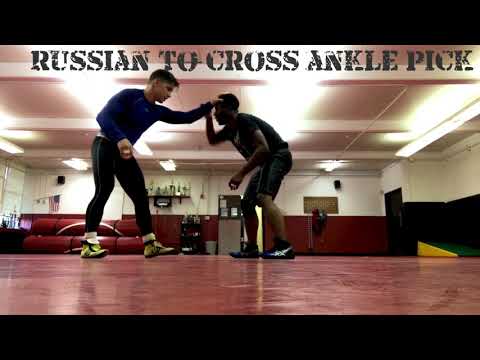
The High Crotch Russian Tie subfamily encompasses a set of takedown variations that emerge from the two-on-one Russian tie clinch control, distinguished by the specific entry angle and finishing mechanics employed. ZOOM Wrestling frames the Russian tie as a foundational arm-control position from which multiple takedowns branch based on defensive reactions: if the opponent achieves a post hand, a heavy double-leg becomes viable; if they grab the outside elbow, elbow-control wrestling and re-grab exchanges lead to finishing options; if they defend aggressively, cross-ankle picks, high crosses, and headlocks become accessible off the same grip. The core unifying principle is aggressive hip and shoulder pressure combined with head position dominance—the instructor emphasizes that losing head position severely limits offensive options, while establishing it creates a funnel of takedown entries. TeachMeGrappling Coach Brian treats the high crotch specifically as a level-change penetration takedown where the grip on the elbow and butt control allow the practitioner to drive through without necessarily touching the knee, provided the opponent remains upright; he stresses that head placement on the opponent's back (not the side) prevents escape and facilitates finishing variations including lifts, leg throws, and ground control. Both instructors emphasize that the positioning remains deceptive—Coach Brian notes the head placement disguises the direction of attack, while ZOOM Wrestling shows how re-grabs and defensive reads trigger seamless transitions between single-leg, double-leg, and upper-body finishes. The subfamily's strategic value lies in its multiplicity: a single initial clinch configuration accommodates numerous answers to different defensive postures.
Synthesized from 2 instructors
No instructional courses yet for this technique.
Sign in to suggest a course.
Risk of injury to the person this technique is applied to
Arm control positions limit opponent's offense; low direct injury risk
Skill level needed to execute this technique reliably
Whether this technique is allowed under major competition rule sets
Freestyle Wrestling: A Complete Guide for Coaches and Wrestlers (Petrov, 1977)
Alias sources — [1] Freestyle Wrestling: A Complete Guide (Petrov, 2005) [2] Wrestling Physical Conditioning Encyclopedia (Welker, 2010) [3] UWW Technical Terminology (UWW, 2018)
Effectiveness sources — [1] Wrestling Physical Conditioning Encyclopedia (Petrov, 1977)
Standard katakana transliteration of Western martial arts terminology (外来語) — used in Japanese MMA, boxing, and BJJ communities
Alias sources — [1] Freestyle Wrestling: A Complete Guide (Petrov, 2005) [2] Wrestling Physical Conditioning Encyclopedia (Welker, 2010) [3] UWW Technical Terminology (UWW, 2018)
Effectiveness sources — [1] Wrestling Physical Conditioning Encyclopedia (Petrov, 1977)
grip strength, upper body endurance, balance under pressure
strong arms and shoulders, stable base
forearms, deltoids, core, hip muscles
Every move, in any martial art, shares a few universal traits. Mix and match below to pinpoint the right tool — or compare equivalents across styles.
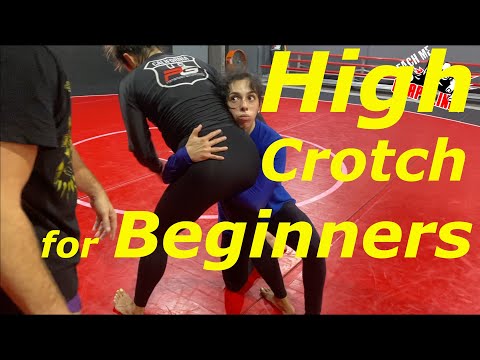
Coach Brian emphasizes that you don't want the grip too high or too low—you want it right where it 'sinks in' on the biceps, and recommends using your thumb for control.
The finishing sequence involves squatting down, popping your hip forward, then swinging your legs out to the side while maintaining head pressure on your opponent to prevent escape.
Head position is critical in the Russian tie setup; if you don't secure proper head position early, your opponent can post and severely limit your available options, so getting head position immediately is the first priority.
The High Crotch Russian Tie subfamily covers the variation of the two-on-one position where the controlling grip is positioned high on the opponent's arm near the shoulder, with the attacker's body close to the opponent, facilitating high-crotch takedown entries. This elevated grip placement allows the attacker to drive into the opponent's hip while maintaining arm control, combining upper-body dominance with lower-body attacking.
The high crotch variation of the Russian tie emerged as wrestlers sought to combine the arm control advantages of the two-on-one with direct leg attack entries. It became a common technique in freestyle wrestling where the ability to chain upper-body clinch work into leg attacks is essential for competitive success.
Unified MMA: legal — Legal — clinching is integral to MMA; IJF: legal — Legal — kumi-kata (grip fighting) is fundamental to judo; IBJJF: legal — Legal — standing grip fighting and clinch work permitted; IFMA: legal — Legal — the clinch is a core element of Muay Thai, clinch dominance is highly…; WBC/Boxing: restricted — Holding is technically a foul — referee breaks clinch, excessive holding resu…; K: restricted — 1/GLORY — One attack from clinch allowed, then referee breaks; WAKO: restricted — Clinch generally broken by referee — limited or no clinch fighting in most fo…; UWW: legal — Legal — clinch is fundamental to wrestling, the primary position in Greco-Roman
Danger rating 3/10. Moderate — arm control positions limit opponent's offense; low direct injury risk
The standard setup chain: Close Distance → Establish Primary Grip → Position the Hips → Apply Pressure.
Standard counters include: Pummeling — fight for inside position by swimming arms under opponent's grips / Frame and Push — create distance using forearm frames against the chest or neck / Grip Break — systematically strip the opponent's controlling grips / Posture Up — straighten the spine and drive the hips forward to break clinch control.
Common variants: Standard Russian tie (two hands controlling one arm at the wrist and upper arm); Russian tie to arm drag (transitioning the two-on-one into an arm drag for angle); Russian tie to snap-down (using the two-on-one to snap the opponent's posture down).
The high crotch Russian tie is commonly seen in NCAA Division I and Olympic freestyle competition.
Top errors to watch for: Releasing the Russian tie before completing the shot — keep the arm controlled throughout the level change / Shooting without first yanking the arm to create a reaction — the yank opens the lane for the shot / Shooting to the wrong side (the free-arm side) — shoot to the side of the controlled arm / Not changing levels enough — the high crotch requires a deep penetration step.
The High Crotch Russian Tie is also known as Hai Kurocchi Roshian Tai, High-Crotch Two-On-One, High Russian Tie, Elevated Russian Tie.