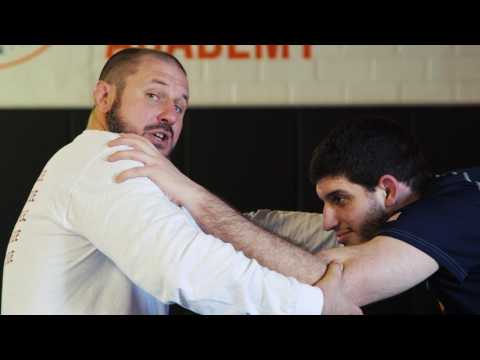
Oklahoma State Cowboy Elbow Control Tricks
0
Standard Inside Elbow Control·FloWrestling·Added by Admin
Mike Mal goes behind the dirt to break down John Smith and Oklahoma State's elbow control technique. Watch FloWrestling…
Translation: standard inside elbow control
The Standard Inside Elbow Control positions the attacker's hand on the inside of the opponent's elbow, cupping the joint and using it as a steering handle to redirect the opponent's arm and prevent them from achieving inside position. [1] The grip is maintained with the fingers wrapped around the inner elbow crease, thumb on the outside, allowing the controller to push, pull, or circle the opponent's arm. [1],[2] This position is a starting point for many clinch transitions — from here the attacker can swim to an underhook, execute an arm drag, or pummel for better position. [2],[3]
The standard inside elbow control grip places one hand on the inner bend of the opponent's elbow, providing leverage to redirect their arm and create throwing or striking angles. [1]
This grip is a fundamental component of judo's kumi-kata system and is taught from the earliest stages of training. [1]
No images yet for this technique.
Sign in to suggest an image.
Mike Mal goes behind the dirt to break down John Smith and Oklahoma State's elbow control technique. Watch FloWrestling…
No instructional courses yet for this technique.
Sign in to suggest a course.
Risk of injury to the person this technique is applied to
Arm control positions limit opponent's offense; low direct injury risk
Skill level needed to execute this technique reliably
Whether this technique is allowed under major competition rule sets
Freestyle Wrestling: A Complete Guide for Coaches and Wrestlers (Petrov, 1977)
Alias sources — [1] Wrestling Physical Conditioning Encyclopedia (Welker, 2010) [2] Clinch Fighting for MMA (Couture, 2011) [3] MMA Instruction Manual (UFC, 2008)
Effectiveness sources — [1] Kodokan Judo (Kano, 1986)
Mixed Japanese-Western terminology — combines traditional Japanese terms with katakana loanwords
Alias sources — [1] Wrestling Physical Conditioning Encyclopedia (Welker, 2010) [2] Clinch Fighting for MMA (Couture, 2011) [3] MMA Instruction Manual (UFC, 2008)
Effectiveness sources — [1] Kodokan Judo (Kano, 1986)
swimming speed for inside position, shoulder drive, hip pressure
strong shoulders and low centre of gravity
deltoids, pectorals, core, quadriceps
No. You should never go to the same side as your head position—instead, make room for yourself by dropping to the opposite side, which sets up techniques like the double leg takedown.
Inside elbow control will move your opponent somewhat, though the effect is modest compared to other control methods.
The Standard Inside Elbow Control positions the attacker's hand on the inside of the opponent's elbow, cupping the joint and using it as a steering handle to redirect the opponent's arm and prevent them from achieving inside position. The grip is maintained with the fingers wrapped around the inner elbow crease, thumb on the outside, allowing the controller to push, pull, or circle the opponent's arm.
Standard inside elbow control is one of the most basic clinch positions taught in wrestling and MMA, forming the first line of engagement when two fighters meet in the clinch. It has been a fundamental teaching point in wrestling rooms for generations.
Unified MMA: legal — Legal — clinching is integral to MMA; IJF: legal — Legal — kumi-kata (grip fighting) is fundamental to judo; IBJJF: legal — Legal — standing grip fighting and clinch work permitted; IFMA: legal — Legal — the clinch is a core element of Muay Thai, clinch dominance is highly…; WBC/Boxing: restricted — Holding is technically a foul — referee breaks clinch, excessive holding resu…; K: restricted — 1/GLORY — One attack from clinch allowed, then referee breaks; WAKO: restricted — Clinch generally broken by referee — limited or no clinch fighting in most fo…; UWW: legal — Legal — clinch is fundamental to wrestling, the primary position in Greco-Roman
Danger rating 3/10. Moderate — arm control positions limit opponent's offense; low direct injury risk
The standard setup chain: Close Distance → Establish Primary Grip → Position the Hips → Apply Pressure.
Standard counters include: Pummeling — fight for inside position by swimming arms under opponent's grips / Frame and Push — create distance using forearm frames against the chest or neck / Grip Break — systematically strip the opponent's controlling grips / Posture Up — straighten the spine and drive the hips forward to break clinch control.
Common variants: Single underhook (one arm inside for angle and control); Double underhooks (both arms inside for maximum inside position); Underhook with collar tie (combining the underhook with head control).
Inside elbow control (cupping the elbow) is a common clinch grip in MMA used to steer the opponent and prevent strikes. It is frequently seen in UFC clinch exchanges.
Top errors to watch for: Cupping with a loose hand — the palm must make firm contact to control the arm direction / Pushing the arm too far and overextending — keep the arm within a manageable range / Not stepping to create an angle — the grip alone isn't enough; your feet must move to exploit the opening / Standing in front of the opponent with the elbow controlled — step to the side of the controlled arm.
The Standard Inside Elbow Control is also known as Sutandādo Uchi Hiji Seigyo, Basic Inside Elbow Cup, Fundamental Elbow Block, Inside Elbow Frame.