Strike & defenceLocksClose rangeFighting multiple people
Distance
CloseMiddleLong
Body target
Upper bodyMiddle bodyLower body
Overview
The Standard Outside Arm Drag executes the fundamental outside arm drag where the attacker grips the opponent's wrist and elbow, pulling the arm outward and away from the body while stepping to the inside line. [1] This clears the opponent's arm as a defensive barrier and places the attacker in position for single-leg entries, body lock clinch, or inside trips. [1],[2] The outside drag requires the attacker to move into the opponent's space rather than around them, making it a more aggressive entry than the inside variation. [2],[3]
Also known as
Basic Outside Arm DragWrestling[1]Lateral Drag[2]Outside Bicep Drag[3]
The standard outside arm drag has been a staple of wrestling and grappling curricula, complementing the inside arm drag as part of a complete arm drag offence system. [1] It is commonly taught alongside inside arm drags to give athletes options based on the opponent's reaction. [2],[3]
Country of origin· shown in random order
🇬🇷GreeceWrestling
🇺🇸USAWrestling, MMA
🇧🇷BrazilMMA, BJJ
🇯🇵JapanBJJ
Effectiveness
The standard outside arm drag creates a different angle than its inside counterpart, pulling the opponent's arm laterally to expose the back or side. [1] Petrov notes it is particularly effective when the opponent is reaching forward with an extended arm, as the drag exploits the overcommitment. [1]
Lineage
The standard outside arm drag is taught in freestyle and folkstyle wrestling as one of the primary setups for back exposure and go-behind scoring. [1]
Competition Record
The outside arm drag is a standard technique in NCAA and Olympic freestyle competition. [1]
Images
No images yet for this technique.
Sign in to suggest an image.
Biomechanical Mechanism
Primary Action — Establishing a controlling connection with the opponent at close range
Joints Involved — Upper body contact points — head, arms, and torso used for control and balance disruption
Force Vector — Varies by clinch type — downward (collar tie), lateral (arm drags), or forward (chest pressure)
Control Mechanic — Inside position and head control are the dominant factors in clinch superiority
Position & Entry
From clinch range — Swim inside past the opponent's arms, lock hands around their torso in a body lock (gable grip or clasp)
From underhook battle — Win double underhooks, step in and lock hands around the body
Variants
Front body lock — locked hands around the torso face-to-face
Rear body lock — hands locked around the torso from behind
Side body lock — angled body lock for trips and throws
Over-arms body lock — locking over both arms to pin the opponent's arms to their body
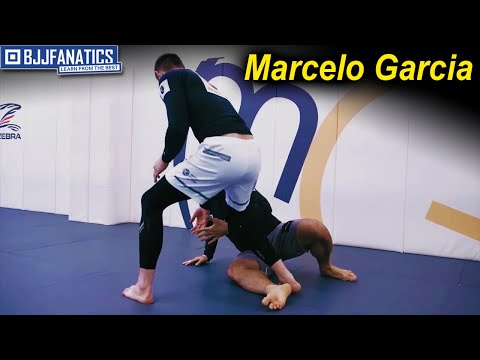
When should I go for the back take instead of the leg during an arm drag?
According to Marcelo Garcia, if your opponent's hands touch the floor early and he starts to come up, you should transition to the back take instead of going for the leg. Keep his arm controlled, place your hand over his shoulder and back, and climb his back from there.
How do I maintain control when my opponent tries to jump over my back after an arm drag back take?
Marcelo Garcia emphasizes keeping a strong base by maintaining hand and leg contact with the floor—don't follow him if he jumps. Once you secure the seatbelt grip, keep your chest lined up with your shoulder and maintain that grip before adding hooks.
What's the priority when securing the back after an arm drag?
The seatbelt grip is the most important control point. Get the seatbelt first, maintain it with proper chest alignment, and only then work on adding hooks.
How does the Standard Outside Arm Drag work?
The Standard Outside Arm Drag executes the fundamental outside arm drag where the attacker grips the opponent's wrist and elbow, pulling the arm outward and away from the body while stepping to the inside line. This clears the opponent's arm as a defensive barrier and places the attacker in position for single-leg entries, body lock clinch, or inside trips.
Where does the Standard Outside Arm Drag come from?
The standard outside arm drag has been a staple of wrestling and grappling curricula, complementing the inside arm drag as part of a complete arm drag offence system. It is commonly taught alongside inside arm drags to give athletes options based on the opponent's reaction.
Is the Standard Outside Arm Drag legal in competition?
Unified MMA: legal — Legal — clinching is integral to MMA; IJF: legal — Legal — kumi-kata (grip fighting) is fundamental to judo; IBJJF: legal — Legal — standing grip fighting and clinch work permitted; IFMA: legal — Legal — the clinch is a core element of Muay Thai, clinch dominance is highly…; WBC/Boxing: restricted — Holding is technically a foul — referee breaks clinch, excessive holding resu…; K: restricted — 1/GLORY — One attack from clinch allowed, then referee breaks; WAKO: restricted — Clinch generally broken by referee — limited or no clinch fighting in most fo…; UWW: legal — Legal — clinch is fundamental to wrestling, the primary position in Greco-Roman
How dangerous is the Standard Outside Arm Drag?
Danger rating 3/10. Moderate — arm control positions limit opponent's offense; low direct injury risk
How do I set up the Standard Outside Arm Drag?
The standard setup chain: Close Distance → Establish Primary Grip → Position the Hips → Apply Pressure.
How do I defend against the Standard Outside Arm Drag?
Standard counters include: Pummeling — fight for inside position by swimming arms under opponent's grips / Frame and Push — create distance using forearm frames against the chest or neck / Grip Break — systematically strip the opponent's controlling grips / Posture Up — straighten the spine and drive the hips forward to break clinch control.
What are the variants of the Standard Outside Arm Drag?
Common variants: Front body lock (locked hands around the torso face-to-face); Rear body lock (hands locked around the torso from behind); Side body lock (angled body lock for trips and throws); Over-arms body lock (locking over both arms to pin the opponent's arms to thei…).
How effective is the Standard Outside Arm Drag in competition?
The outside arm drag is a standard technique in NCAA and Olympic freestyle competition.
What are common mistakes when doing the Standard Outside Arm Drag?
Top errors to watch for: Dragging the arm across your body (inside) instead of clearing it to your outside / Not stepping inside during the drag — the body must fill the space the arm was occupying / Cupping the tricep too loosely — a firm cup is needed to redirect the arm / Dragging without a follow-up position — the drag opens a window, you must go through it.
What are other names for the Standard Outside Arm Drag?
The Standard Outside Arm Drag is also known as Sutandādo Autosaido Āmu Doraggu, Basic Outside Arm Drag, Lateral Drag, Outside Bicep Drag.