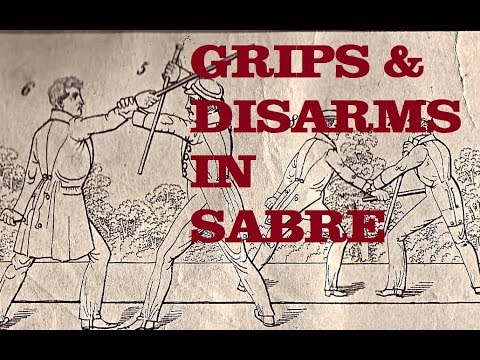
Military Sabre Fencing - Grips and Disarms
0
Military Sabre Guard·scholagladiatoria
Military Sabre Fencing - Grips and Disarms https://www.facebook.com/historicalfencing/ http://www.fioredeiliberi.org/
Перевод: military sabre guard
The Military Sabre Guard subfamily covers the defensive positions and parrying stances used with the military sabre, typically numbering between three and seven guards depending on the national tradition. [1] Military sabre guards protect the major target areas — head, flank, and leg — while positioning the blade for immediate counter-cuts. [1],[2] Unlike the nuanced guard systems of rapier or longsword, military sabre guards prioritise simplicity and reliability under combat stress. [2],[3]
Military sabre guard positions were standardised in cavalry drill manuals from the eighteenth and nineteenth centuries, with each European army developing its own system. [1] The British system used five guards, the French used three primary positions, and the Prussians developed a six-guard framework. [2],[3]
Military sabre guard positions were codified in army training manuals across Europe, with each nation developing distinct guard systems. [1]
Military sabre guards are studied and practised in HEMA tournaments that specifically feature military sabre bouts. [1]
Изображений для этой техники пока нет.
Войдите, чтобы предложить изображение.
Military Sabre Fencing - Grips and Disarms https://www.facebook.com/historicalfencing/ http://www.fioredeiliberi.org/
Учебных курсов по этой технике пока нет.
Войдите, чтобы предложить курс.
Риск травмы для человека, к которому применяется техника
Edged weapons cause fatal lacerations; historical battlefield mortality rates >30% (Amberger 1999)
Уровень мастерства, необходимый для надёжного выполнения техники
Разрешена ли техника по основным соревновательным правилам
The Art of Fencing (Luigi Barbasetti, 1932)
Alias sources — [1] Cold Steel (Hutton, 1889) [2] Hoplology (Burton, 1884) [3] Hoplology (Burton, 1884)
Effectiveness sources — [1] The Martial Arts of Renaissance Europe (Anglo, 2000) [2] The Art and Science of Fencing (Evangelista, 1996)
Established Japanese martial arts naming convention — native Japanese term (和語/漢語)
Alias sources — [1] Cold Steel (Hutton, 1889) [2] Hoplology (Burton, 1884) [3] Hoplology (Burton, 1884)
Effectiveness sources — [1] The Martial Arts of Renaissance Europe (Anglo, 2000) [2] The Art and Science of Fencing (Evangelista, 1996)
wrist control for edge alignment, grip endurance, footwork precision
quick wrists, strong forearms, good posture
forearm extensors/flexors, deltoids, core, calves
Каждое движение в любом боевом искусстве обладает рядом универсальных свойств. Комбинируйте параметры ниже, чтобы найти нужный инструмент или сравнить аналоги из разных стилей.
Traverses are footwork movements found in some sabre systems, though not all. Early British sources like Rowarth's system include traverses, and Hutton makes reference to them, though they're sometimes only implied in other approaches.
The Military Sabre Guard subfamily covers the defensive positions and parrying stances used with the military sabre, typically numbering between three and seven guards depending on the national tradition. Military sabre guards protect the major target areas — head, flank, and leg — while positioning the blade for immediate counter-cuts.
Military sabre guard positions were standardised in cavalry drill manuals from the eighteenth and nineteenth centuries, with each European army developing its own system. The British system used five guards, the French used three primary positions, and the Prussians developed a six-guard framework.
FIE: разрешён — Legal fencing technique — governed by FIE rules for foil, épée, and sabre; HEMA: разрешён — Legal in historical fencing competition
Оценка опасности 9/10. Extreme — edged weapons cause fatal lacerations; historical battlefield mortality rates >30% (Amberger 1999)
Стандартная цепочка подготовки: Assume Guard (Kamae/Hut) → Measure Distance (Ma-ai) → Initiate Cut/Thrust → Follow Through (Zanshin).
Стандартные контрприёмы: Parry (Absetzen) — deflect the incoming blade with a counter-displacement / Void (Step Back) — withdraw from measure to avoid the cutting arc / Counter-Cut (Nachreisen) — strike into the opponent's opening during their attack.
Распространённые варианты: Standard cut (primary cutting angle from the ready stance); Thrust (tsuki) (straight thrust targeting the throat, chest, or face); Rising cut (kiri-age) (upward diagonal cut from low to high); Diagonal cut (kesa-giri) (downward diagonal cut following the kimono line).
Military sabre guards are studied and practised in HEMA tournaments that specifically feature military sabre bouts.
Основные ошибки, на которые стоит обратить внимание: Holding one guard position without transitioning — guards must flow based on the opponent's actions / Using a guard that leaves the primary target open — each guard must protect the most likely target areas / Holding the guard with a stiff arm — the arm must be flexible enough to respond to attacks / Not understanding which attacks each guard defends against — each guard has specific defensive responsibilities.
Military Sabre Guard также известен как Guntō Kamae, Sabre Guard Position, Cavalry Guard, Tierce en Sabre.