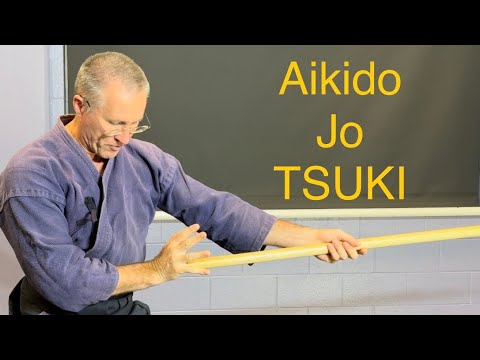
Aikido Jo Thrust TSUKI tutorial
0
Tsuki Thrust·Paul Frank
Master the Tsuki attack with an Aikido jo in this step-by-step tutorial. This video breaks down the technique, emphasizi…
Перевод: Thrust
The Tsuki Thrust targets the throat protector (tsuki-dare) of the men with a straight forward thrust of the shinai tip, making it the only non-cutting technique among kendō's four scoring actions. [1] Tsuki is the most dangerous technique in kendō due to the risk of injury if misdirected, and it is therefore restricted in competition — generally permitted only for adults at dan-grade level. [1],[2] A valid tsuki must contact the tsuki-dare squarely with the kensen (sword tip) while demonstrating full body commitment and zanshin. [2],[3]
The thrust (tsuki) has always been a core technique in kenjutsu, valued for its speed and directness, and was incorporated into kendō as the fourth valid target when bōgu design included the throat protector. [1] Koryū schools such as Ittō-ryū and Jigen-ryū include extensive tsuki techniques in their curricula. [2],[3]
Tsuki (throat thrust) targets the tsuki-dare (throat protector) with a straight thrusting motion. [1] It is the most dangerous technique in kendo due to the risk of injury if improperly executed, and is restricted to competitors of 2nd dan (nidan) and above in most federations. [2] When executed correctly, tsuki is extremely effective because it travels the shortest distance to the target, but the narrow target area and high risk make it a specialist technique. [2]
The tsuki (throat thrust) in kendo is the most dangerous allowed technique, targeting the throat protector. It descended from classical kenjutsu thrusting technique and is restricted to certain rank levels in some competitions. [1]
Tsuki accounts for approximately 5–10% of ippon in elite kendo competition, making it the least frequently scored target but one that carries high tactical value as a threat. [1]
Изображений для этой техники пока нет.
Войдите, чтобы предложить изображение.
Master the Tsuki attack with an Aikido jo in this step-by-step tutorial. This video breaks down the technique, emphasizi…
Aiki-jo (Aikido Jo) Greg O'Connor - 7th Dan, Aikikai Founder & Chief Instructor of Aikido Centers Inc. / Aikido Centers …
The tsuki thrust with the jo is a fundamental striking technique executed with precise grip and hip-driven power, as detailed by both Paul Frank and Greg O'Connor. Both instructors emphasize that the thrust originates from hip movement rather than upper-body muscling, with the weapon remaining in alignment with the body's centerline throughout the motion. Frank and O'Connor agree on grip fundamentals: the middle finger should overlap the thumb to prevent slipping, and the hand should remain on top of the weapon to channel force efficiently. Frank distinguishes between two grip positions—bottom-hand and top-hand thrusts—recommending the top-hand grip as more versatile and faster once developed. O'Connor introduces terminology consistent with aikido jo practice (kamae, harai, tenuuchi) and emphasizes covering the weapon's end during the draw-back phase to obscure the strike. Both instructors stress the importance of avoiding common errors: bending at the waist, pulling the hips back during extension, and allowing the elbow to flare outward. O'Connor adds detail regarding stance width and the sequential finger closure during tenuuchi grip technique. Frank emphasizes that advanced practitioners should move the tip directly toward the target without preliminary backward arcing, generating speed through integrated hip and torso engagement. Both methodologies converge on the principle that power derivation depends on postural integrity and frontal alignment of elbow, hips, and weapon.
Сформировано на основе 2 инструкторов
Учебных курсов по этой технике пока нет.
Войдите, чтобы предложить курс.
Риск травмы для человека, к которому применяется техника
Edged weapons cause fatal lacerations; historical battlefield mortality rates >30% (Amberger 1999)
Уровень мастерства, необходимый для надёжного выполнения техники
Разрешена ли техника по основным соревновательным правилам
The Book of Five Rings (Miyamoto Musashi, 1645)
Alias sources — [1] Japanese Swordsmanship (Warner & Draeger, 1982) [2] Japanese Swordsmanship (Warner & Draeger, 1982) [3] Japanese Swordsmanship (Warner & Draeger, 1982)
Effectiveness sources — [1] All Japan Kendo Federation, Kendo Official Manual (AJKF) [2] Warner, G. & Draeger, D., Japanese Swordsmanship: Technique and Practice (Weatherhill, 1982)
Established Japanese martial arts naming convention — native Japanese term (和語/漢語)
Alias sources — [1] Japanese Swordsmanship (Warner & Draeger, 1982) [2] Japanese Swordsmanship (Warner & Draeger, 1982) [3] Japanese Swordsmanship (Warner & Draeger, 1982)
Effectiveness sources — [1] All Japan Kendo Federation, Kendo Official Manual (AJKF) [2] Warner, G. & Draeger, D., Japanese Swordsmanship: Technique and Practice (Weatherhill, 1982)
wrist control for edge alignment, grip endurance, footwork precision
quick wrists, strong forearms, good posture
forearm extensors/flexors, deltoids, core, calves
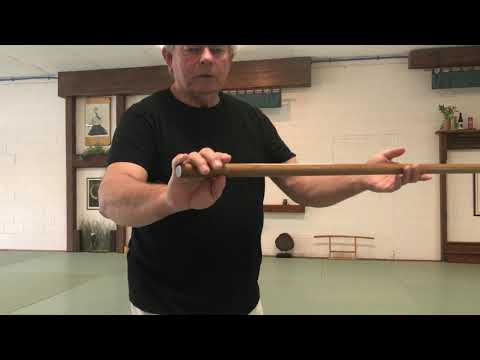
According to Paul Frank, your middle finger should overlap with your thumb, similar to sword grip, rather than holding it on the end. Your hand should push down through your forearm so everything is in alignment, and you should drive over the top of the weapon to transfer power properly and avoid hurting your thumb.
Paul Frank emphasizes that power should come from your hips, not your upper body. Keep your hip in line with your elbow and push your center forward in a straight line toward the target, rather than pulling your center back as you thrust.
Paul Frank notes that people often bring their elbow out to the side instead of keeping it in line with their body, which causes the weapon to arc around rather than going straight. You want to keep your elbow aligned with your body to maintain a direct line to the target.
Greg O'Connor explains that you want the body to initiate the movement, with the foot following, rather than having the hands lead. This principle applies across different jo styles and methodologies.
The Tsuki Thrust targets the throat protector (tsuki-dare) of the men with a straight forward thrust of the shinai tip, making it the only non-cutting technique among kendō's four scoring actions. Tsuki is the most dangerous technique in kendō due to the risk of injury if misdirected, and it is therefore restricted in competition — generally permitted only for adults at dan-grade level.
The thrust (tsuki) has always been a core technique in kenjutsu, valued for its speed and directness, and was incorporated into kendō as the fourth valid target when bōgu design included the throat protector. Koryū schools such as Ittō-ryū and Jigen-ryū include extensive tsuki techniques in their curricula.
FIK Kendo: разрешён — Legal, valid strike requires correct form (datotsu-bu), spirit (kiai), and fo…
Оценка опасности 9/10. Extreme — edged weapons cause fatal lacerations; historical battlefield mortality rates >30% (Amberger 1999)
Стандартная цепочка подготовки: Assume Guard (Kamae/Hut) → Measure Distance (Ma-ai) → Initiate Cut/Thrust → Follow Through (Zanshin).
Стандартные контрприёмы: Parry (Absetzen) — deflect the incoming blade with a counter-displacement / Void (Step Back) — withdraw from measure to avoid the cutting arc / Counter-Cut (Nachreisen) — strike into the opponent's opening during their attack.
Распространённые варианты: Standard cut (primary cutting angle from the ready stance); Thrust (tsuki) (straight thrust targeting the throat, chest, or face); Rising cut (kiri-age) (upward diagonal cut from low to high); Diagonal cut (kesa-giri) (downward diagonal cut following the kimono line).
Tsuki accounts for approximately 5–10% of ippon in elite kendo competition, making it the least frequently scored target but one that carries high tactical value as a threat.
Основные ошибки, на которые стоит обратить внимание: Thrusting without proper point alignment — the kissaki must be directed precisely at the throat throughout / Using excessive force — tsuki requires accuracy and control, not power / Dropping the point during the thrust — the point must travel in a straight line / Not recovering to Chudan after the thrust — the recovery must be immediate.
Tsuki Thrust также известен как Tsuki, Sword Thrust, Kendo Tsuki.