Yokomenuchi Variations
0
Yokomen·MasaKatsuAiki
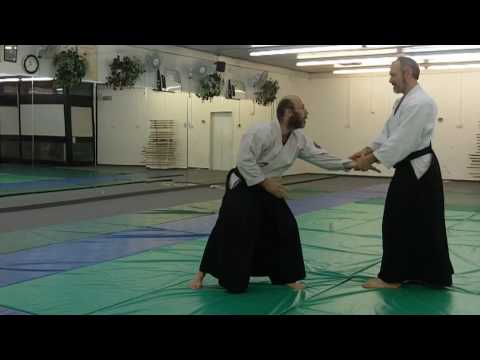
Seidokan Aikido of South Carolina Chief Instructor, Doug Wedell, and Senior instructor, Paul Bradley, demonstrate defens…
Перевод: Side Face
Yokomen (diagonal head cut) strikes the side of the men target at approximately a 45-degree angle, making it one of the two fundamental men-uchi techniques in kendo alongside shomen. [1] The technique has roots in classical kenjutsu, where diagonal cuts were considered essential battlefield actions — a diagonal trajectory was more likely to find gaps in armour at the neck and temple than a straight vertical cut. [2] In modern kendo, yokomen is taught as a more advanced strike than shomen because it requires precise angling and footwork to deliver the cut at the correct trajectory while maintaining ki-ken-tai-ichi. [1] The All Japan Kendo Federation includes yokomen as a standard waza in its grading syllabus. [3]
Yokomen (diagonal head strike) targets the side of the head, descended from classical kenjutsu diagonal cutting technique (kesa-giri). [1]
Yokomen is a valid scoring technique in kendo competition, though less commonly scored than shomen due to the difficulty of demonstrating correct form on a diagonal trajectory. [1]
Изображений для этой техники пока нет.
Войдите, чтобы предложить изображение.
Seidokan Aikido of South Carolina Chief Instructor, Doug Wedell, and Senior instructor, Paul Bradley, demonstrate defens…
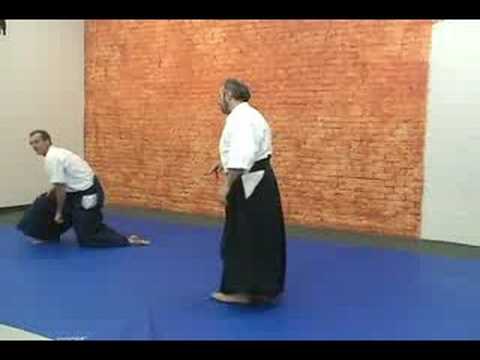
Instructional video with Doug Wedell, Chief Instructor of Seidokan Aikido of South Carolina, demonstrating the basic shi…
Yokomenuchi is a diagonal overhead or side cut executed in kenjutsu and aikido contexts, requiring precise footwork and angular displacement to execute effectively. MasaKatsuAiki's instructional material emphasizes that proper footwork is fundamental to maintaining composure and fluidity when responding to yokomenuchi attacks. The instructor stresses that the defender's positioning must account for the attacker's line of force and the shikaku (dead angle) behind the opponent. Key footwork patterns involve multiple pivots—often three distinct movements (step, pivot, step, step)—to shift angles approximately 45 degrees from the initial attack vector. The distance of retreat is determined by the vigor of the incoming strike. When executing shihonage (four-direction throw) in response, the defender controls primarily the wrist and handle rather than the blade itself, using minimal rotational force and light contact to maintain complete control. Alternative responses such as koteotoshi (wrist-pin throw) require fewer footwork adjustments—essentially a single pivot motion—making it faster than tenkan (turning) techniques. Throughout execution, the defender must maintain awareness of the opponent's position relative to their own, preventing the attacker from recovering striking distance while avoiding unnecessary body rotation that compromises control.
Сформировано на основе 2 инструкторов
Учебных курсов по этой технике пока нет.
Войдите, чтобы предложить курс.
Риск травмы для человека, к которому применяется техника
Edged weapons cause fatal lacerations; historical battlefield mortality rates >30% (Amberger 1999)
Уровень мастерства, необходимый для надёжного выполнения техники
Разрешена ли техника по основным соревновательным правилам
The Book of Five Rings (Miyamoto Musashi, 1645)
Alias sources — [1] Japanese Swordsmanship (Warner & Draeger, 1982) [2] Japanese Swordsmanship (Warner & Draeger, 1982) [3] Japanese Swordsmanship (Warner & Draeger, 1982)
Effectiveness sources — [1] All Japan Kendo Federation, Kendo Official Manual (AJKF) [2] Warner, G. & Draeger, D., Japanese Swordsmanship: Technique and Practice (Weatherhill, 1982)
Established Japanese martial arts naming convention — native Japanese term (和語/漢語)
Alias sources — [1] Japanese Swordsmanship (Warner & Draeger, 1982) [2] Japanese Swordsmanship (Warner & Draeger, 1982) [3] Japanese Swordsmanship (Warner & Draeger, 1982)
Effectiveness sources — [1] All Japan Kendo Federation, Kendo Official Manual (AJKF) [2] Warner, G. & Draeger, D., Japanese Swordsmanship: Technique and Practice (Weatherhill, 1982)
wrist control for edge alignment, grip endurance, footwork precision
quick wrists, strong forearms, good posture
forearm extensors/flexors, deltoids, core, calves
According to MasaKatsuAiki, if your footwork is wrong, it's difficult to maintain calmness and motion in your technique. Proper footwork is foundational to executing yokomenuchi responses effectively.
MasaKatsuAiki demonstrates the sequence as: step, pivot, step, step. The goal is to position yourself at the correct angle, sliding from the elbow down to the wrist at approximately 45 degrees away from the attacker's strike.
MasaKatsuAiki emphasizes that you should make sure you're looking in the attacker's ear before you cut and throw. This visual reference point helps you establish the correct angle and timing for your technique.
Diagonal cut targeting the side of the head, angled approximately 45 degrees from vertical.
Yokomen (diagonal head cut) strikes the side of the men target at approximately a 45-degree angle, making it one of the two fundamental men-uchi techniques in kendo alongside shomen. The technique has roots in classical kenjutsu, where diagonal cuts were considered essential battlefield actions — a diagonal trajectory was more likely to find gaps in armour at the neck and temple than a straight vertical cut.
FIK Kendo: разрешён — Legal, valid strike requires correct form (datotsu-bu), spirit (kiai), and fo…
Оценка опасности 9/10. Extreme — edged weapons cause fatal lacerations; historical battlefield mortality rates >30% (Amberger 1999)
Стандартная цепочка подготовки: Ready Position → Distance Control → Execute Technique → Return to Guard.
Стандартные контрприёмы: Parry (Absetzen) — deflect the incoming blade with a counter-displacement / Void (Step Back) — withdraw from measure to avoid the cutting arc / Counter-Cut (Nachreisen) — strike into the opponent's opening during their attack.
Распространённые варианты: Standard cut (primary cutting angle from the ready stance); Thrust (tsuki) (straight thrust targeting the throat, chest, or face); Rising cut (kiri-age) (upward diagonal cut from low to high); Diagonal cut (kesa-giri) (downward diagonal cut following the kimono line).
Yokomen is a valid scoring technique in kendo competition, though less commonly scored than shomen due to the difficulty of demonstrating correct form on a diagonal trajectory.
Основные ошибки, на которые стоит обратить внимание: Cutting at too steep or too shallow an angle — yokomen should be approximately 45 degrees / Using the same mechanics as shomen — yokomen requires adjusted hand position and hip angle for the diagonal path / Telegraphing the yokomen — the preparation should not reveal whether shomen or yokomen will be delivered / Not achieving proper edge alignment on the diagonal — hasuji is more challenging on diagonal cuts; extra attention is….
Yokomen также известен как Yokomen Uchi, Diagonal Head Cut, Side Men.