Learn the Art of Combat: Longsword Guards - Beginners Guide
0
Ochs·Björn Rüther
Knowing the guards in the long sword, knowing which techniques and concepts to apply from each posture, and being able t…
Перевод: ochs (ox guard)
Ochs (the ox) is a high guard that positions the longsword beside the head with the point aimed at the opponent's face or upper chest, hilt at temple height. [1] Ochs threatens an immediate thrust to the opponent's face while simultaneously protecting the upper line with the crossguard and blade. [1],[2] The guard can be held on either side of the head, with left Ochs and right Ochs covering different lines and threatening different angles of thrust. [2],[3]
Ochs (Ox) positions the sword high and to one side with the point aimed at the opponent's face, threatening a direct thrust while covering the upper openings with the cross-guard and blade. [1] It is the primary guard for initiating thrusts and for entering the Winden (winding) from the bind. [2] Its weakness is exposure of the lower body, which the opponent can exploit with Unterhäue or the Krumphau. [2]
Ochs (ox) is a high guard in the Liechtenauer system used to threaten thrusts and wind into the opponent's openings in HEMA competition. [1]
Изображений для этой техники пока нет.
Войдите, чтобы предложить изображение.
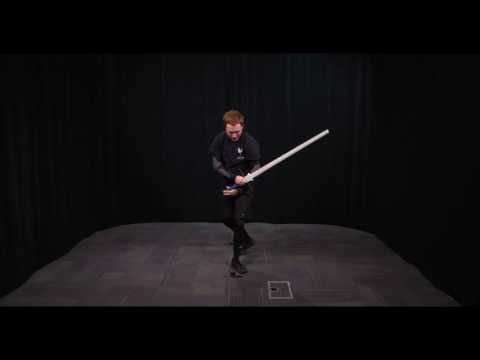
Knowing the guards in the long sword, knowing which techniques and concepts to apply from each posture, and being able t…
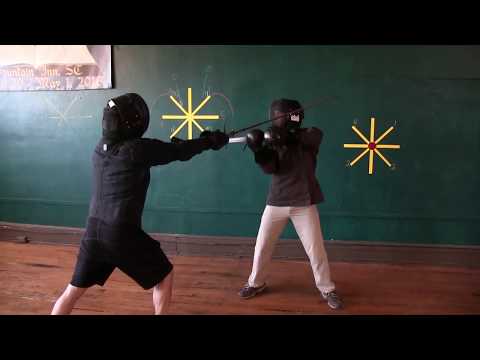
Here Josh gives us some great insights into how the Krumphau breaks Ochs. And thanks to Chris for volunteering to work w…
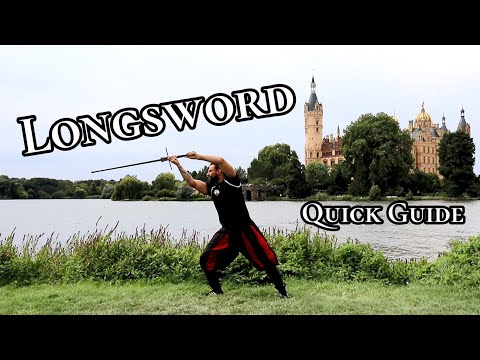
Here we discuss the Ochs guard and how it can be used in sparring, as well as the various transfers associated with it. …
Ochs (Ox) is one of the four primary guards in German longsword fencing, characterized by the sword held high with the point directed toward the opponent's face, creating a constant threat of thrust while protecting the head. According to Björn Rüther, this medium-distance guard allows execution of all principal strikes and twere strikes without difficulty, and serves as a common follow-up position when entering the bind with an opponent. VCU HEMA's Nick Allen emphasizes the anatomical distinction between right- and left-handed practitioners: a right-handed fencer's arms cross in right-side ochs (uncross on the left side), with the thumb placed on the flat of the blade for superior sensory feedback and tip control. Allen identifies three primary transfers from ochs: the middle howl (a circular transition with the tip passing behind the head), the thrust (extending the point while stepping to maintain offensive pressure during vulnerable footwork), and the unter howl (a downward cut using the true edge with restricted wrist angles due to anatomical limits). Sword Carolina's Josh emphasizes that ochs applications depend heavily on distance and principle rather than rigid positioning; when an opponent in ochs attempts to thrust during a crump attack on the hands, they expose both hands and head, violating manuscript principles. He introduces the concept of stepping offline (perpendicular to center line) when attempting hand-targeted crumps to maintain defensive advantage and avoid overextension. All three instructors agree ochs serves both defensive and offensive functions, though they approach pedagogical structure differently.
Сформировано на основе 3 инструкторов
Учебных курсов по этой технике пока нет.
Войдите, чтобы предложить курс.
Риск травмы для человека, к которому применяется техника
Edged weapons cause fatal lacerations; historical battlefield mortality rates >30% (Amberger 1999)
Уровень мастерства, необходимый для надёжного выполнения техники
Разрешена ли техника по основным соревновательным правилам
The Art of Combat (Joachim Meyer, 1570)
Alias sources — [1] Sigmund Ringeck's Knightly Arts of Combat [2] Sigmund Ringeck's Knightly Arts of Combat [3] Sigmund Ringeck's Knightly Arts of Combat
Effectiveness sources — [1] Forgeng, J., The Art of Combat (Palgrave Macmillan, 2003) [2] Tobler, C., Fighting with the German Longsword (Freelance Academy Press, 2004)
Standard katakana transliteration of Western martial arts terminology (外来語) — used in Japanese MMA, boxing, and BJJ communities
Alias sources — [1] Sigmund Ringeck's Knightly Arts of Combat [2] Sigmund Ringeck's Knightly Arts of Combat [3] Sigmund Ringeck's Knightly Arts of Combat
Effectiveness sources — [1] Forgeng, J., The Art of Combat (Palgrave Macmillan, 2003) [2] Tobler, C., Fighting with the German Longsword (Freelance Academy Press, 2004)
wrist control for edge alignment, grip endurance, footwork precision
quick wrists, strong forearms, good posture
forearm extensors/flexors, deltoids, core, calves
In Ochs, your thumb should be on the sword hilt, which gives you much better control of the tip and lets you know what's happening with your opponent's blade. This thumb positioning is important whether you're on the right or left side.
When training Ochs, take big oblique passing steps rather than moving straight forward or backward. This allows you to effectively train what it will be like in actual combat distance and positioning.
If you respond to an opponent's thrust from Ochs by stepping off the center line to the side, you force them to expose their hands closer to you, giving you a defensive advantage. Sword Carolina emphasizes stepping to the side rather than forward when responding.
In Ochs your knees are less bent and you stand a bit higher than in guards like Vom Tag, since your sword is concentrated upward rather than over your shoulder.
Ochs (the ox) is a high guard that positions the longsword beside the head with the point aimed at the opponent's face or upper chest, hilt at temple height. Ochs threatens an immediate thrust to the opponent's face while simultaneously protecting the upper line with the crossguard and blade.
Ochs is one of Liechtenauer's four principal guards, named for its resemblance to an ox's horns threatening from above. The German glossators describe Ochs as the guard that commands the upper openings and from which the most dangerous thrusts are delivered.
Traditional martial arts: разрешён — Practiced in traditional kata/forms and weapon-specific competition under var…; IWUF: разрешён — Legal in wushu taolu if applicable; HEMA: разрешён — Legal in applicable historical weapon categories
Оценка опасности 9/10. Extreme — edged weapons cause fatal lacerations; historical battlefield mortality rates >30% (Amberger 1999)
Стандартная цепочка подготовки: Assume Guard (Kamae/Hut) → Measure Distance (Ma-ai) → Initiate Cut/Thrust → Follow Through (Zanshin).
Стандартные контрприёмы: Parry (Absetzen) — deflect the incoming blade with a counter-displacement / Void (Step Back) — withdraw from measure to avoid the cutting arc / Counter-Cut (Nachreisen) — strike into the opponent's opening during their attack.
Распространённые варианты: Standard cut (primary cutting angle from the ready stance); Thrust (tsuki) (straight thrust targeting the throat, chest, or face); Rising cut (kiri-age) (upward diagonal cut from low to high); Diagonal cut (kesa-giri) (downward diagonal cut following the kimono line).
Ochs (ox) is a high guard in the Liechtenauer system used to threaten thrusts and wind into the opponent's openings in HEMA competition.
Основные ошибки, на которые стоит обратить внимание: Holding Ochs with the point too high — the point must threaten the opponent's face for the guard to be effective / Not threatening the thrust from Ochs — the thrust is the primary weapon; without the threat, the guard is passive / Keeping the arms too extended — the arms should be slightly bent for mobility and responsiveness / Only using Ochs on one side — both left and right Ochs must be trained for complete coverage.
Ochs также известен как Okusu, Ox Guard, Ox, Upper Hanging Guard.