The Quarterstaff: Lesson 1
0
Standard Quarterstaff·Triskelion Combat
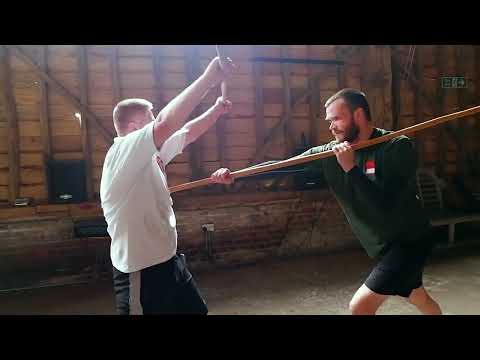
Lesson 1 of our approach on the Quarterstaff based on and inspired mostly by Zachary Wylde (1711). We also use the littl…
Перевод: standard quarterstaff
Core quarterstaff techniques from historical European sources including strikes, thrusts, and parries.
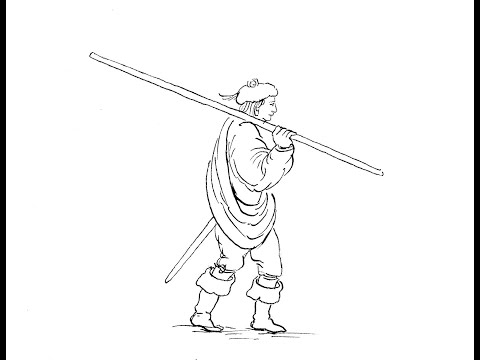
The standard quarterstaff subfamily encompasses the core fighting method described in English Renaissance sources, employing a 6-to-8-foot hardwood staff gripped at the middle third with both hands. [1] Silver describes the standard method as holding the staff with hands approximately two feet apart, enabling rapid transitions between thrusts and strikes from either end. [2] This two-handed centre-grip method distinguishes the English quarterstaff from the Japanese bo (typically gripped nearer one end) and reflects the European emphasis on thrusting as the primary offensive action. [1],[2]
English quarterstaff fighting was documented by George Silver in Paradoxes of Defence (1599) and Brief Instructions (c.1605), with additional German staff traditions in Fechtbücher. [1]
Quarterstaff competition is held at HEMA events, with dedicated staff divisions at tournaments. [1]
Изображений для этой техники пока нет.
Войдите, чтобы предложить изображение.
Lesson 1 of our approach on the Quarterstaff based on and inspired mostly by Zachary Wylde (1711). We also use the littl…
he English quarterstaff has a rich history deeply embedded in the martial traditions of England. Its origins trace back …
Учебных курсов по этой технике пока нет.
Войдите, чтобы предложить курс.
Риск травмы для человека, к которому применяется техника
Staff/bo/jo weapons generate significant blunt force; fracture risk
Уровень мастерства, необходимый для надёжного выполнения техники
Разрешена ли техника по основным соревновательным правилам
The Art of Combat (Joachim Meyer, 1570)
Alias sources — [1] The Medieval Art of Swordsmanship (Tobler, 2010) [2] Old Sword-Play (Hutton, 1892) [3] Old Sword-Play (Hutton, 1892)
History sources — [1] Anglo, S., The Martial Arts of Renaissance Europe (Yale University Press, 2000) [2] Silver, G., Paradoxes of Defence (1599)
Standard katakana transliteration of Western martial arts terminology (外来語) — used in Japanese MMA, boxing, and BJJ communities
Alias sources — [1] The Medieval Art of Swordsmanship (Tobler, 2010) [2] Old Sword-Play (Hutton, 1892) [3] Old Sword-Play (Hutton, 1892)
History sources — [1] Anglo, S., The Martial Arts of Renaissance Europe (Yale University Press, 2000) [2] Silver, G., Paradoxes of Defence (1599)
wrist snap speed, sliding grip coordination, hip rotation
long reach and strong wrists for staff manipulation
forearms, wrist rotators, core rotators, shoulders
Каждое движение в любом боевом искусстве обладает рядом универсальных свойств. Комбинируйте параметры ниже, чтобы найти нужный инструмент или сравнить аналоги из разных стилей.
Oak and ash are the preferred materials for quarterstaffs due to their density and resistance to splintering. Some quarterstaffs were further reinforced with metal bands at the ends to prevent splitting and increase durability.
According to Triskelion Combat, the best and quickest way to defend is to use the back edge of your quarterstaff to carry the blow to the side, then counter with a triangle step or inside traverse to target your opponent's head or hand.
Footwork is crucial for maintaining balance and manoeuvrability while executing strikes and evasions. Quick footwork allows fighters to adjust position and angle of attack, and combined with proper timing and distance control, enables skilled practitioners to exploit openings in their opponent's defence.
According to Triskelion Combat, if your opponent pushes strongly in the bind, you can disengage and thrust forward, or if you feel you have a strong bind position yourself, step forward while maintaining the bind and execute a counter-thrust.
Core quarterstaff techniques from historical European sources including strikes, thrusts, and parries.
The standard quarterstaff subfamily encompasses the core fighting method described in English Renaissance sources, employing a 6-to-8-foot hardwood staff gripped at the middle third with both hands. Silver describes the standard method as holding the staff with hands approximately two feet apart, enabling rapid transitions between thrusts and strikes from either end.
Traditional martial arts: разрешён — Practiced in traditional kata/forms and weapon-specific competition under var…; IWUF: разрешён — Legal in wushu taolu if applicable; HEMA: разрешён — Legal in applicable historical weapon categories
Оценка опасности 7/10. Very High — staff/bo/jo weapons generate significant blunt force; fracture risk
Стандартная цепочка подготовки: Grip and Stance → Chamber → Strike → Recovery.
Стандартные контрприёмы: Beat Parry — deflect the blade with a sharp lateral beat before it reaches target / Displacement — move the body off the line while threatening with the point / Counter-Thrust — extend into the attacker's line during their advance.
Распространённые варианты: Overhead strike (bringing the staff down from above in a vertical arc); Lateral strike (horizontal sweep targeting the ribs or head); Thrust (straight thrust with the end of the staff); Butt-end strike (striking with the rear end of the staff at close range).
Quarterstaff competition is held at HEMA events, with dedicated staff divisions at tournaments.
Основные ошибки, на которые стоит обратить внимание: Not mastering the sliding grip extension — this is the quarterstaff's signature technique; it must be practised until… / Using only swinging strikes — the thrust is Silver's primary recommended attack; cuts are secondary / Gripping too tightly at both ends — the butt hand must be able to slide freely for the extension technique / Standing at sword distance — the quarterstaff's advantage is its superior reach; maintain long range.
Standard Quarterstaff также известен как Sutandādo Kwōtā Sutaffu, Short Staff — HEMA, European Quarterstaff Technique, Silver's Staff.