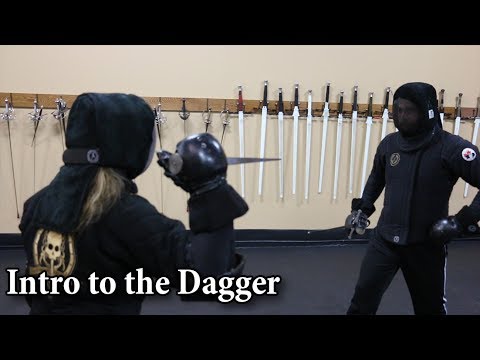
Introduction to the Dagger - Showcasing HEMA
0
Standard HEMA Dagger Technique·Blood and Iron HEMA
Knife goes in, guts come out. Knife goes in, guts come out. Check out our Patreon for extended and early content! - www…
Перевод: standard HEMA dagger technique
The Standard HEMA Dagger Technique genus represents the fundamental dagger actions taught across HEMA programs — the thrust, the parry, the disarm, and the counter-thrust. [1] Fiore dei Liberi's system organises these into a flowchart of plays: the attacker thrusts, the defender parries and counters with a lock or disarm, and subsequent plays address each counter-to-the-counter. [1],[2] Training typically progresses from set plays (drills) to free-form dagger sparring. [2],[3]
Fiore dei Liberi's Fior di Battaglia (1409) contains the most influential dagger play sequence, with roughly twenty illustrated plays covering attack, defence, and counter-defence. [1] German sources such as Talhoffer's 1467 Fechtbuch and Codex Wallerstein supplement these with additional judicial-duel techniques. [2],[3]
Standard HEMA dagger techniques cover the fundamental thrusts, defences, and disarms from medieval fighting manuals. [1]
These techniques are reconstructed from 14th–15th century Fechtbücher, particularly the works of Fiore dei Liberi and Hans Talhoffer. [1]
Standard HEMA dagger techniques are practised and competed at HEMA events worldwide. [1]
Изображений для этой техники пока нет.
Войдите, чтобы предложить изображение.
Knife goes in, guts come out. Knife goes in, guts come out. Check out our Patreon for extended and early content! - www…
Would you like to see a part 2? Let me know! Friends and Collaborators! ===================== The Sword Lynx: https:/…
Kyle Toelle sent me his instructional video material on the use of the dagger based on medieval and renaissance sources …
Standard HEMA dagger technique centers on the rondelle dagger as a thrusting weapon, with instructors Blood and Iron HEMA, Skallagrim, and Apperceptive_Swordsman collectively emphasizing its design and tactical application. All three instructors agree that the rondelle dagger's triangular blade is optimized for thrusting rather than cutting, making it effective against armor gaps and thick medieval clothing. Blood and Iron HEMA and Apperceptive_Swordsman both identify the downward ice-pick grip strike as a primary attack vector, while Apperceptive_Swordsman additionally details the hammer grip (forward grip) as an alternative offering greater reach and centerline alignment. Defense techniques are consistently described across sources: deflection using the offhand (Blood and Iron HEMA), footwork combined with body structure and force redirection (Skallagrim), and dual-handed blocking in iron gate guards (Apperceptive_Swordsman). All instructors stress that guards are dynamic moments rather than static positions. Skallagrim emphasizes testing techniques against resisting opponents and maintaining structural integrity throughout exchanges, while Apperceptive_Swordsman highlights Fiore de la Berry's five primary stances and the importance of simultaneous offense and defense. Common follow-ups include disarms, wrist locks, arm breaks, and grappling transitions. Apperceptive_Swordsman uniquely notes that unarmed defense against the dagger was historically prioritized in training, with some of Fiore's guards designed specifically for weapon-free scenarios.
Сформировано на основе 3 инструкторов
Учебных курсов по этой технике пока нет.
Войдите, чтобы предложить курс.
Риск травмы для человека, к которому применяется техника
Knives and short blades are the most common weapon in real-world assaults; high lethality
Уровень мастерства, необходимый для надёжного выполнения техники
Разрешена ли техника по основным соревновательным правилам
The Art of Combat (Joachim Meyer, 1570)
Alias sources — [1] The Medieval Art of Swordsmanship (Tobler, 2010) [2] Fiore dei Liberi's Fior di Battaglia (1409) [3] Fiore dei Liberi's Fior di Battaglia (1409)
Effectiveness sources — [1] Medieval Combat (Talhoffer, 2000 translation)
Standard katakana transliteration of Western martial arts terminology (外来語) — used in Japanese MMA, boxing, and BJJ communities
Alias sources — [1] The Medieval Art of Swordsmanship (Tobler, 2010) [2] Fiore dei Liberi's Fior di Battaglia (1409) [3] Fiore dei Liberi's Fior di Battaglia (1409)
Effectiveness sources — [1] Medieval Combat (Talhoffer, 2000 translation)
wrist control for edge alignment, grip endurance, footwork precision
quick wrists, strong forearms, good posture
forearm extensors/flexors, deltoids, core, calves
Guards are just a moment in time, not fixed positions you hold statically. You should switch between guards to keep your opponent guessing and move naturally—dagger fighting is much more dynamic than people sometimes think (Skallagrim, "How to Fight with Daggers").
Use footwork to step offline while extending your arm fully and driving the weapon up rather than just catching it passively—this way your entire skeletal structure supports the action (Skallagrim, "How to Fight with Daggers").
Focus on the full iron gate single and middle iron gate doubled, where your left hand is forward and your dagger hand is back—this philosophy allows you to defend yourself well against quick thrusts while maintaining offensive capability (Apperceptive_Swordsman, "How to fight with a Rondel Dagger!").
If your dagger gets caught, letting it go and defending yourself unarmed might be more useful than trying to defend with one hand while holding the dagger, which is very difficult (Apperceptive_Swordsman, "How to fight with a Rondel Dagger!").
The Standard HEMA Dagger Technique genus represents the fundamental dagger actions taught across HEMA programs — the thrust, the parry, the disarm, and the counter-thrust. Fiore dei Liberi's system organises these into a flowchart of plays: the attacker thrusts, the defender parries and counters with a lock or disarm, and subsequent plays address each counter-to-the-counter.
Fiore dei Liberi's Fior di Battaglia (1409) contains the most influential dagger play sequence, with roughly twenty illustrated plays covering attack, defence, and counter-defence. German sources such as Talhoffer's 1467 Fechtbuch and Codex Wallerstein supplement these with additional judicial-duel techniques.
Traditional martial arts: разрешён — Practiced in traditional kata/forms and weapon-specific competition under var…; IWUF: разрешён — Legal in wushu taolu if applicable; HEMA: разрешён — Legal in applicable historical weapon categories
Оценка опасности 9/10. Extreme — knives and short blades are the most common weapon in real-world assaults; high lethality
Стандартная цепочка подготовки: Ready Position → Distance Control → Execute Technique → Return to Guard.
Стандартные контрприёмы: Beat Parry — deflect the blade with a sharp lateral beat before it reaches target / Displacement — move the body off the line while threatening with the point / Counter-Thrust — extend into the attacker's line during their advance.
Распространённые варианты: Standard cut (primary cutting angle from the ready stance); Thrust (tsuki) (straight thrust targeting the throat, chest, or face); Rising cut (kiri-age) (upward diagonal cut from low to high); Diagonal cut (kesa-giri) (downward diagonal cut following the kimono line).
Standard HEMA dagger techniques are practised and competed at HEMA events worldwide.
Основные ошибки, на которые стоит обратить внимание: Trying to intercept the dagger rather than the arm — control the arm and the dagger is controlled automatically / Not stepping offline — the body must move off the attack line; standing in the path of the thrust risks failure / Using one hand against the opponent's attacking arm — two-on-one leverage is essential for reliable control / Applying the lock gently — in training, control is appropriate, but the technique must be understood as a joint break….
Standard HEMA Dagger Technique также известен как Sutandādo HEMA Dagā Waza, Basic Dagger Play, Dolchfechten, Standard Dagger Combat.