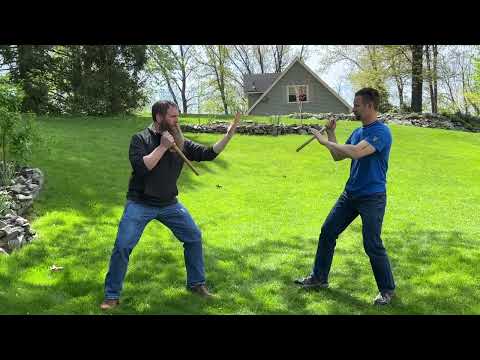
A Fundamental to HEMA Wrestling and Dagger
0
Standard HEMA Dagger·New Jersey Historical Fencing Association
A demonstration of body positioning for HEMA wrestling and dagger (rondel) fighting. Intro music: The altered segment …
Перевод: standard HEMA dagger
The Standard HEMA Dagger subfamily groups the core techniques of European historical dagger fighting as described in medieval fight-books. [1] These techniques emphasise close-range thrusting, parrying with the off-hand or dagger quillons, joint locks derived from Ringen (wrestling), and disarms that exploit leverage against the opponent's grip. [1],[2] Practitioners typically train with steel or synthetic rondel-style daggers and wear padded gloves or gauntlets to allow realistic sparring intensity. [2],[3]
Standard HEMA dagger technique draws primarily from Fiore dei Liberi's dagger section and the German fight-book tradition, both of which treat the dagger as an extension of grappling rather than a stand-alone cutting weapon. [1] Modern HEMA clubs reconstruct these techniques through scholarly interpretation of manuscripts and test them in competitive sparring. [2],[3]
HEMA dagger techniques include thrusts, cuts, disarms, and grappling at close range, reconstructed from medieval fighting manuals by masters like Fiore dei Liberi and Talhoffer. [1]
HEMA dagger competition is held at major tournaments with dedicated divisions using padded or blunted training daggers. [1]
Изображений для этой техники пока нет.
Войдите, чтобы предложить изображение.
A demonstration of body positioning for HEMA wrestling and dagger (rondel) fighting. Intro music: The altered segment …
Учебных курсов по этой технике пока нет.
Войдите, чтобы предложить курс.
Риск травмы для человека, к которому применяется техника
Knives and short blades are the most common weapon in real-world assaults; high lethality
Уровень мастерства, необходимый для надёжного выполнения техники
Разрешена ли техника по основным соревновательным правилам
The Art of Combat (Joachim Meyer, 1570)
Alias sources — [1] The Medieval Art of Swordsmanship (Tobler, 2010) [2] Fiore dei Liberi's Fior di Battaglia (1409) [3] Fiore dei Liberi's Fior di Battaglia (1409)
Effectiveness sources — [1] Medieval Combat (Talhoffer, 2000 translation)
Standard katakana transliteration of Western martial arts terminology (外来語) — used in Japanese MMA, boxing, and BJJ communities
Alias sources — [1] The Medieval Art of Swordsmanship (Tobler, 2010) [2] Fiore dei Liberi's Fior di Battaglia (1409) [3] Fiore dei Liberi's Fior di Battaglia (1409)
Effectiveness sources — [1] Medieval Combat (Talhoffer, 2000 translation)
wrist control for edge alignment, grip endurance, footwork precision
quick wrists, strong forearms, good posture
forearm extensors/flexors, deltoids, core, calves
Каждое движение в любом боевом искусстве обладает рядом универсальных свойств. Комбинируйте параметры ниже, чтобы найти нужный инструмент или сравнить аналоги из разных стилей.
Dagger is fundamentally an application of wrestling. The New Jersey Historical Fencing Association emphasizes that understanding arm positioning in front of your body is where you initiate wrestling, and feeling your opponent's movement through close contact allows you to set up locks and control.
Many practitioners fall into what instructors call 'viper strike mode'—quickly stabbing at each other—but this doesn't match what historical fencing manuals actually teach. Instead, proper dagger work emphasizes keeping the arm extended in front to control distance and initiate wrestling exchanges.
Extending the hand forward with an inverted grip allows you to control range and perform disarms or strips from a position of advantage, whether you're working with the dagger or transitioning to unarmed grappling.
The Standard HEMA Dagger subfamily groups the core techniques of European historical dagger fighting as described in medieval fight-books. These techniques emphasise close-range thrusting, parrying with the off-hand or dagger quillons, joint locks derived from Ringen (wrestling), and disarms that exploit leverage against the opponent's grip.
Standard HEMA dagger technique draws primarily from Fiore dei Liberi's dagger section and the German fight-book tradition, both of which treat the dagger as an extension of grappling rather than a stand-alone cutting weapon. Modern HEMA clubs reconstruct these techniques through scholarly interpretation of manuscripts and test them in competitive sparring.
Traditional martial arts: разрешён — Practiced in traditional kata/forms and weapon-specific competition under var…; IWUF: разрешён — Legal in wushu taolu if applicable; HEMA: разрешён — Legal in applicable historical weapon categories
Оценка опасности 9/10. Extreme — knives and short blades are the most common weapon in real-world assaults; high lethality
Стандартная цепочка подготовки: Ready Position → Distance Control → Execute Technique → Return to Guard.
Стандартные контрприёмы: Beat Parry — deflect the blade with a sharp lateral beat before it reaches target / Displacement — move the body off the line while threatening with the point / Counter-Thrust — extend into the attacker's line during their advance.
Распространённые варианты: Standard cut (primary cutting angle from the ready stance); Thrust (tsuki) (straight thrust targeting the throat, chest, or face); Rising cut (kiri-age) (upward diagonal cut from low to high); Diagonal cut (kesa-giri) (downward diagonal cut following the kimono line).
HEMA dagger competition is held at major tournaments with dedicated divisions using padded or blunted training daggers.
Основные ошибки, на которые стоит обратить внимание: Treating dagger guards as static positions — guards are transitional positions; the fighter flows between them / Attempting to counter-attack before controlling the weapon arm — arm control must come first in HEMA dagger defence / Using only one grip — the standard system uses multiple grips; limiting to one reduces technical options / Not training the counter-remedies — knowing only the remedies means being defeated by anyone who knows the counter-re….
Standard HEMA Dagger также известен как Sutandādo HEMA Dagā, Ringen mit dem Dolch, Dagger Grappling, Dolch Technique.