Kali Espada y Daga Tutorial
0
Standard Espada Y Daga Technique·Sakan Lam
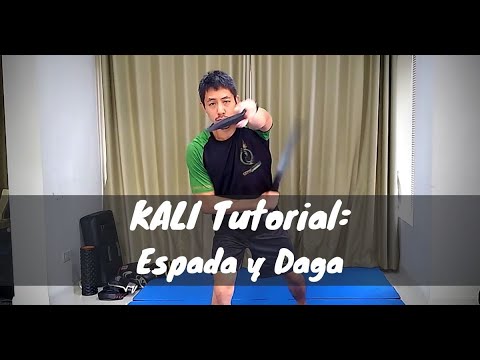
#kali #espadaydaga #tutorial Tutorial on the basics of Espada y Daga. -Make sure to become proficient with the basic an…
Перевод: standard espada y daga technique
The Standard Espada Y Daga Technique executes the core coordination drill where the long weapon delivers a numbered angle strike while the short weapon simultaneously performs a checking, blocking, or trapping action, followed by the short weapon delivering its own counter-strike while the long weapon recovers or blocks. [1] The fundamental drill cycles through the angle system, training the practitioner to pair each long-weapon angle strike with the appropriate short-weapon action. [1],[2] Execution requires developing independent hand coordination — the ability to strike with one hand while blocking or checking with the other, a skill that transfers directly to empty-hand combat. [2],[3]
Standard espada y daga technique drills have been part of Filipino martial arts training for centuries, representing one of the most sophisticated dual-weapon coordination exercises in any fighting system. [1] The drills are designed to build the reflexive bilateral coordination needed for effective dual-weapon combat. [2],[3]
Standard espada y daga technique covers the fundamental combinations of long and short weapon work in Filipino martial arts. [1]
Standard espada y daga techniques were systematised within major FMA systems like Doce Pares, Balintawak, and Modern Arnis. [1]
Standard espada y daga techniques are performed in FMA tournament competition. [1]
Изображений для этой техники пока нет.
Войдите, чтобы предложить изображение.
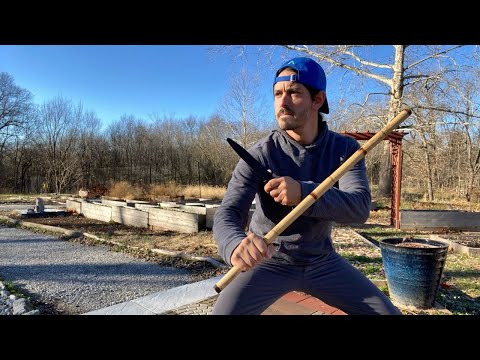
#kali #espadaydaga #tutorial Tutorial on the basics of Espada y Daga. -Make sure to become proficient with the basic an…
Espada Y Daga is the 3rd area of Kali and is considered the most sophisticated of the areas. Here are 3 great basic dril…
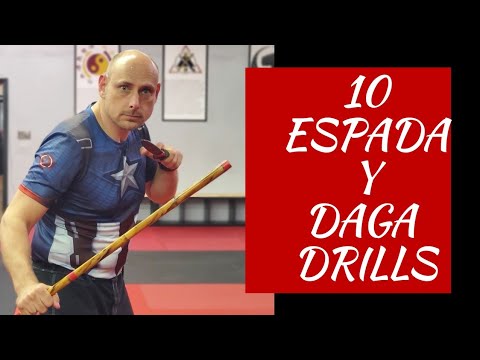
Thanks for checking out our channel. Guro JD brings you 10 Espada y Daga or Stick and Dagger six-count drills that you …
Standard Espada y Daga technique involves coordinated striking and thrusting with a long weapon (espada/stick) and short weapon (daga/knife) in Filipino martial arts. All three instructors—Kali Center, Sakan Lam, and Martial Arts Unlimited—emphasize foundational competency in the twelve angles of attack before combining weapons. Kali Center's approach focuses on sequential drilling: striking angles 1-2 down the X with the espada while chambering the daga at the hip, then alternating with angles 3-4, interspersed with high and low daga thrusts. The daga hand must remain controlled near the hip to avoid self-injury. Sakan Lam similarly advocates mastering the twelve angles individually, then alternating espada strikes with daga thrusts after every two angles, preferring spiral thrusts reminiscent of overhand punching mechanics. Martial Arts Unlimited presents the technique through six-count drills based on figure-8 patterns (downward, upward, flat) and abaniko (fan) sequences (high-low-high, low-high-low, triple high, triple low), each followed by a consistent finishing sequence: stab-hit-stab. All instructors stress the importance of chamber points—typically the hip for the daga—and recommend practicing drills individually before flowing between them. The instructors agree on foundational principles but vary in drill structure: Kali Center uses angle-based progressions, Sakan Lam emphasizes angle mastery with alternating thrusts, and Martial Arts Unlimited organizes training through repetitive six-count figure patterns.
Сформировано на основе 3 инструкторов
Учебных курсов по этой технике пока нет.
Войдите, чтобы предложить курс.
Риск травмы для человека, к которому применяется техника
Arnis/Escrima/Kali stick and blade techniques; designed for close-range lethality
Уровень мастерства, необходимый для надёжного выполнения техники
Разрешена ли техника по основным соревновательным правилам
The Filipino Martial Arts (Dan Inosanto, 1980)
Alias sources — [1] Filipino Martial Arts (Wiley, 1994) [2] Filipino Martial Arts (Wiley, 1994) [3] Filipino Martial Arts (Wiley, 1994)
Effectiveness sources — [1] Filipino Martial Arts (Wiley, 1997)
Mixed Japanese-Western terminology — combines traditional Japanese terms with katakana loanwords
Alias sources — [1] Filipino Martial Arts (Wiley, 1994) [2] Filipino Martial Arts (Wiley, 1994) [3] Filipino Martial Arts (Wiley, 1994)
Effectiveness sources — [1] Filipino Martial Arts (Wiley, 1997)
close-range reflexes, wrist dexterity, grip transitions
quick hands, strong wrists for grip changes
forearm flexors, wrist rotators, deltoids, core
Chamber the weapon that's not being used at the hip, and slide it down next to your hip when striking. Make sure to keep the tip pointing down and clear it out of the way to avoid accidentally cutting or thrusting yourself.
Some practitioners prefer a straight thrust, while others like a spiral thrust. Sakan Lam recommends thinking of the spiral thrust as an overhand punch combined with a freestyle swimmer stroke, which also helps improve your overall punching technique.
Once you have all three drills accomplished individually, start experimenting by flowing all the drills into one continuous flow drill, such as a SIA or karenza (solitary free flow), but only after you have mastered each drill separately.
The Standard Espada Y Daga Technique executes the core coordination drill where the long weapon delivers a numbered angle strike while the short weapon simultaneously performs a checking, blocking, or trapping action, followed by the short weapon delivering its own counter-strike while the long weapon recovers or blocks. The fundamental drill cycles through the angle system, training the practitioner to pair each long-weapon angle strike with the appropriate short-weapon action.
Standard espada y daga technique drills have been part of Filipino martial arts training for centuries, representing one of the most sophisticated dual-weapon coordination exercises in any fighting system. The drills are designed to build the reflexive bilateral coordination needed for effective dual-weapon combat.
WEKAF: разрешён — Legal in padded stick competition; HEMA: разрешён — Legal in applicable weapon categories
Оценка опасности 8/10. Very High — Arnis/Escrima/Kali stick and blade techniques; designed for close-range lethality
Стандартная цепочка подготовки: Ready Position → Distance Control → Execute Technique → Return to Guard.
Стандартные контрприёмы: Parry (Absetzen) — deflect the incoming blade with a counter-displacement / Void (Step Back) — withdraw from measure to avoid the cutting arc / Counter-Cut (Nachreisen) — strike into the opponent's opening during their attack.
Распространённые варианты: Forward grip slash (cutting with the blade in a forward (hammer) grip); Reverse grip stab (thrusting with the blade in an icepick (reverse) grip); Forward grip thrust (straight thrust targeting the body or limbs); Defensive cut (slashing the opponent's attacking limb to disable it).
Standard espada y daga techniques are performed in FMA tournament competition.
Основные ошибки, на которые стоит обратить внимание: Delivering the stick strike without the simultaneous dagger check — both weapons must work at the same time / Thrusting with the dagger before the stick strike has created an opening — the stick must go first to draw the oppone… / Not recovering the stick to guard after the initial strike — the stick must protect while the dagger attacks at close… / Using the dagger to cut rather than thrust at close range — in tight quarters, the thrust is more effective and harde….
Standard Espada Y Daga Technique также известен как Sutandādo Esupada i Daga Waza, Basic Espada Y Daga, Long-and-Short Combination, Olisi Y Baraw Basic.