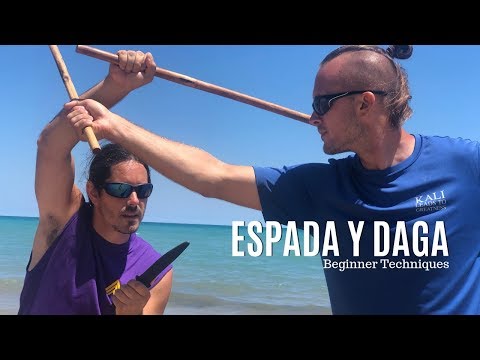
ESPADA Y DAGA BASIC TECHNIQUES | ESCRIMA STICK
0
Stick And Dagger — Espada Y Daga·Kali Center
Training Espada Y Daga is a great way to accelerate your skill and understanding of Kali. Train with me at my online aca…
Перевод: stick and dagger — espada y daga
The Stick And Dagger (Espada Y Daga) family covers techniques using a long weapon (stick or sword) in the dominant hand and a short weapon (dagger or short stick) in the other hand, which is one of the most tactically versatile weapon configurations in Filipino martial arts. [1] Espada y daga (Spanish for 'sword and dagger') assigns distinct roles to each weapon: the long weapon provides range, power, and primary offence, while the short weapon handles close-range defence, trapping, checking, and close-quarters counter-attack. [1],[2] The combination creates a comprehensive fighting system where the practitioner can engage at multiple ranges simultaneously — the long weapon threatens at distance while the dagger controls the close range. [2],[3]
Espada y daga was influenced by both indigenous Filipino dual-weapon traditions and the Spanish rapier-and-dagger (espada y daga) fighting system brought by Spanish colonisers beginning in the 16th century. [1] The Filipino adaptation incorporated local blade types and fighting principles, creating a hybrid system that combined European and indigenous Southeast Asian weapon methodology. [2],[3]
Espada y daga (sword/stick and dagger) is considered one of the most advanced and tactically rich FMA training methods because it requires coordinating two weapons of different lengths and functions simultaneously — the long weapon (espada) for range attacks and the short weapon (daga) for close-range trapping, checking, and thrusting. [1]
Espada y daga training is documented in virtually all traditional FMA systems and reflects the historical reality of Filipino warriors carrying a primary weapon (bolo, kampilan) paired with a short blade (daga, balisong). [1] The Spanish influence is evident in the nomenclature, suggesting cross-pollination during the colonial period. [2]
Espada y daga is competed in FMA tournaments as a specialty division, featuring a long weapon (stick/sword) and a short weapon (dagger/knife) simultaneously. [1]
Изображений для этой техники пока нет.
Войдите, чтобы предложить изображение.
Training Espada Y Daga is a great way to accelerate your skill and understanding of Kali. Train with me at my online aca…
Учебных курсов по этой технике пока нет.
Войдите, чтобы предложить курс.
Риск травмы для человека, к которому применяется техника
Arnis/Escrima/Kali stick and blade techniques; designed for close-range lethality
Уровень мастерства, необходимый для надёжного выполнения техники
Разрешена ли техника по основным соревновательным правилам
Bubishi: The Classic Manual of Combat (Patrick McCarthy, 2008)
Alias sources — [1] Filipino Martial Arts (Wiley, 1994) [2] Filipino Martial Arts (Wiley, 1994) [3] Filipino Martial Arts (Wiley, 1994)
Effectiveness sources — [1] Wiley, M., Filipino Martial Arts (Charles E. Tuttle, 1994)
Standard katakana transliteration of Western martial arts terminology (外来語) — used in Japanese MMA, boxing, and BJJ communities
Alias sources — [1] Filipino Martial Arts (Wiley, 1994) [2] Filipino Martial Arts (Wiley, 1994) [3] Filipino Martial Arts (Wiley, 1994)
Effectiveness sources — [1] Wiley, M., Filipino Martial Arts (Charles E. Tuttle, 1994)
wrist control for edge alignment, grip endurance, footwork precision
quick wrists, strong forearms, good posture
forearm extensors/flexors, deltoids, core, calves
Каждое движение в любом боевом искусстве обладает рядом универсальных свойств. Комбинируйте параметры ниже, чтобы найти нужный инструмент или сравнить аналоги из разных стилей.
Espada y daga (sword and dagger) is the Filipino adaptation of the Spanish colonial sword-and-dagger fighting system. The long weapon (stick/sword) attacks while the short weapon (dagger/knife) defends and counter-attacks at close range. (Wiley, Filipino Martial Arts; FMA history)
The Stick And Dagger (Espada Y Daga) family covers techniques using a long weapon (stick or sword) in the dominant hand and a short weapon (dagger or short stick) in the other hand, which is one of the most tactically versatile weapon configurations in Filipino martial arts. Espada y daga (Spanish for 'sword and dagger') assigns distinct roles to each weapon: the long weapon provides range, power, and primary offence, while the short weapon handles close-range defence, trapping, checking, and close-quarters counter-attack.
Espada y daga was influenced by both indigenous Filipino dual-weapon traditions and the Spanish rapier-and-dagger (espada y daga) fighting system brought by Spanish colonisers beginning in the 16th century. The Filipino adaptation incorporated local blade types and fighting principles, creating a hybrid system that combined European and indigenous Southeast Asian weapon methodology.
WEKAF: разрешён — Legal in padded stick competition; HEMA: разрешён — Legal in applicable weapon categories
Оценка опасности 8/10. Very High — Arnis/Escrima/Kali stick and blade techniques; designed for close-range lethality
Стандартная цепочка подготовки: Assume Guard (Kamae/Hut) → Measure Distance (Ma-ai) → Initiate Cut/Thrust → Follow Through (Zanshin).
Стандартные контрприёмы: Parry (Absetzen) — deflect the incoming blade with a counter-displacement / Void (Step Back) — withdraw from measure to avoid the cutting arc / Counter-Cut (Nachreisen) — strike into the opponent's opening during their attack.
Распространённые варианты: Standard cut (primary cutting angle from the ready stance); Thrust (tsuki) (straight thrust targeting the throat, chest, or face); Rising cut (kiri-age) (upward diagonal cut from low to high); Diagonal cut (kesa-giri) (downward diagonal cut following the kimono line).
Espada y daga is competed in FMA tournaments as a specialty division, featuring a long weapon (stick/sword) and a short weapon (dagger/knife) simultaneously.
Основные ошибки, на которые стоит обратить внимание: Treating the dagger as secondary — the dagger is the primary defensive and close-range offensive tool; neglecting it … / Using both weapons at the same range — the stick and dagger have distinct optimal ranges; maintain the range appropri… / Not training the dagger hand for checking and trapping — the dagger hand's checking function is as important as its c… / Forgetting to use the stick when the dagger is engaged — both weapons should work simultaneously, not alternately.
Stick And Dagger — Espada Y Daga также известен как Esupada i Daga, Espada Y Daga, Sword And Dagger, Olisi Y Baraw.