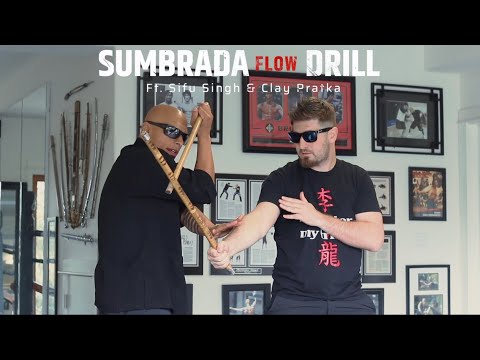
Learn The Sumbrada Flow Drill
0
Flow Drill·Budo Brothers
Grab your safety glasses (or shades) and join Sifu Singh & Clay Pratka as they teach us the classic Sumbrada Flow Drill …
Перевод: flow drill
The Flow Drill subfamily covers continuous, partner-based training patterns in double-stick work where both practitioners cycle through predetermined sequences of attacks and defences without stopping, developing timing, reflexes, and sensitivity to the opponent's movements. [1] Flow drills are the primary training methodology in Filipino martial arts — they simulate the continuous nature of actual combat by eliminating the stop-start pattern of technique isolation, instead training the practitioner to react fluidly and maintain offensive-defensive flow. [1],[2] In double-stick flow drills, both practitioners wield two sticks and cycle through attack-block sequences that build progressively in complexity and speed. [2],[3]
Flow drills are the traditional training method of Filipino martial arts, passed down through oral tradition and physical practice in lineage-based teaching systems. [1] The drill-based training methodology allowed the arts to be preserved even during periods of colonial suppression when formal practice was banned. [2],[3]
FMA flow drills (hubud-lubud, sumbrada) develop sensitivity, timing, and reflexive counter-attacking ability by training continuous give-and-take patterns with a partner. [1]
Flow drills are a signature training method of Filipino martial arts, developing the continuous motion (flow) that distinguishes FMA from more rigid weapon arts. [1]
Flow drills are demonstrated at FMA seminars and events, and the reflexive patterns they develop are applied in WEKAF sparring competition. [1]
Изображений для этой техники пока нет.
Войдите, чтобы предложить изображение.
Grab your safety glasses (or shades) and join Sifu Singh & Clay Pratka as they teach us the classic Sumbrada Flow Drill …
Учебных курсов по этой технике пока нет.
Войдите, чтобы предложить курс.
Риск травмы для человека, к которому применяется техника
Arnis/Escrima/Kali stick and blade techniques; designed for close-range lethality
Уровень мастерства, необходимый для надёжного выполнения техники
Разрешена ли техника по основным соревновательным правилам
The Filipino Martial Arts (Dan Inosanto, 1980)
Alias sources — [1] Filipino Martial Arts (Wiley, 1994) [2] Filipino Martial Arts (Wiley, 1994) [3] Filipino Martial Arts (Wiley, 1994)
Effectiveness sources — [1] Filipino Martial Arts (Wiley, 1997)
Standard katakana transliteration of Western martial arts terminology (外来語) — used in Japanese MMA, boxing, and BJJ communities
Alias sources — [1] Filipino Martial Arts (Wiley, 1994) [2] Filipino Martial Arts (Wiley, 1994) [3] Filipino Martial Arts (Wiley, 1994)
Effectiveness sources — [1] Filipino Martial Arts (Wiley, 1997)
wrist speed, hand coordination (especially double stick), cardiovascular endurance
quick hands, conditioned forearms, coordination
forearms, wrists, shoulders, core rotators
Каждое движение в любом боевом искусстве обладает рядом универсальных свойств. Комбинируйте параметры ниже, чтобы найти нужный инструмент или сравнить аналоги из разных стилей.
You step in because if you step back, the stick will smash your hand. Stepping in allows you to meet your partner's movement and create the roof block structure safely, as emphasized in the Budo Brothers sumbrada instruction.
You should work in the medium range where your hand can touch your partner's hand, as this is where counter-for-counter action and fast reflexes develop most effectively. The long-range counters are covered separately in other drills like the numerata drill, according to Budo Brothers.
It depends on the position and whether the weapons are in a closed or open stance. If you start open, a roof block doesn't make sense; instead, the response changes based on your existing positioning, as Budo Brothers explains.
When executing a drop stick, shuffle your feet back and hit your partner's stick into the ground while checking with your other hand—this prevents them from countering to your leg or exploiting an opening, as detailed in the Budo Brothers flow drill instruction.
The Flow Drill subfamily covers continuous, partner-based training patterns in double-stick work where both practitioners cycle through predetermined sequences of attacks and defences without stopping, developing timing, reflexes, and sensitivity to the opponent's movements. Flow drills are the primary training methodology in Filipino martial arts — they simulate the continuous nature of actual combat by eliminating the stop-start pattern of technique isolation, instead training the practitioner to react fluidly and maintain offensive-defensive flow.
Flow drills are the traditional training method of Filipino martial arts, passed down through oral tradition and physical practice in lineage-based teaching systems. The drill-based training methodology allowed the arts to be preserved even during periods of colonial suppression when formal practice was banned.
WEKAF: разрешён — Legal in padded stick competition; HEMA: разрешён — Legal in applicable weapon categories
Оценка опасности 8/10. Very High — Arnis/Escrima/Kali stick and blade techniques; designed for close-range lethality
Стандартная цепочка подготовки: Grip and Stance → Chamber → Strike → Recovery.
Стандартные контрприёмы: Umbrella Block — raise the stick overhead to intercept a downward strike / Cross Block — meet the incoming strike with a perpendicular block / Disarm — strip the opponent's weapon through leverage on the hand or wrist.
Распространённые варианты: Angle 1 (forehand diagonal) (downward diagonal strike from the dominant side); Angle 2 (backhand diagonal) (downward diagonal strike from the off side); Angle 5 (thrust) (straight thrust with the tip of the stick); Redonda (continuous) (flowing circular strikes chaining multiple angles).
Flow drills are demonstrated at FMA seminars and events, and the reflexive patterns they develop are applied in WEKAF sparring competition.
Основные ошибки, на которые стоит обратить внимание: Going too fast before mastering the pattern — speed must be earned through accurate repetition / Being a poor feeder — the feeder controls the drill quality; feeding too fast or inaccurately ruins the drill for bot… / Tensing up during the drill — flow requires relaxation; tension destroys timing and sensitivity / Not maintaining proper range — drifting too close or too far breaks the drill's integrity.
Flow Drill также известен как Furō Doriru, Hubad-Lubad, Sumbrada, Continuous Drill.