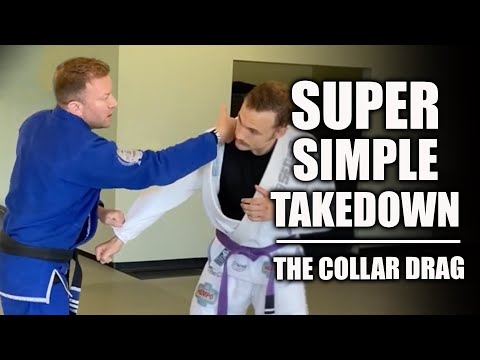
Super Simple Takedown - The Collar Drag
0
Drag Takedown·Knight Jiu-Jitsu
For a long time now, the collar drag takedown has been a favorite of mine in the gi. Once you understand the grips, entr…
Перевод: drag takedown (katakana)
The Drag Takedown family covers takedowns that use a drag-and-redirect mechanism to off-balance the opponent and pull them past the attacker's body, creating a takedown from the resulting positional advantage. [1] Unlike arm drags that pull a single arm, drag takedowns use two-on-one control (Russian tie) or similar double-grip configurations to redirect the opponent's entire upper body. [1],[2] The drag creates momentum that carries the opponent past the attacker, exposing the back or side for a takedown finish. [2] Drag takedowns are particularly effective against aggressive forward-pressuring opponents whose momentum can be redirected. [2],[3]
Drag takedowns are fundamental techniques in wrestling and MMA competition at all levels. [1]
Изображений для этой техники пока нет.
Войдите, чтобы предложить изображение.
For a long time now, the collar drag takedown has been a favorite of mine in the gi. Once you understand the grips, entr…
Учебных курсов по этой технике пока нет.
Войдите, чтобы предложить курс.
Риск травмы для человека, к которому применяется техника
Drag/snap motion for off-balancing; low impact
Уровень мастерства, необходимый для надёжного выполнения техники
Разрешена ли техника по основным соревновательным правилам
Japanese amateur wrestling terminology
Japanese amateur wrestling terminology
Standard katakana transliteration of Western martial arts terminology (外来語) — used in Japanese MMA, boxing, and BJJ communities
Standard katakana transliteration used in Japanese wrestling (レスリング)
hand speed, lateral agility, quick level change
quick hands and explosive hips
biceps, deltoids, core rotators, hip flexors
Каждое движение в любом боевом искусстве обладает рядом универсальных свойств. Комбинируйте параметры ниже, чтобы найти нужный инструмент или сравнить аналоги из разных стилей.
The Russian Tie Drag subfamily uses the Russian tie grip — a two-on-one control where both hands grip the opponent's one arm at the wrist and above the elbow — to drag the opponent past the attacker and create a takedown opportunity. [1] The Russian tie provides powerful leverage against a single arm, allowing the attacker to redirect the opponent's body by pulling that arm in the desired direction. [1,2] The drag motion pulls the opponent forward and past the attacker, typically leading to a back take, single-leg entry, or snap-down finish. [2,3]
The Two-On-One Drag subfamily uses a general two-on-one grip configuration — both hands controlling one of the opponent's arms — to execute a drag takedown, without specifically using the Russian tie hand placement. [1] Various two-on-one configurations can be used, including wrist-and-bicep, wrist-and-elbow, or wrist-and-shoulder grips, each providing slightly different leverage and control angles. [1,2] The drag mechanics are similar to the Russian tie variant: the opponent's arm is pulled across the attacker's body to redirect the opponent's balance and create an angle for takedown. [2,3]
The most common mistake is falling to your shoulder instead of facing your opponent, which gives him an easier angle to establish top position. Instead, you should throw past your opponent and sweep while staying facing him.
Keep a hold of the collar, slide through and pivot on your knee, then come up and hug the leg with your head in his ribs. From there, pick the leg up, pull him in your direction, and turn to complete the takedown, which sets you up for passes like the knee cut.
After the takedown, collapse the legs down and face inside to establish top side control position. Make sure to keep pressure on the legs to prevent guard replacement, then move up to avoid him re-establishing guard.
Once you get the collar and sleeve grip attachments, it's very difficult for your opponent to defend against, making it a very high percentage technique.
The Drag Takedown family covers takedowns that use a drag-and-redirect mechanism to off-balance the opponent and pull them past the attacker's body, creating a takedown from the resulting positional advantage. Unlike arm drags that pull a single arm, drag takedowns use two-on-one control (Russian tie) or similar double-grip configurations to redirect the opponent's entire upper body.
Drag takedowns developed from Russian wrestling traditions, where the two-on-one arm control (Russian tie) was a primary offensive tool. The technique was refined through international freestyle wrestling competition and later adopted into MMA and submission grappling.
IJF: разрешён — Legal takedown technique; IBJJF: разрешён — Legal at all belt levels, scored as takedown (2 points); UWW: разрешён — Legal in both freestyle and Greco-Roman; Unified MMA: разрешён — Legal takedown technique; ADCC: разрешён — Legal, scored 2-4 points in second half of match; FIAS Sport Sambo: разрешён — Legal — all takedowns permitted; FIAS Combat Sambo: разрешён — Legal; NCAA Folkstyle: разрешён — Legal, scored as takedown (2 points)
Оценка опасности 3/10. Moderate — drag/snap motion for off-balancing; low impact
Стандартная цепочка подготовки: Establish Contact → Create Off-Balance → Execute the Takedown → Follow to Ground.
Стандартные контрприёмы: Sprawl — drop hips back and drive weight down to stuff the takedown attempt / Underhook — establish inside position to control distance and prevent the takedown entry / Post and Circle — post on the attacker's head and circle away to break their angle / Level Change Defence — recognize the shot early and react with appropriate hip defence.
Распространённые варианты: Standing arm drag (pulling the arm across from collar tie to take an angle b…); Seated arm drag (executing from a seated guard pull position); Arm drag to back take (dragging to circle fully behind the opponent).
Drag takedowns are fundamental techniques in wrestling and MMA competition at all levels.
Основные ошибки, на которые стоит обратить внимание: Pulling the opponent toward you instead of past you — the drag creates an angle, not a collision / Standing still while dragging instead of stepping offline to create the angle / Releasing the dragged limb too early, letting the opponent recover / Not using the opponent's forward momentum — the drag is most effective against pressure.
Drag Takedown также известен как Doraggu Teikudaun, Drag, Russian Tie, Two-On-One Attack.