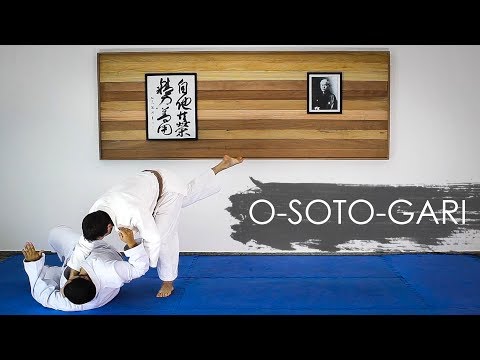
Como realizar o O-soto-gari
0
O Soto Gari Trip·Projeto Judô
O vídeo ensina a execução do O-soto-gari, golpe que faz parte das técnicas de projeção (Nage-waza), do grupo das técnica…
Перевод: major outer reap
The O Soto Gari Trip subfamily applies judo's major outer reap as a takedown, where the attacker sweeps or reaps the opponent's leg from the outside with a powerful backward leg sweep while driving the upper body in the opposite direction. [1] O soto gari is one of judo's most powerful throws, using the full length of the attacker's leg to sweep the opponent's supporting leg while simultaneously creating strong backward kuzushi (off-balancing) with the hands. [1],[2] The technique generates tremendous rotational force and can produce spectacular high-impact falls. [2] O soto gari is effective from multiple clinch configurations and is one of the most commonly scored techniques in judo competition. [2],[3]
Изображений для этой техники пока нет.
Войдите, чтобы предложить изображение.
O vídeo ensina a execução do O-soto-gari, golpe que faz parte das técnicas de projeção (Nage-waza), do grupo das técnica…
Учебных курсов по этой технике пока нет.
Войдите, чтобы предложить курс.
Риск травмы для человека, к которому применяется техника
O-Soto-Gari style; backward fall with head impact risk
Уровень мастерства, необходимый для надёжного выполнения техники
Разрешена ли техника по основным соревновательным правилам
Kodokan Judo — Official Nage-waza Classification
Traditional Judo throwing/takedown terminology (Kodokan Institute)
Official Kodokan ground technique classification system
Standard Japanese martial arts terminology (kanji/hiragana)
Established Japanese martial arts naming convention — native Japanese term (和語/漢語)
Traditional Judo throwing/takedown terminology (Kodokan Institute)
timing, balance, upper body control for push-pull
good coordination and sense of opponent's weight distribution
core stabilisers, hip adductors/abductors, calves
Каждое движение в любом боевом искусстве обладает рядом универсальных свойств. Комбинируйте параметры ниже, чтобы найти нужный инструмент или сравнить аналоги из разных стилей.
The grip depends on your preferred side; for example, if you prefer your right side, you would establish your grip accordingly before executing the technique.
Like most Naguasa techniques, O Soto Gari can be executed in three distinct stages.
The O Soto Gari Trip subfamily applies judo's major outer reap as a takedown, where the attacker sweeps or reaps the opponent's leg from the outside with a powerful backward leg sweep while driving the upper body in the opposite direction. O soto gari is one of judo's most powerful throws, using the full length of the attacker's leg to sweep the opponent's supporting leg while simultaneously creating strong backward kuzushi (off-balancing) with the hands.
O soto gari is one of the original 40 throws of judo classified by Jigoro Kano and is widely considered one of the most important and frequently used techniques in judo history. The throw has been adopted into sambo, wrestling, and MMA where it remains a potent outside trip.
IJF: разрешён — Legal (ashi-waza) — trips executed without grabbing opponent's legs are permi…; IBJJF: разрешён — Legal at all belt levels, scored as takedown (2 points); UWW: ограничен — Legal in freestyle, restricted in Greco-Roman (leg-to-leg contact prohibited); Unified MMA: разрешён — Legal takedown technique; ADCC: разрешён — Legal, scored 2-4 points in second half of match; FIAS Sport Sambo: разрешён — Legal — all takedowns permitted; FIAS Combat Sambo: разрешён — Legal; NCAA Folkstyle: разрешён — Legal, scored as takedown (2 points)
Оценка опасности 5/10. High — O-Soto-Gari style; backward fall with head impact risk
Стандартная цепочка подготовки: Establish Grip → Off-Balance (Kuzushi) → Execute the Reap/Sweep.
Стандартные контрприёмы: Sprawl — drop hips back and drive weight down to stuff the takedown attempt / Lift the Targeted Leg — raise the foot being attacked to avoid the reap or sweep / Step Over — lift the targeted leg over the sweeping limb to evade / Counter-Throw — use opponent's committed weight shift to execute a counter technique.
Распространённые варианты: Standard trip (blocking or sweeping the support leg while driving the up…); Combination trip (chaining an inside trip with an outside trip when the opp…); Counter trip (using the trip as a counter when the opponent attacks); Clinch trip (executing the trip from a tight clinch position).
O soto gari is one of the most commonly scored ippon techniques in Olympic judo and IJF World Championships. It is also widely used in sambo and MMA competition.
Основные ошибки, на которые стоит обратить внимание: Sweeping without breaking the opponent's balance backward first — they brace and counter / Standing too far away, so the sweep only catches the ankle instead of the full leg / Leaning away from the opponent during the sweep instead of driving through / Sweeping the wrong leg (the unweighted one) — always sweep the leg bearing weight.
O Soto Gari Trip также известен как O Soto Gari, Major Outer Reap, Big Outside Reap, Podnozhka Snaruzhi.