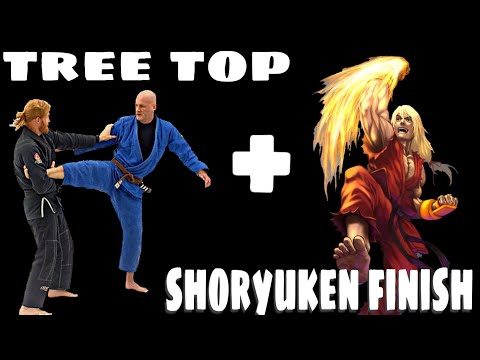
Tree Top Finish + Shoryuken Finish
0
Tree-Top Finish·Still Rolling·Added by Admin
How to finish the single leg
Перевод: tree-top finish (katakana)
The Tree-Top Finish completes the single leg by elevating the captured leg as high as possible — over the attacker's shoulder — so the opponent is balanced on one foot with their leg extended nearly vertical. [1] The extreme elevation makes balance impossible, and the opponent falls backward as their centre of gravity shifts behind the supporting foot. [1],[2] The tree-top requires significant upper body strength to elevate the leg overhead while maintaining control. [2] The finish is named for the visual image of the opponent's foot being lifted 'to the tree tops' while they topple backward. [2],[3]
The tree-top finish (also called the high-crotch lift finish) is effective because elevating the captured leg above the opponent's hip line makes it nearly impossible for them to maintain balance. [1] The technique requires the attacker to stand fully upright with the leg elevated, then use a lateral dump or forward drive to complete the takedown. [1]
The tree-top finish elevates the captured leg high above the opponent's centre of gravity, forcing them to hop backward before driving them to the mat. [1]
The tree-top finish is used in folkstyle and freestyle competition, particularly against opponents who maintain good balance on one leg. [1]
Изображений для этой техники пока нет.
Войдите, чтобы предложить изображение.
How to finish the single leg
Учебных курсов по этой технике пока нет.
Войдите, чтобы предложить курс.
Риск травмы для человека, к которому применяется техника
Single leg is one of the safest takedowns; controlled descent (John Smith methodology)
Уровень мастерства, необходимый для надёжного выполнения техники
Разрешена ли техника по основным соревновательным правилам
Japanese amateur wrestling terminology
Japanese amateur wrestling terminology
Standard katakana transliteration of Western martial arts terminology (外来語) — used in Japanese MMA, boxing, and BJJ communities
Standard katakana transliteration used in Japanese wrestling (レスリング)
penetration step speed, upper body endurance for finishing, balance
longer arms for reach, quick hips for level change
quadriceps, hip flexors, shoulders, grip/forearms
Either hand can slide down, whichever you prefer. According to Still Rolling, it doesn't matter which hand you choose to grip with—the technique works effectively either way.
Keep pressure on your opponent and maintain control up high to prevent them from grabbing you. Still Rolling emphasizes keeping grip control (behind the shoulder, front, or inner grip) while preventing them from establishing their own grips.
Step to the side, maintain pressure, and pull them down rather than trying to step in directly. Still Rolling notes that against stronger opponents with longer reach, the pulling motion is more effective than trying to control them standing up.
The Tree-Top Finish completes the single leg by elevating the captured leg as high as possible — over the attacker's shoulder — so the opponent is balanced on one foot with their leg extended nearly vertical. The extreme elevation makes balance impossible, and the opponent falls backward as their centre of gravity shifts behind the supporting foot.
The tree-top finish has been a wrestling technique for generations, valued as a high-amplitude finish that scores well in both folkstyle and freestyle competition. The dramatic elevation makes it a crowd-favourite technique in wrestling tournaments.
IJF: запрещён — Banned since 2010 leg grab prohibition — direct hansoku-make for touching opp…; IBJJF: разрешён — Legal at all belt levels, scored as takedown (2 points); UWW: ограничен — Legal in freestyle (2-4 points), banned in Greco-Roman (no attacks below waist); Unified MMA: разрешён — Legal takedown technique; ADCC: разрешён — Legal, scored 2-4 points in second half of match; FIAS Sport Sambo: разрешён — Legal — all takedowns permitted; FIAS Combat Sambo: разрешён — Legal; NCAA Folkstyle: разрешён — Legal, scored as takedown (2 points)
Оценка опасности 3/10. Moderate — single leg is one of the safest takedowns; controlled descent (John Smith methodology)
Стандартная цепочка подготовки: Establish Contact → Create Off-Balance → Execute the Takedown → Follow to Ground.
Стандартные контрприёмы: Sprawl — drop hips back and drive weight down to stuff the takedown attempt / Underhook — establish inside position to control distance and prevent the takedown entry / Post and Circle — post on the attacker's head and circle away to break their angle / Level Change Defence — recognize the shot early and react with appropriate hip defence.
Распространённые варианты: Inside single (shooting to the inside of the lead leg, head inside position); Outside single (attacking from the outside of the lead leg); High crotch (securing the thigh above the knee with head in the hip); Low single (attacking the ankle from outside range without deep penet…).
The tree-top finish is used in folkstyle and freestyle competition, particularly against opponents who maintain good balance on one leg.
Основные ошибки, на которые стоит обратить внимание: Not elevating high enough — a half-tree-top with the leg at waist height is easy to defend / Losing your own balance because your base is too narrow while holding the elevated leg / Letting the opponent grab your head or body from the tree-top position for a counter / Taking too long to finish from the top position — push them over before they adjust.
Tree-Top Finish также известен как Tsurī Toppu Finisshu, Tree Top, High Elevation Finish, Over-The-Shoulder Single.