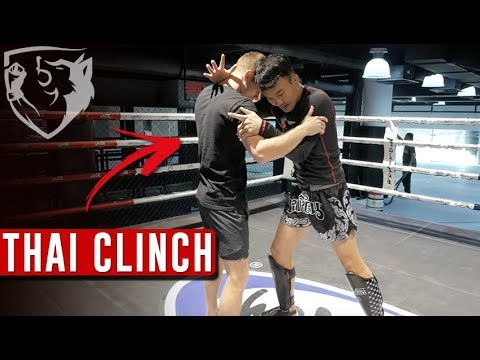
Dominate the Muay Thai Clinch with Petchboonchu
0
From Clinch·fightTIPS·Added by Admin
Train with me in Singapore►http://bit.ly/FightTIPSinSingapore I had the honor of taking a private training lesson with P…
Перевод: from clinch
The radial deviation wrist lock from the clinch applies sideways pressure to the wrist — bending it toward the thumb side (radial deviation) — while standing in a clinch position. [1],[2] The attacker isolates the opponent's wrist during a clinch exchange, then applies lateral force to deviate the wrist beyond its natural radial range of motion. [1] The clinch provides body-to-body contact that prevents the opponent from simply pulling away, making the wrist lock more controllable than from distance. [1] This is a quick, opportunistic attack during standing grappling exchanges. [1],[2]
Clinch submissions exploit the close-range tie-up to attack with standing guillotines, arm-in chokes, and neck cranks. [1]
Clinch submissions derive from judo standing submissions and catch wrestling. [1]
Standing guillotine chokes from the clinch are among the most common submissions in MMA competition. [1]
Изображений для этой техники пока нет.
Войдите, чтобы предложить изображение.
Train with me in Singapore►http://bit.ly/FightTIPSinSingapore I had the honor of taking a private training lesson with P…
In this video we go through the different clinch positions in EA Sports UFC 5 and how to transition between them. We als…
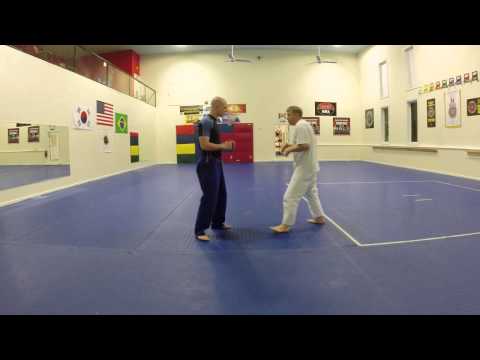
These are two fundamental self defense takedowns from the Clinch
From clinch, wrist-lock via radial deviation represents a specialized submission category that requires establishing and maintaining a controlling clinch position before executing the joint-lock. The instructors collectively emphasize that successful clinch control depends on positional dominance—hands inside on the triceps or back of the head, squared hips, bent knees, and a lowered center of gravity. FightTIPS highlights the constant hand-fighting dynamic of clinch exchanges, demonstrating how grips shift between inside and outside arm control, with particular attention to the mechanics of the steering wheel grip (triceps control) and head positioning. Royal Marsh Jiu-Jitsu stresses the importance of full-body connection—shoulder to hip line contact—to prevent the opponent from creating distance or escaping, and emphasizes that clinch maintenance is fundamental before transitioning to takedowns. Both instructors note that wrist and arm positioning emerge naturally from these controlling positions: the opponent's trapped arm configuration during head control or body lock setups creates mechanical vulnerability at the wrist joint. IC4Games provides game-context mechanics that parallel real clinch dynamics, showing how positional transitions between single collar, tie, over-under, and back clinch create different submission opportunities. The synthesis suggests that radial-deviation wrist-locks from clinch operate as opportunistic techniques arising when the clincher has achieved superior arm control and can manipulate the opponent's wrist orientation—particularly when one arm is pinned or extended during defensive posturing.
Сформировано на основе 3 инструкторов
Учебных курсов по этой технике пока нет.
Войдите, чтобы предложить курс.
Риск травмы для человека, к которому применяется техника
Wrist lock variant targeting carpal and radioulnar joints through forced deviation or torsion
Уровень мастерства, необходимый для надёжного выполнения техники
Разрешена ли техника по основным соревновательным правилам
Japanese martial arts anatomical terminology
Japanese martial arts anatomical terminology
Standard katakana transliteration of Western martial arts terminology (外来語) — used in Japanese MMA, boxing, and BJJ communities
Japanese terminology sourced from Japanese martial arts anatomical terminology
fine motor control, grip sensitivity, quick hand transitions
dexterous hands with strong fingers
forearm flexors and extensors, intrinsic hand muscles
Get your arms on the inside and grab the triceps in the steering wheel position, or grab the back of the head instead of the neck for more control. According to fightTIPS, grabbing the back of the head gives you better leverage than the back of the neck.
Use a wider stance slightly more than hip-width apart, bend your knees to lower your center of gravity, and keep your hips square to your opponent. Turning or twisting gives your opponent dominant angles and the ability to break your posture.
Think of a recycling sign: pull down on the head, lift on the arm, and bump with the knee. Timing is critical—step in to block the opponent's knee as they throw it to knock them off balance for the dump.
Create a complete line of contact from your shoulder down to your hip rather than just isolated points of contact, which are easier to break. Lock your hands with a gable grip, ball of hook grip, or S grip depending on body type and preference.
The radial deviation wrist lock from the clinch applies sideways pressure to the wrist — bending it toward the thumb side (radial deviation) — while standing in a clinch position. The attacker isolates the opponent's wrist during a clinch exchange, then applies lateral force to deviate the wrist beyond its natural radial range of motion.
Radial deviation wrist locks from standing clinch positions appear in aikido (kote-gaeshi elements), traditional jujutsu, and self-defense systems. The clinch-specific application was developed in BJJ and MMA where standing wrist attacks occur during grip fighting.
IBJJF: разрешён — Legal at all belt levels; IJF: запрещён — Only elbow joint locks (kansetsu-waza) permitted in judo — all other joint lo…; ADCC: разрешён — Legal — all submissions legal in ADCC; Unified MMA: разрешён — Legal submission technique; FIAS Sport Sambo: разрешён — Legal; FIAS Combat Sambo: разрешён — Legal
Оценка опасности 5/10. Wrist lock variant targeting carpal and radioulnar joints through forced deviation or torsion
Стандартная цепочка подготовки: Establish Position → Create the Threat → Secure the Hold → Finish.
Стандартные контрприёмы: Early Recognition — identify the submission attempt early and begin defence immediately / Posture and Base — maintain strong posture and base to prevent submission setups / Grip Fight — deny the attacker their preferred gripping configuration.
Распространённые варианты: Standard wrist lock (kote gaeshi) (two-handed rotational lock on the wrist); Gooseneck wrist lock (flexion lock bending the wrist down toward the forearm); Standing wrist lock (applied during grip fighting or a standing exchange); Ground wrist lock (catching the opponent's posted hand from mount, side cont…).
Standing guillotine chokes from the clinch are among the most common submissions in MMA competition.
Основные ошибки, на которые стоит обратить внимание: Using pain compliance from clinch without a takedown or transition plan — the pain should create openings for the nex… / Leaning your weight into the opponent without maintaining base — you become vulnerable to counter-throws and trips / Applying trachea pressure in training — throat strikes and pressure are dangerous and should only be simulated lightl… / Using clinch pain compliance as stalling — referees may break the clinch if no technique follows the control.
From Clinch также известен как Kurinchi kara, Clinch Radial Wrist Lock, Standing Radial Deviation Lock.