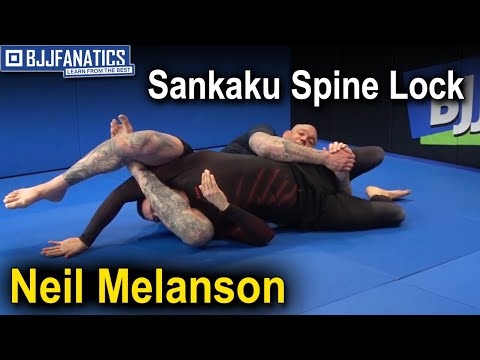
Sankaku Spine Lock by Neil Melanson
0
Spine Lock·BJJ Fanatics
SANKAKU SPINE LOCK BY NEIL MELANSON // In this Jiu JItsu Moves video, Neil Melanson teaches the Sankaku Spine Lock tech…
Перевод: spine lock
Spine locks target the vertebral column — cervical, thoracic, or lumbar spine — by applying compression, torsion, or hyperextension forces to the spinal segments. [1],[2] These are among the most dangerous submission techniques because the spinal cord and nerve roots are directly at risk; structural damage to the spine can cause paralysis or death. Spine locks include the twister (lateral spinal rotation), can opener (cervical compression), Boston crab (lumbar hyperextension), and various neck cranks that primarily target vertebral structures. [3] Due to extreme injury risk, spine locks are heavily restricted in competition: IBJJF prohibits cervical locks at all levels; judo prohibits all spinal attacks; ADCC and MMA permit some spine lock variations. [4],[5] Spine locks applied by slamming or spiking are universally prohibited.
Spinal manipulation techniques appear in classical jujutsu (koryu), including schools such as Takenouchi-ryū and Fusen-ryū, where they were studied as part of battlefield combat systems. [1],[2],[3] In catch wrestling, spine-based submissions (Boston crab, camel clutch) were standard professional wrestling holds before professional wrestling transitioned to entertainment. The twister, developed by Eddie Bravo from wrestling's guillotine ride, is the most prominent modern spine lock in competitive grappling. [4],[5] The extreme danger of spine locks has led to their progressive restriction across competition rule sets.
Spine locks appear in catch wrestling, sambo, and were codified in various submission grappling curricula. [1]
Spine locks are legal in MMA and some submission grappling formats. [1]
Изображений для этой техники пока нет.
Войдите, чтобы предложить изображение.
SANKAKU SPINE LOCK BY NEIL MELANSON // In this Jiu JItsu Moves video, Neil Melanson teaches the Sankaku Spine Lock tech…
Учебных курсов по этой технике пока нет.
Войдите, чтобы предложить курс.
Риск травмы для человека, к которому применяется техника
Spinal locks carry extreme risk of permanent neurological damage; twisting or compressing the vertebral column
Уровень мастерства, необходимый для надёжного выполнения техники
Разрешена ли техника по основным соревновательным правилам
Koryu Jujutsu — Takenouchi-ryu, Fusen-ryu
Japanese terminology sourced from Koryu Jujutsu — Takenouchi-ryu, Fusen-ryu
Classical schools: Tenjin Shin'yo-ryu, Takenouchi-ryu, etc.
Classical ground-fighting jujutsu school
Standard Japanese martial arts terminology (kanji/hiragana)
Established Japanese martial arts naming convention — native Japanese term (和語/漢語)
Japanese terminology sourced from Koryu Jujutsu — Takenouchi-ryu, Fusen-ryu
grip strength, joint isolation ability, positional control
strong forearms and stable base
forearm flexors, core stabilisers, hip muscles for base
Каждое движение в любом боевом искусстве обладает рядом универсальных свойств. Комбинируйте параметры ниже, чтобы найти нужный инструмент или сравнить аналоги из разных стилей.
Spine compression locks apply axial compression or stacking force to the vertebral column, compressing the intervertebral discs and stressing the spinal ligaments. [1] Common examples include the Boston crab (lumbar hyperextension), stacking an opponent in guard until spinal compression occurs, and various body fold techniques. These are extremely dangerous due to proximity to the spinal cord. [2,3]
Spine cranks apply rotational or lateral bending force to the vertebral column, twisting or side-bending the spine beyond its normal range. [1,2] The twister (lateral rotation of the thoracolumbar spine) is the most famous spine crank. Other spine cranks include the banana split (hip and spine abduction) and various torture-rack-style submissions from back control. [3,4,5]
Spinal locks are among the most restricted submissions in competition — banned at most levels in IBJJF and restricted in many MMA jurisdictions. The Twister (spinal rotation) and Boston Crab (spinal extension) are the primary spine lock families. (IBJJF Rules v6.0)
According to Neil Melanson, establish a triangle arm lock, then use a two-on-one grip on the same-side leg and pull your opponent off to the side by lifting it—once they're tilted to the side, you can execute the spine lock.
Neil Melanson emphasizes that you must prevent your feet from being elevated or shoved onto your opponent's hip, as this compromises the lock's position and effectiveness.
Spine locks target the vertebral column — cervical, thoracic, or lumbar spine — by applying compression, torsion, or hyperextension forces to the spinal segments. These are among the most dangerous submission techniques because the spinal cord and nerve roots are directly at risk; structural damage to the spine can cause paralysis or death.
Spinal manipulation techniques appear in classical jujutsu (koryu), including schools such as Takenouchi-ryū and Fusen-ryū, where they were studied as part of battlefield combat systems. In catch wrestling, spine-based submissions (Boston crab, camel clutch) were standard professional wrestling holds before professional wrestling transitioned to entertainment.
IBJJF: разрешён — Legal at all belt levels; IJF: запрещён — Only elbow joint locks (kansetsu-waza) permitted in judo — all other joint lo…; ADCC: разрешён — Legal — all submissions legal in ADCC; Unified MMA: разрешён — Legal submission technique; FIAS Sport Sambo: разрешён — Legal; FIAS Combat Sambo: разрешён — Legal
Оценка опасности 9/10. Spinal locks carry extreme risk of permanent neurological damage; twisting or compressing the vertebral column
Стандартная цепочка подготовки: Establish Position → Create the Threat → Secure the Hold → Finish.
Стандартные контрприёмы: Early Recognition — identify the submission attempt early and begin defence immediately / Posture and Base — maintain strong posture and base to prevent submission setups / Grip Fight — deny the attacker their preferred gripping configuration.
Распространённые варианты: Standard variation (primary grip configuration and finishing angle); Gi variation (using the gi material for grip assistance and control); No-gi variation (adapted grips for submission grappling without the gi); Transition variation (applied during a positional change or scramble).
Spine locks are legal in MMA and some submission grappling formats.
Основные ошибки, на которые стоит обратить внимание: Applying spine locks in training at any significant intensity — the spine is irreplaceable; even moderate spine lock … / Not knowing competition rules — spine locks are illegal in many rule sets; know what's allowed before competing / Using spine cranks as primary attacks — they are high-risk techniques with serious ethical implications; use them onl… / Applying without positional dominance — spine locks require total body control; the opponent must be immobilised befo….
Spine Lock также известен как Sekitsui Kansetsu-waza, Spinal Lock, Seobone-kansetsu, Back Lock.