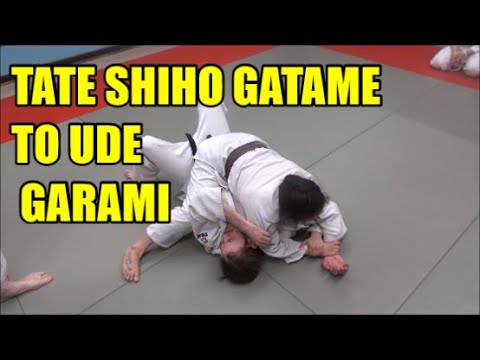
TATE SHIHO GATAME TO UDE GARAMI Pin and Armlock
0
Hiza-Gatame From Standing·welcomematstevescott
This video shows how to apply Tate Shiho Gatame (vertical 4 Corner Hold) and finish your opponent with Ude Garami (Arm E…
Перевод: knee hold from standing
Hiza-gatame from standing is a standing armbar where the attacker uses the knee as the fulcrum point against the back of the opponent's elbow, pulling the wrist downward while driving the knee upward to hyperextend the joint. [1],[2] The knee provides a sharp, focused pressure point that makes this one of the most efficient standing arm locks in terms of force generation relative to effort. [1] The attacker typically secures the technique from a wrist control or arm-drag position where the opponent's arm is already extended. [1],[2]
Hiza-gatame (膝固, knee hold) is a Kodokan judo kansetsu-waza using the knee as the fulcrum for standing elbow hyperextension. [1],[2] The technique is found across multiple Japanese martial arts including aikido, where it is applied as part of the standing joint lock curriculum. [1] In law enforcement and military combatives, hiza-gatame provides a rapid standing arm-break option that can be applied from a clinch or arm-control position without going to the ground. [1],[2]
Standing hiza-gatame applies the knee armlock from an upright position, typically during a scramble. [1]
Standing hiza-gatame is part of judo's tachi-waza armlock system. [1]
Standing hiza-gatame occasionally appears in judo competition. [1]
Изображений для этой техники пока нет.
Войдите, чтобы предложить изображение.
This video shows how to apply Tate Shiho Gatame (vertical 4 Corner Hold) and finish your opponent with Ude Garami (Arm E…
http://www.silverstranddojo.com/ This video is an instructional video that deals with Hiza hishigi juji gatame of juj…
Hiza-gatame from standing, as taught in these instructional contexts, represents a transition from a top control position (tate shiho gatame) into an arm lock submission. According to welcomematstevescott, the technique emphasizes maintaining positional control before executing the submission. The practitioner first establishes a stable base by posting with the legs while keeping the opponent's head controlled to prevent escape; premature lifting of the opponent's arm creates opportunities for escape. The submission itself—termed ude garami (arm lock)—is set up by sliding across the opponent's body after securing the wrist, with weight shifted to maintain stability throughout the transition. The instructor stresses that control should remain intimate with the opponent's body to execute the lock effectively. The broader context involves holding the opponent on their back or backside for 20 seconds (per judo rules) while simultaneously setting up the submission, making the pin both a time-based hold and a positioning device for the finish. Gene Silverstrand's video provides visual demonstration of the technique but lacks detailed verbal instruction in the available transcript. Both instructors implicitly agree on the importance of maintaining contact and control during the transition from standing position into the arm lock.
Сформировано на основе 2 инструкторов
Учебных курсов по этой технике пока нет.
Войдите, чтобы предложить курс.
Риск травмы для человека, к которому применяется техника
Hiza-gatame (knee armlock) uses the knee as a fulcrum point against the elbow
Уровень мастерства, необходимый для надёжного выполнения техники
Разрешена ли техника по основным соревновательным правилам
Kodokan Judo — Official Katame-waza Classification
Kodokan hiza-gatame + positional modifier
Standard Japanese martial arts terminology (kanji/hiragana)
Established Japanese martial arts naming convention — native Japanese term (和語/漢語)
Kodokan hiza-gatame + positional modifier
hip flexibility, hip bridge power, leg clamping strength
long legs for controlling the opponent's torso
hip extensors (glutes), adductors, quadriceps, hamstrings
Standing hiza gatame applies the knee arm lock while standing — the attacker places their knee against the opponent's extended elbow and applies leverage. Quick application from standing exchanges. (Kano, Kodokan Judo)
Keep continuous contact with the arm and trap it quickly without lifting it too high, which gives your opponent a chance to escape. Welcome Mat Steve Scott emphasizes maintaining this connection throughout the transition to prevent them from getting out.
Shift your weight and post with your legs strategically—posting on one side during the pin and then posting on the other side as you slide across to form the armlock. This weight transfer helps you maintain control and apply pressure effectively.
Hiza-gatame from standing is a standing armbar where the attacker uses the knee as the fulcrum point against the back of the opponent's elbow, pulling the wrist downward while driving the knee upward to hyperextend the joint. The knee provides a sharp, focused pressure point that makes this one of the most efficient standing arm locks in terms of force generation relative to effort.
Hiza-gatame (膝固, knee hold) is a Kodokan judo kansetsu-waza using the knee as the fulcrum for standing elbow hyperextension. The technique is found across multiple Japanese martial arts including aikido, where it is applied as part of the standing joint lock curriculum.
IBJJF: разрешён — Legal at all belt levels; IJF: запрещён — Only elbow joint locks (kansetsu-waza) permitted in judo — all other joint lo…; ADCC: разрешён — Legal — all submissions legal in ADCC; Unified MMA: разрешён — Legal submission technique; FIAS Sport Sambo: разрешён — Legal; FIAS Combat Sambo: разрешён — Legal
Оценка опасности 7/10. Hiza-gatame (knee armlock) uses the knee as a fulcrum point against the elbow
Стандартная цепочка подготовки: Control the Arm → Position the Hips → Pinch Knees → Extend for the Finish.
Стандартные контрприёмы: Clasp Hands — grip own wrist to prevent arm extension / Stack — drive forward to compress the attacker and relieve elbow pressure / Hitchhiker Escape — rotate the thumb toward the mat and roll to extract the arm.
Распространённые варианты: Standard armbar (hips drive upward against the extended arm with legs clam…); Belly-down armbar (rolling to face the mat to prevent the opponent from stac…); S-mount armbar (transitioned from S-mount position for tighter control be…); Spinning armbar (rapid pivot from guard or side to catch the arm during tr…).
Standing hiza-gatame occasionally appears in judo competition.
Основные ошибки, на которые стоит обратить внимание: Dropping the knee without wrist control — the arm will retract if the wrist isn't secured first / Missing the elbow joint with the knee — the drop must be precise; the knee on the upper arm or forearm doesn't create… / Dropping too hard — controlled weight placement is better than a wild knee drop that misses or injures / Not transitioning when the opponent pulls the arm away — if the arm retracts, flow to the next technique; don't chase.
Hiza-Gatame From Standing также известен как Hiza-gatame (Tachi kara), Standing Hiza-Gatame, Standing Knee Armlock.