Maximize Your Scissor Sweep: Hiza Garuma and Sumi Gaeshi to the Rescue (BJJ/Jiu-Jitsu)
0
Hiza-Gatame·Brian Glick
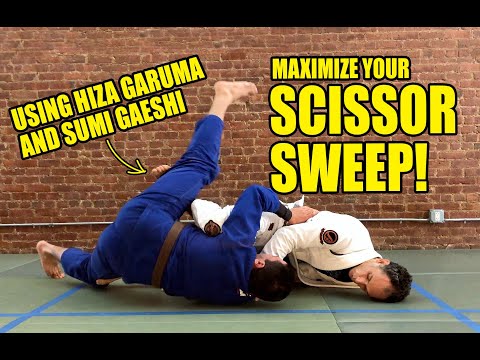
Hiza garuma is most commonly seen as a high-amplitude takedown in judo, but we can make perfect use of it down on the gr…
Перевод: knee hold
Hiza-gatame (膝固め, 'knee hold') is an elbow lock where the attacker uses the knee as a fulcrum against the back of the opponent's elbow while controlling the wrist to hyperextend the joint. [1],[2] The attacker places their knee against the back of the extended elbow and pulls the wrist toward themselves, creating a lever action with the knee as the pivot point. [1] Hiza-gatame can be applied from guard or when the opponent posts an arm, using the knee's precise positioning to target the elbow joint efficiently. [1],[3]
Hiza-gatame is a recognized Kodokan Judo kansetsu-waza where the knee serves as the fulcrum for elbow hyperextension. [2],[3] Like other judo arm locks named for their fulcrum body part, hiza-gatame reflects systematic classification principles. [2] The technique has practical applications in self-defense and law enforcement arm control. [1]
Hiza-gatame (knee armlock) uses the knee as a fulcrum against the opponent's elbow for a straight armlock. [1]
Hiza-gatame is a classical judo armlock in the Kodokan system. [1]
Hiza-gatame is used in judo and BJJ competition as an armlock variation. [1]
Изображений для этой техники пока нет.
Войдите, чтобы предложить изображение.
Hiza garuma is most commonly seen as a high-amplitude takedown in judo, but we can make perfect use of it down on the gr…
One of many Attacks from Guard: Bottom; This is a straightforward approach that's relatively easy to recall and retain …
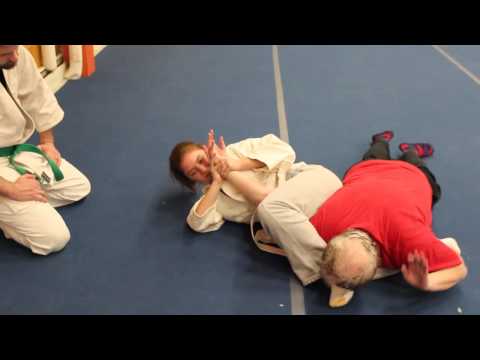
Hiza Gatame (Arm Bar) Newaza Technique as demonstrated by Sensai Bob @ The Tohkon Judo Academy of Chicago.
Hiza-gatame is an elbow lock submission applied primarily from guard position, where the practitioner uses their foot to apply pressure to the opponent's elbow while controlling the arm with their hands. WINNING emphasizes precise foot placement on the thigh rather than the knee, with the sole of the foot maintaining contact with the mat to prevent the opponent from stepping over it. The instructor stresses that the lock requires continuous control—if the opponent escapes or lifts their leg, the practitioner must immediately reapply pressure. WINNING notes the lock's mechanics: the foot on the hip combined with hand pressure pulling the arm prevents escape, and the opponent's instinctive response to push their hand inward actually worsens their position. The lock can be achieved from multiple positions beyond the formal kata sequence, including from both players on their knees. Rob Jackson presents a modified version leading into reverse juji-gatame, demonstrating the technique's utility as a transitional submission. Brian Glick's material focuses on hiza-guruma (knee wheel), a related but distinct sweeping technique from guard that uses foot placement on the knee to destabilize the opponent's base. While Glick's content emphasizes the sweep variation rather than the submission lock, it illustrates the foundational principle of strategic foot positioning on the leg. All instructors agree on the importance of maintaining control and recognizing when repositioning is necessary.
Сформировано на основе 3 инструкторов
Учебных курсов по этой технике пока нет.
Войдите, чтобы предложить курс.
Риск травмы для человека, к которому применяется техника
Hiza-gatame (knee armlock) uses the knee as a fulcrum point against the elbow
Уровень мастерства, необходимый для надёжного выполнения техники
Разрешена ли техника по основным соревновательным правилам
Kodokan Judo — Official Katame-waza Classification
Kodokan — Hiza-gatame (膝固め) classification
Standard Japanese martial arts terminology (kanji/hiragana)
Established Japanese martial arts naming convention — native Japanese term (和語/漢語)
Kodokan — Hiza-gatame (膝固め) classification
fine motor control, grip sensitivity, quick hand transitions
dexterous hands with strong fingers
forearm flexors and extensors, intrinsic hand muscles
Каждое движение в любом боевом искусстве обладает рядом универсальных свойств. Комбинируйте параметры ниже, чтобы найти нужный инструмент или сравнить аналоги из разных стилей.
Hiza gatame (knee arm lock) is a Kodokan judo arm lock where the attacker uses their knee as the fulcrum against the opponent's elbow. One of the nine official kansetsu-waza. The knee provides a hard, precise fulcrum. (Kano, Kodokan Judo)
Controlling the hand and foot prevents your opponent from escaping by pushing away or moving their base. As explained in the WINNING instructional, keeping these points controlled removes their options to push your foot down or come across it to escape.
Your opponent can try to push your foot down with their arm and come across it, or they can crowd in to prevent you from fully establishing the position. If they feel the lock coming, they may also grab something to create control or sit out to create distance.
Brian Glick emphasizes that you must pull and drive your opponent's head over your knee with your hand—simply using leg force alone is very difficult. You should also turn your belly toward the mat for balance and base as you drive them over.
Keep your collar control to prevent backward movement and your shin forward to prevent forward movement, then use your shin as a counter-force against your partner's side to drive them down. Prop on your elbow and draw their hand back while bringing your head to the same height as theirs.
Hiza-gatame (膝固め, 'knee hold') is an elbow lock where the attacker uses the knee as a fulcrum against the back of the opponent's elbow while controlling the wrist to hyperextend the joint. The attacker places their knee against the back of the extended elbow and pulls the wrist toward themselves, creating a lever action with the knee as the pivot point.
Hiza-gatame is a recognized Kodokan Judo kansetsu-waza where the knee serves as the fulcrum for elbow hyperextension. Like other judo arm locks named for their fulcrum body part, hiza-gatame reflects systematic classification principles.
IBJJF: разрешён — Legal at all belt levels; IJF: запрещён — Only elbow joint locks (kansetsu-waza) permitted in judo — all other joint lo…; ADCC: разрешён — Legal — all submissions legal in ADCC; Unified MMA: разрешён — Legal submission technique; FIAS Sport Sambo: разрешён — Legal; FIAS Combat Sambo: разрешён — Legal
Оценка опасности 7/10. Hiza-gatame (knee armlock) uses the knee as a fulcrum point against the elbow
Стандартная цепочка подготовки: Control the Arm → Position the Hips → Pinch Knees → Extend for the Finish.
Стандартные контрприёмы: Clasp Hands — grip own wrist to prevent arm extension / Stack — drive forward to compress the attacker and relieve elbow pressure / Hitchhiker Escape — rotate the thumb toward the mat and roll to extract the arm.
Распространённые варианты: Standard wrist lock (kote gaeshi) (two-handed rotational lock on the wrist); Gooseneck wrist lock (flexion lock bending the wrist down toward the forearm); Standing wrist lock (applied during grip fighting or a standing exchange); Ground wrist lock (catching the opponent's posted hand from mount, side cont…).
Hiza-gatame is used in judo and BJJ competition as an armlock variation.
Основные ошибки, на которые стоит обратить внимание: Placing the knee on the wrong part of the arm — the knee must press directly behind the elbow joint; too high or too … / Not pulling the wrist while pressing the knee — both forces must work simultaneously; the wrist pulls up while the kn… / Using insufficient knee pressure — commit body weight through the knee; light pressure allows the opponent to retract… / Not controlling the opponent's body — they will roll or turn to escape; control the shoulder or head with the free hand.
Hiza-Gatame также известен как Hiza-gatame, Knee Armlock, Knee-Pin Armbar, Knee Arm Lock.