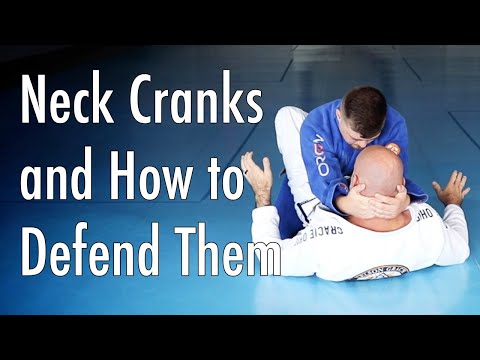
Neck Cranks and How to Defend Them
0
Arm Cranks·Gracie Ohio Jiu-Jitsu Academy
In this video we discuss the importance of understanding neck cranks and how to defend them. In modern jiu-jitsu it's al…
Перевод: arm cranks
Arm cranks apply rotational or torsional force along the axis of the arm — twisting the humerus, forearm, or both in ways that stress the shoulder capsule, elbow ligaments, and surrounding musculature. [1],[2] Unlike linear joint locks (which hyperextend or hyperrotate a single joint), arm cranks apply multi-directional torque that can simultaneously stress the shoulder, elbow, and wrist joints. Common arm cranks include the Americana (ude-garami) applied with outward rotation, standing arm twists, and various rotational attacks from wrist control. Arm cranks are generally legal in most competition formats, as they primarily target the shoulder and elbow rather than the cervical spine. [3]
Arm-twisting techniques (hineri-waza) are documented in classical Japanese jujutsu schools. [1],[2] The Americana (ude-garami, 腕絡み) — a keylock that outwardly rotates the shoulder — is one of the most fundamental arm cranks, named after the technique's association with American catch wrestling when it was introduced to Brazilian grappling circles. [3] In catch wrestling, arm-twisting holds (double wristlocks, hammerlock variations) were standard finishing techniques in professional competition.
Arm cranks apply rotational or twisting force to the arm joints, attacking the shoulder, elbow, or wrist through non-standard angles. [1]
Arm cranks appear in catch wrestling, jūjutsu, and were adopted into submission grappling. [1]
Arm cranks are used in submission grappling and MMA where they are permitted. [1]
Изображений для этой техники пока нет.
Войдите, чтобы предложить изображение.
In this video we discuss the importance of understanding neck cranks and how to defend them. In modern jiu-jitsu it's al…
Учебных курсов по этой технике пока нет.
Войдите, чтобы предложить курс.
Риск травмы для человека, к которому применяется техника
Arm cranks use rotational force on the elbow or shoulder outside normal range of motion
Уровень мастерства, необходимый для надёжного выполнения техники
Разрешена ли техника по основным соревновательным правилам
Japanese MMA/BJJ standard terminology
Japanese MMA/BJJ standard terminology
Standard Japanese martial arts terminology (kanji/hiragana)
Established Japanese martial arts naming convention — native Japanese term (和語/漢語)
Japanese terminology sourced from Japanese MMA/BJJ standard terminology
top position control, wrist and forearm strength
heavier upper body for pinning
forearm flexors, deltoids, pectorals, core stabilisers
The most important principle is not letting your neck get wrapped in the first place. As soon as you feel or sense your opponent reaching toward your neck, swim both hands inside to prevent them from establishing control. Keep your hands on the inside to maintain sensitivity and defend against the attack before it fully develops.
Control your own spine and stay flat—never allow your opponent to control your positioning. If they get hold of your head, swim inside and cut the angle to escape. The key is maintaining control of your spine so they cannot apply leverage for the crank.
Neck cranks can be very devastating, especially when your opponent is bigger and stronger than you. If you're not training defense against them, they become a serious problem. Modern sport jiu-jitsu doesn't allow neck cranks, but you still need to know how to defend them for real-world self-defense situations.
Keeping your hands inside is safer for developing good jiu-jitsu, especially against larger opponents, because it helps you develop neck sensitivity and prevents your head from being wrapped. While underhooks can help force escapes in competition, staying inside prioritizes safety and survival over technique.
Arm cranks apply rotational or torsional force along the axis of the arm — twisting the humerus, forearm, or both in ways that stress the shoulder capsule, elbow ligaments, and surrounding musculature. Unlike linear joint locks (which hyperextend or hyperrotate a single joint), arm cranks apply multi-directional torque that can simultaneously stress the shoulder, elbow, and wrist joints.
Arm-twisting techniques (hineri-waza) are documented in classical Japanese jujutsu schools. The Americana (ude-garami, 腕絡み) — a keylock that outwardly rotates the shoulder — is one of the most fundamental arm cranks, named after the technique's association with American catch wrestling when it was introduced to Brazilian grappling circles.
IBJJF: запрещён — Neck cranks and spinal locks prohibited at all belt levels; IJF: запрещён — Spinal locks and neck cranks prohibited; ADCC: разрешён — Legal — neck cranks and spinal locks permitted; Unified MMA: разрешён — Legal; FIAS Sport Sambo: запрещён — Twisting of cervical spine prohibited; FIAS Combat Sambo: разрешён — Legal
Оценка опасности 7/10. Arm cranks use rotational force on the elbow or shoulder outside normal range of motion
Стандартная цепочка подготовки: Control the Arm → Position the Hips → Pinch Knees → Extend for the Finish.
Стандартные контрприёмы: Clasp Hands — grip own wrist to prevent arm extension / Stack — drive forward to compress the attacker and relieve elbow pressure / Hitchhiker Escape — rotate the thumb toward the mat and roll to extract the arm.
Распространённые варианты: Standard Americana (figure-four grip painting the wrist toward the mat in ext…); Deep Americana (driving the arm further down the mat for increased rotation); Mounted Americana (applied from mount for gravity-assisted pressure); Transition to armbar (using the Americana attempt to bait the opponent into ext…).
Arm cranks are used in submission grappling and MMA where they are permitted.
Основные ошибки, на которые стоит обратить внимание: Applying the rotation without fixing the elbow — the elbow must be pinned or controlled; a free elbow allows the oppo… / Using arm strength to crank — the rotation should come from body movement (hip rotation, posture change), not arm squ… / Not controlling the opponent's body while cranking — if the opponent can roll with the crank, the pressure dissipates / Cranking without controlling the wrist — the wrist must be secured; a free wrist allows the opponent to rotate out.
Arm Cranks также известен как Ude Hineri, Arm Twist Lock, Ude-hineri, Rotational Arm Lock.