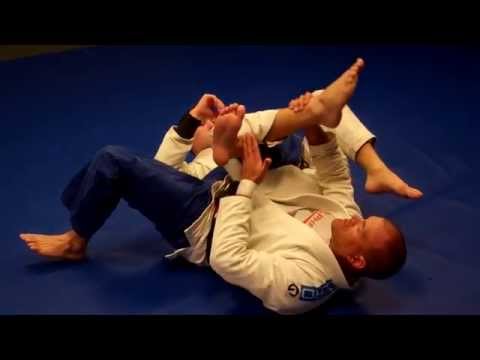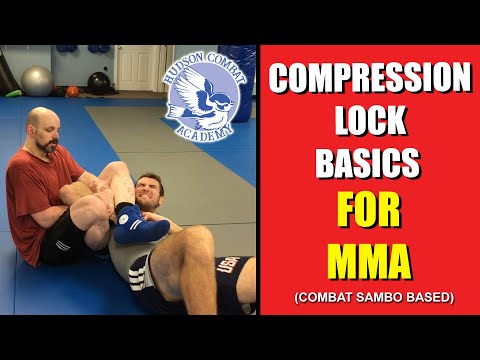
Compression Lock Basics for MMA (Combat Sambo Based)
0
Compression Lock·Hudson Combat Academy
Some basics on compression locks and knee compressions. Combat Sambo based. The Hudson Combat Academy www.HudsonCombat…
Перевод: Compression Techniques
Compression locks are submission techniques that crush muscle tissue against bone, causing intense pain through deep tissue compression rather than joint hyperextension or vascular restriction. [7] The most common compression locks target the biceps (biceps slicer/biceps crush), the calf (calf slicer/calf crush), and the forearm. The mechanism involves trapping a limb across a fulcrum — typically the attacker's shin, forearm, or wrist — and then forcing the opponent's limb to fold, wedging the fulcrum deeper into the muscle belly against the underlying bone. [9] Compression locks can also indirectly stress the adjacent joint: a biceps slicer simultaneously threatens the elbow, and a calf slicer can hyperextend the knee. [9] In competition, compression locks occupy a contested regulatory space: IBJJF rules permit the biceps slicer only at brown and black belt level and the calf slicer at brown belt and above [1]; ADCC and most no-gi events permit all compression locks; judo prohibits them entirely. In MMA under Unified Rules, compression locks are legal.
Compression locks have been practiced in various grappling traditions but were historically less codified than joint locks and chokes. In sambo, the calf slicer has been a standard competition technique since the sport's formalization in the 1930s, reflecting sambo's emphasis on leg attacks. [2],[3] Brazilian Jiu-Jitsu initially treated compression locks as secondary techniques, but their effectiveness in competition — particularly the calf slicer as a counter to the berimbolo and other inversions — has led to increased adoption since the 2010s. [8] The biceps slicer gained prominence in modern no-gi grappling as a complement to armbar attacks, used when the defender straightens the arm to escape the standard armbar. [9]
Compression locks (bicep slicers, calf slicers) crush muscle against bone, causing intense pain and potential muscle/tendon damage. [1]
Compression locks were developed in sambo and catch wrestling and adopted into BJJ. [1]
Compression locks are legal at brown/black belt in IBJJF and fully legal in ADCC and MMA. [1]
Изображений для этой техники пока нет.
Войдите, чтобы предложить изображение.
Some basics on compression locks and knee compressions. Combat Sambo based. The Hudson Combat Academy www.HudsonCombat…
This week was about the back mount. Here, we break down one of the more advanced tactics we covered in the week, the ro…
Учебных курсов по этой технике пока нет.
Войдите, чтобы предложить курс.
Риск травмы для человека, к которому применяется техника
Muscle compression causes intense pain and potential muscle tears but lower structural damage than joint locks
Уровень мастерства, необходимый для надёжного выполнения техники
Разрешена ли техника по основным соревновательным правилам
Borba Sambo — Anatoly Kharlampiev (1949)
Sambo compression lock techniques and leg attack methodology
BJJ curriculum covering compression lock applications at advanced levels
BJJ technique reference including slicer variations
Standard Japanese martial arts terminology (kanji/hiragana)
Established Japanese martial arts naming convention — native Japanese term (和語/漢語)
Sambo compression lock techniques and leg attack methodology
BJJ curriculum covering compression lock applications at advanced levels
BJJ technique reference including slicer variations
shin pressure, leg triangling ability
bony, angular shins for sharper compression
quadriceps, hamstrings, calf muscles (for leg triangle lock)
Каждое движение в любом боевом искусстве обладает рядом универсальных свойств. Комбинируйте параметры ниже, чтобы найти нужный инструмент или сравнить аналоги из разных стилей.
Arm compression techniques (biceps slicers and forearm crushes) work by trapping the opponent's arm over a fulcrum — typically the attacker's wrist, forearm, or shin — and forcing the arm to fold, crushing the biceps or forearm muscle against the underlying bone. [1,2] The biceps slicer is the most common arm compression, applied by placing a forearm or shin in the crook of the opponent's elbow and pulling the wrist to close the angle, compressing the biceps against the radius and ulna. Arm compressions can also indirectly hyperextend the elbow, making them effective combination threats with armbars. [3] In IBJJF competition, arm compressions (biceps slicers) are only legal at brown and black belt levels; in ADCC and MMA, they are unrestricted.
The calf slicer (also called calf crush or calf compression) works by placing a hard fulcrum — typically the shin or forearm — behind the opponent's knee and folding the lower leg back, crushing the calf muscle between the fulcrum and the femur. [1,2] The technique generates intense pain through deep muscle compression and can also hyperextend the knee joint. Calf slicers are commonly entered from leg entanglement positions, back control (particularly when an opponent tries to clear hooks), and as counters to berimbolo and inversion-based guard passes. [3] In IBJJF competition, calf slicers are legal only at brown belt and above; in ADCC and MMA, they are unrestricted. The calf slicer has become increasingly important in modern no-gi grappling as leg lock games have expanded.
The Spladle is a unique submission hold that originates from wrestling and functions as a compression lock/stretch submission — the attacker traps the opponent's head and one leg together, then forces the other leg apart, creating a painful split that attacks the groin, hip, and lower back. [1] In wrestling, the spladle is primarily used as a pinning combination (trapping the head and leg together while driving the opponent's shoulders to the mat), but in submission grappling and MMA, it has been adapted as a submission hold where the forced split creates enough pain and joint stress to force a tap. [1,2] The spladle is entered from front headlock position or when the opponent attempts a single-leg takedown — the attacker threads their arm between the opponent's legs to capture the far leg while maintaining head control, creating the head-and-leg trap. [2,3] While not a common submission in modern competition, the spladle has a dedicated following and has been used successfully in MMA by fighters like Ben Askren. [3]
Compression locks use bone-on-muscle pressure to create pain — bicep slicers, calf slicers, chest compression. Banned in IBJJF below brown belt. Less common than joint locks but extremely effective when applied. Bicep slicer appears in 8 passages across 2 books. (2+ books; IBJJF Rules v6.0; BJJ instructionals)
According to Hudson Combat Academy, never grab the opponent's actual foot because you cannot hold onto it—if they kick your hands or face and pull their foot back, you will always lose it.
Hudson Combat Academy advises not to try punching through it since there's too much pressure keeping you away. Instead, reach your hand through the back of the knee to create an escape or counter.
Hudson Combat Academy recommends putting your feet behind your opponent's knees and hiding them there, as this is the safest position for them to be in.
Alpha BJJ emphasizes getting your feet underneath you and counterintuitively putting your weight on your feet instead of on your opponent, which allows you to take small steps back and sink your hips over theirs for a much more solid position.
Compression locks are submission techniques that crush muscle tissue against bone, causing intense pain through deep tissue compression rather than joint hyperextension or vascular restriction. The most common compression locks target the biceps (biceps slicer/biceps crush), the calf (calf slicer/calf crush), and the forearm.
Compression locks have been practiced in various grappling traditions but were historically less codified than joint locks and chokes. In sambo, the calf slicer has been a standard competition technique since the sport's formalization in the 1930s, reflecting sambo's emphasis on leg attacks.
IBJJF: ограничен — Brown and black belt only; IJF: запрещён — Only elbow joint locks permitted in judo — compression locks prohibited; ADCC: разрешён — Legal; Unified MMA: разрешён — Legal; FIAS Sport Sambo: разрешён — Legal; FIAS Combat Sambo: разрешён — Legal
Оценка опасности 6/10. Muscle compression causes intense pain and potential muscle tears but lower structural damage than joint locks
Стандартная цепочка подготовки: Control the Arm → Position the Hips → Pinch Knees → Extend for the Finish.
Стандартные контрприёмы: Clasp Hands — grip own wrist to prevent arm extension / Stack — drive forward to compress the attacker and relieve elbow pressure / Hitchhiker Escape — rotate the thumb toward the mat and roll to extract the arm.
Распространённые варианты: Standard calf slicer (shin across the calf with triangle leg lock compressing t…); Truck calf slicer (applied from truck position after a back-take attempt); Standing calf slicer (trapping the calf during a scramble or guard exchange).
Compression locks are legal at brown/black belt in IBJJF and fully legal in ADCC and MMA.
Основные ошибки, на которые стоит обратить внимание: Applying compression locks explosively — the intense pain requires controlled, gradual application to allow the train… / Ignoring the joint lock threat within the compression — many compression positions also threaten the knee or elbow; b… / Not securing the position before applying compression — like all submissions, positional control precedes the finishi… / Using compression locks as primary attacks — they are most effective as transitions from failed joint locks, not as f….
Compression Lock также известен как Appaku-waza, Muscle Crush, Slicer, Compression Submission.