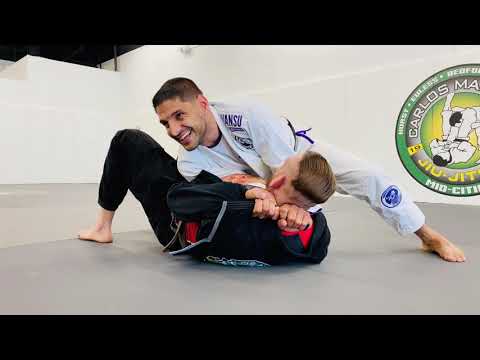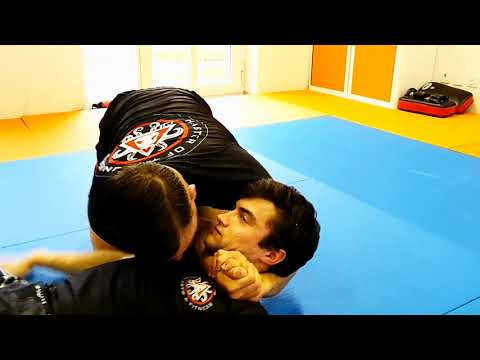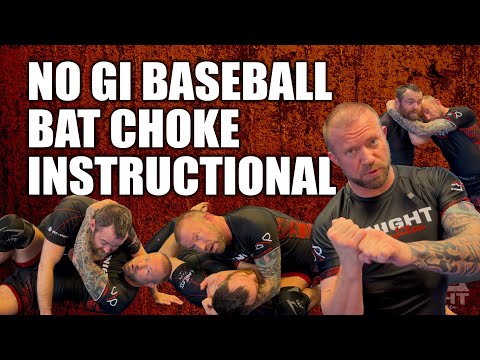
The No Gi Baseball Bat Choke Complete Guide
0
Baseball Choke·Knight Jiu-Jitsu
The No Gi Baseball Bat Choke is a powerful and deceptive choke with a variety of uses and combinations. This video shows…
Перевод: Baseball choke — named for the split grip on the collar resembling how a batter grips a baseball bat (one hand palm-up, one palm-down)
The Baseball Choke is a gi-based collar choke that uses a distinctive split grip — one hand gripping the collar palm-up and the other palm-down in opposite directions — creating a powerful rotational wringing action around the opponent's neck that compresses both carotid arteries simultaneously. [1] The name derives from the grip's resemblance to how a baseball batter holds the bat: one hand above the other with palms facing opposite directions. [1] What makes the Baseball Choke uniquely dangerous in competition is its versatility of entry: unlike most collar chokes that require a specific dominant position, the Baseball Choke can be initiated from knee-on-belly, side control, bottom half guard, and even bottom mount — and in several cases, the grip is set from a disadvantageous position but finishes after the attacker transitions to a dominant one. [1],[2] The most common and tactically significant application is the 'bottom-to-top' Baseball Choke: the attacker sets the split grip while on bottom (in half guard or during a guard pass), allows the opponent to complete the pass, and then tightens the choke as the opponent settles into side control — meaning the opponent effectively chokes themselves by advancing their position. [2],[3] This counter-intuitive mechanic — where the attacker appears to give up position to finish the choke — makes the Baseball Choke one of the most deceptive submissions in competitive BJJ. [2] Magid Hage famously won his IBJJF World Championship match in 2013 at black belt with the Baseball Choke, cementing the technique's reputation as a legitimate world-class weapon. [3]
The Baseball Choke emerged in Brazilian Jiu-Jitsu competition in the 2000s as a natural evolution of collar choke mechanics — practitioners discovered that opposing grip rotations on the collar created a uniquely powerful wringing action. [2] The technique gained widespread recognition after Magid Hage won his black belt match at the 2013 IBJJF World Championships using a Baseball Choke, demonstrating that the technique works at the absolute highest level of competition. [3] Hage became so associated with the technique that he subsequently released instructional material dedicated entirely to the Baseball Choke system. [3] The 'bottom-position trap' variant — setting grips from half guard and allowing the pass — became a significant tactical development in competition BJJ, as it transformed a typically defensive situation (being passed) into an offensive trap. [2],[3] Saulo Ribeiro included the technique in Jiu-Jitsu University (2008) as a side control attack, establishing it in the BJJ instructional canon. [1]
The Baseball Choke is one of the highest-percentage collar chokes in competitive BJJ when initiated from the bottom-position trap or knee-on-belly. [2],[3] Its primary advantage is deception: opponents frequently do not recognise the threat until the choke is already locked, because the grip setup from bottom position appears passive or even advantageous for the top player. [2] The fast onset (3-5 seconds to unconsciousness once rotated) means that even a brief moment of inattention from the opponent is sufficient to finish the choke. [3] Magid Hage's World Championship victory demonstrated that the technique is effective against the best grapplers in the world. [3] The bottom-position trap variant has added a new tactical dimension to guard passing situations: passers must now check for the split grip before committing to the pass, which slows their passing game. [2]
Magid Hage — 2013 IBJJF World Championship black belt victory via Baseball Choke || Multiple IBJJF Pan American and European Open finishes via Baseball Choke || The bottom-position trap variant has become a standard tactical weapon in competition BJJ at purple belt and above || The technique's deceptive nature has led to multiple unconscious opponents in competition who did not tap in time.
Изображений для этой техники пока нет.
Войдите, чтобы предложить изображение.
The No Gi Baseball Bat Choke is a powerful and deceptive choke with a variety of uses and combinations. This video shows…
@BernardoFariaBJJFanatics says "I Have NEVER Seen Anyone Breaking Arms Bars Using The Lapel, and It Works Very Well! Th…
Der No Gi Baseball Choke ist eine der effektivsten und gleichzeitig einfachsten Submission Techniken im BJJ Grappling un…
The baseball choke is a fundamental submission that derives its name from the gripping mechanics resembling a baseball bat swing. In the gi version, practitioners grip the collar with thumb on one side and fingers on the other, then cross the arms to apply pressure; however, instructors emphasize significant variation in no-gi execution. Knight Jiu-Jitsu's Eli details multiple grip options—gable grip, preacher grip, three-finger grip, and S-grip—noting that the S-grip (interlaced fingers in parallel palm configuration) provides optimal wrist flexibility and is his preferred method. Renzo Gracie Jiu Jitsu DFW's Professor Jason Yousef emphasizes the lapel-based approach, stressing that the grip must be deep into the shoulder area with pinky and pointer finger touching at all times, and that finishing involves pulling the collar apart from itself to tighten the choke through elbow pinching. Peter Mettler Martial Arts presents the no-gi version as exceptionally simple, requiring only one hand around the head with either a shovel grip (neutral wrist) or Indian grip, combined with elbow-to-elbow connection and a step-out or hip displacement to drive the elbow toward the floor. All three instructors agree on the core mechanics: arm crossing, elbow connection, and neck compression. Key differences emerge in grip terminology and depth of setup instruction; Yousef provides extensive positional context (knee-on-belly combinations, the 'two-for-one special'), while Mettler offers practical defensive details such as using the knee to clear the opponent's blocking arm. The choke frequently succeeds during transitions when opponents focus on position advancement rather than defensive framing.
Сформировано на основе 3 инструкторов
Учебных курсов по этой технике пока нет.
Войдите, чтобы предложить курс.
Риск травмы для человека, к которому применяется техника
The Baseball Choke is one of the fastest-onset chokes in BJJ — the rotational compression of both carotid arteries simultaneously can cause unconsciousness in 3-5 seconds once fully locked. The deceptive nature of the setup (often set from bottom position) means opponents frequently do not realise the choke is in place until it is too late. Multiple competition matches have ended with opponents going unconscious because they did not feel the choke building until the moment of blackout.
Уровень мастерства, необходимый для надёжного выполнения техники
Разрешена ли техника по основным соревновательным правилам
Jiu-Jitsu University (Ribeiro & Howell, 2008)
description: [1] Ribeiro 2008, [2] Danaher 2019, [3] Hage 2014/IBJJF 2013
Standard katakana transliteration of Western martial arts terminology (外来語) — used in Japanese MMA, boxing, and BJJ communities
description: [1] Ribeiro 2008, [2] Danaher 2019, [3] Hage 2014/IBJJF 2013
Requires strong grip for maintaining the collar grips during rotation
Good body awareness for timing the spin/rotation
Does NOT require exceptional strength — the choke finishes through geometry (rotation) rather than force
Accessible to all body types
Practitioners with longer arms find the cross-collar reach easier
Baseball bat appears in 158 passages across 48 books — though many are non-martial-arts references. The baseball bat choke grips the collar like a baseball bat (one hand over, one under) and rotates to create a choking pressure. Can be applied from knee-on-belly, side control, or bottom half guard. (BJJ instructionals; Carlson Gracie & Fernandez, BJJ for Experts Only)
In gi, the baseball choke uses thumb in one side of the collar and fingers in the other side. In no-gi, you can't grip the collar, so you use hand-to-hand grips instead, such as an S-grip where you interlace your fingers to create pressure on the neck.
Drive your elbow toward the floor rather than holding it on top of the ribcage. Slide off the ribcage and shoulder, keeping the narrow side of your forearm on the neck to maximize pressure with minimal strength.
Knight Jiu-Jitsu recommends using an S-grip by interlacing all four fingers together to create an S-style configuration, which allows you to connect both hands and pull the choke into the side of the opponent's neck.
If your opponent frames and starts pushing away, use your knee to cut away their primary defense. Pinch your elbows together while keeping the knee positioned to prevent them from using an effective frame escape.
The Baseball Choke is a gi-based collar choke that uses a distinctive split grip — one hand gripping the collar palm-up and the other palm-down in opposite directions — creating a powerful rotational wringing action around the opponent's neck that compresses both carotid arteries simultaneously. The name derives from the grip's resemblance to how a baseball batter holds the bat: one hand above the other with palms facing opposite directions.
The Baseball Choke emerged in Brazilian Jiu-Jitsu competition in the 2000s as a natural evolution of collar choke mechanics — practitioners discovered that opposing grip rotations on the collar created a uniquely powerful wringing action. The technique gained widespread recognition after Magid Hage won his black belt match at the 2013 IBJJF World Championships using a Baseball Choke, demonstrating that the technique works at the absolute highest level of competition.
IBJJF: разрешён — Legal at all belt levels, gi and no-gi — chokes are the safest submission cat…; IJF: разрешён — Legal (shime-waza) — strangulation techniques are one of three permitted subm…; ADCC: ограничен — N/A (no-gi competition only — technique requires gi); Unified MMA: ограничен — N/A (technique requires gi — not applicable in MMA); FIAS Sport Sambo: запрещён — All chokes prohibited in Sport Sambo; FIAS Combat Sambo: разрешён — Legal
Оценка опасности 9/10. The Baseball Choke is one of the fastest-onset chokes in BJJ — the rotational compression of both carotid arteries simultaneously can cause unconsciousness in 3-5 seconds once fully locked. The deceptive nature of the setup (often set from bottom position) means opponents frequently do not realise the choke is in place until it is too late. Multiple competition matches have ended with opponents going unconscious because they did not feel the choke building until the moment of blackout.
Стандартная цепочка подготовки: From knee-on-belly: Establish KOB → Opponent reacts by turning away → Reach across to set split grips on collar → Opponent continues turning → Spin behind them and tighten → Finish → From bottom half guard (trap): Being passed → Set split grips before guard is fully passed → Allow the pass → Opponent settles into side control → Turn away from opponent → Choke tightens from their weight and your rotation → Finish.
Стандартные контрприёмы: Strip the grips early — the moment you recognise the split-grip pattern on your collar, use both hands to strip the g… / Do not complete the pass — if you detect baseball grips while passing guard, STOP the pass and address the grips firs… / Posture up — creating distance between your neck and the opponent's hands reduces the wringing effect / Turn into the opponent — turning TOWARD the opponent (not away) loosens the choke's rotational mechanics.
Распространённые варианты: Knee-on-belly Baseball (the most commonly taught version, initiated from knee-on-…); Bottom Baseball (the trap) (set from bottom position, finished after the opponent pas…); North-South Baseball (transitioning to north-south to tighten the grips); Baseball from mount (reaching down to set grips from mounted position, then ro…); Reverse Baseball (reversing which hand is palm-up and which is palm-down, a…); No-rotation Baseball (finishing the choke without spinning, using pure grip pre…).
Magid Hage — 2013 IBJJF World Championship black belt victory via Baseball Choke || Multiple IBJJF Pan American and European Open finishes via Baseball Choke || The bottom-position trap variant has become a standard tactical weapon in competition BJJ at purple belt and above || The technique's deceptive nature has led to multiple unconscious opponents in competition who did not tap in time.
Основные ошибки, на которые стоит обратить внимание: Both hands gripping the same direction — the choke REQUIRES opposing grip directions (one palm-up, one palm-down); pa… / Trying to squeeze with arm strength — the baseball choke finishes through rotation (turning away) or opponent movemen… / Grips too shallow — both hands must have deep collar grips (four fingers inside each collar); shallow grips slip when… / Spinning the wrong direction — the attacker must turn AWAY from the opponent (toward the opponent's legs) to tighten;….
Baseball Choke также известен как Bēsubōru Chōku, Baseball Bat Choke, Split-Grip Choke, Beisebol (Portuguese), Bat Choke.