Duane van Helvoirt guest technique
0
Reverse Guillotine From Sprawl Spin-Behind·Energia Martial Arts
Duane van Helvoirt guest technique ONE FC fighter and UFC grappling coach Duane van Helvoirt will show you a quick and d…
Перевод: Reverse Guillotine (katakana loanword)
The reverse guillotine from sprawl spin-behind is applied during a transition where the attacker sprawls to defend a takedown, then spins behind the opponent while maintaining a reverse-wrapped neck grip. [1],[2] As the attacker moves from front to side or behind, the reverse guillotine grip naturally tightens as the angle changes, creating compression on the carotid from a different vector than the original front-facing position. [1] The spin-behind adds rotational torque to the strangle, making it a dynamic transition submission. [1],[2]
The sprawl-to-spin-behind reverse guillotine developed as a chain wrestling concept adapted for submission grappling, where the traditional wrestling spin-behind was enhanced with a choking grip. [1],[2] Competitors in no-gi grappling found that maintaining the reverse guillotine grip during the spin created a submission opportunity that pure wrestlers would not expect. [1] This dynamic transition reflects the blending of wrestling movement patterns with BJJ submission mechanics. [1],[2]
Moderate effectiveness — requires precise timing during the sprawl-and-spin transition; higher percentage when the opponent is already compromised from a failed takedown [1]
A hybrid wrestling-BJJ technique that emerged as MMA cross-training became standard in the 2000s [1]
More common in MMA than pure grappling competition; seen when wrestlers' shot attempts are stuffed [1]
Изображений для этой техники пока нет.
Войдите, чтобы предложить изображение.
Duane van Helvoirt guest technique ONE FC fighter and UFC grappling coach Duane van Helvoirt will show you a quick and d…
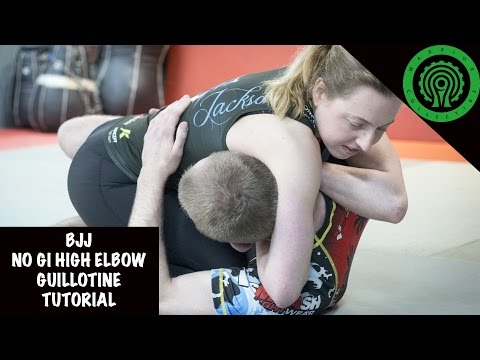
Kate Jackson, Pro MMA fighter, coach of Pure Grappling and instructor at Koncept Gym in Cornwall is here filmed by the W…
The reverse guillotine from sprawl spin-behind is not directly addressed in these transcripts. Instructor 1 (Stuart Tomlinson via Warrior Collective) teaches a high-elbow guillotine primarily from side control and half-guard positions, emphasizing a deep palm-to-palm grip with the arm rolled through the neck, followed by chest expansion and elbow compression to create a blood choke rather than windpipe pressure. The technique involves posting on the head to create space, rolling the arm over the top, and maintaining an underhook for control before executing the submission. Instructor 2 (Energia Martial Arts featuring Duane van Helvoirt) demonstrates a takedown from back control with double underhooks—a completely different entry point and technique involving hip displacement, stepping to create angle, and executing a throw rather than a ground submission. These videos address distinct technical domains: Tomlinson covers submission mechanics from positional advantage on the ground, while van Helvoirt covers takedown defense and offensive positioning from standing/clinch range. Neither transcript contains specific instruction on the reverse guillotine from a sprawl spin-behind sequence.
Сформировано на основе 2 инструкторов
Учебных курсов по этой технике пока нет.
Войдите, чтобы предложить курс.
Риск травмы для человека, к которому применяется техника
Reverse-wrap chokes use an inverted grip pattern from front headlock for a different angle of attack
Уровень мастерства, необходимый для надёжного выполнения техники
Разрешена ли техника по основным соревновательным правилам
Japanese BJJ community; derived from ギロチンチョーク
Japanese BJJ community; derived from ギロチンチョーク
Standard katakana transliteration of Western martial arts terminology (外来語) — used in Japanese MMA, boxing, and BJJ communities
Japanese terminology sourced from Japanese BJJ community; derived from ギロチンチョーク
forearm and grip strength, hip flexibility for guard retention
longer arms for deeper chin-strap wrap
forearm flexors, biceps, hip flexors
Каждое движение в любом боевом искусстве обладает рядом универсальных свойств. Комбинируйте параметры ниже, чтобы найти нужный инструмент или сравнить аналоги из разных стилей.
When you're not tight enough, your opponent will naturally tuck their head to escape. Duane van Helvoirt emphasizes that if you're not controlling the position properly, they'll find angles to get your back easily.
Stuart Tomlinson recommends getting an underhook, pulling your legs back, compressing your elbows and chest in tight, then securing a palm-to-palm grip as deep as possible with the arm around the head in a front naked choke position with their chin inside the crook.
Post on the head to clear room, roll the arm through, and then bring your leg up for extra drive while posting on the other leg and squeezing with your chest and elbows compressed together.
The reverse guillotine from sprawl spin-behind is applied during a transition where the attacker sprawls to defend a takedown, then spins behind the opponent while maintaining a reverse-wrapped neck grip. As the attacker moves from front to side or behind, the reverse guillotine grip naturally tightens as the angle changes, creating compression on the carotid from a different vector than the original front-facing position.
The sprawl-to-spin-behind reverse guillotine developed as a chain wrestling concept adapted for submission grappling, where the traditional wrestling spin-behind was enhanced with a choking grip. Competitors in no-gi grappling found that maintaining the reverse guillotine grip during the spin created a submission opportunity that pure wrestlers would not expect.
IBJJF: разрешён — Legal at all belt levels, gi and no-gi — chokes are the safest submission cat…; IJF: разрешён — Legal (shime-waza) — strangulation techniques are one of three permitted subm…; ADCC: разрешён — Legal; Unified MMA: разрешён — Legal — choke submissions are among the most common finishes in MMA; FIAS Sport Sambo: запрещён — All chokes prohibited in Sport Sambo; FIAS Combat Sambo: разрешён — Legal
Оценка опасности 8/10. Reverse-wrap chokes use an inverted grip pattern from front headlock for a different angle of attack
Стандартная цепочка подготовки: Achieve Controlling Position → Isolate the Neck → Set the Grip → Apply Pressure.
Стандартные контрприёмы: Tuck Chin — protect the neck by lowering the chin to prevent the choke from sinking / Two-on-One Grip Fight — use both hands to strip the choking grip before it locks / Turn Into — rotate toward the choking arm to relieve carotid pressure / Posture Up — straighten the spine and create distance to break the choking angle.
Распространённые варианты: Arm-in guillotine (traps the opponent's arm inside the choke for additional …); High-elbow guillotine (Marcelotine) (elevates the elbow above the head for stronger carotid co…); Standing guillotine (finished from the feet without pulling guard); Power guillotine (chin-strap grip with a rear-naked-choke-style finish for …).
More common in MMA than pure grappling competition; seen when wrestlers' shot attempts are stuffed
Основные ошибки, на которые стоит обратить внимание: Spinning without maintaining contact — stay connected to the opponent during the spin; separation allows them to reco… / Not completing the sprawl first — the sprawl must stop the takedown; spinning during a successful takedown loses posi… / Wrapping too loosely after the spin — the wrap must be tight immediately; the spin creates momentum that can loosen t… / Not choosing a finishing method — elbow pin, overhook, or back take; plan the finish during the spin.
Reverse Guillotine From Sprawl Spin-Behind также известен как Ribāsu Girochin, Sprawl Spin-Behind Reverse Guillotine, Reverse Guillotine from Spin.