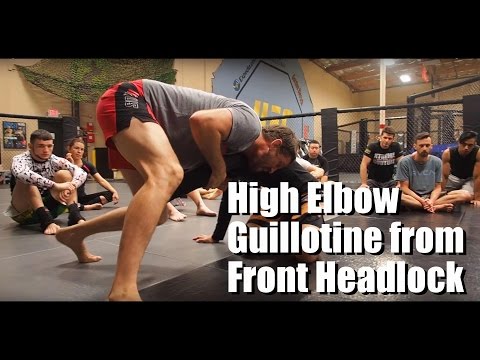
High Elbow Guillotine from the Front Headlock
0
Reverse Guillotine From Front Headlock·Rich Castro
Nogi BJJ technique Xtreme Couture coach Robert Follis EM5II
Перевод: Reverse Guillotine (katakana loanword)
The reverse guillotine from front headlock is applied by wrapping the arm around the opponent's neck from the front but with the choking forearm positioned on the opposite side compared to the standard guillotine — typically with the blade of the wrist pressing against the back or side of the neck rather than the throat. [1],[2] From the front headlock, the attacker rotates the grip to attack the far-side carotid artery, creating a different angle of compression. [1] The technique can finish as a blood choke or a crank depending on the precise forearm placement and the direction of the squeeze. [1],[2]
The reverse guillotine emerged in competitive no-gi grappling as practitioners explored non-standard grip configurations from the front headlock position. [1],[2] When the standard guillotine grip was defended by tucking the chin, attackers discovered that reversing the wrap direction could access different choking angles. [1] The technique gained visibility through its use in ADCC and professional MMA by grapplers with unorthodox front headlock games. [1],[2]
A useful secondary attack from front headlock when the opponent defends the standard guillotine grip; less common but effective when the choking arm threads to the far side [1]
Emerged in the 2010s no-gi scene as athletes explored all possible head-and-arm configurations from front headlock control [1]
Seen occasionally at ADCC trials and no-gi worlds; more common as a transition than a primary finish [1]
Изображений для этой техники пока нет.
Войдите, чтобы предложить изображение.
Nogi BJJ technique Xtreme Couture coach Robert Follis EM5II
Учебных курсов по этой технике пока нет.
Войдите, чтобы предложить курс.
Риск травмы для человека, к которому применяется техника
Reverse-wrap chokes use an inverted grip pattern from front headlock for a different angle of attack
Уровень мастерства, необходимый для надёжного выполнения техники
Разрешена ли техника по основным соревновательным правилам
Japanese BJJ community; derived from ギロチンチョーク
Japanese BJJ community; derived from ギロチンチョーク
Standard katakana transliteration of Western martial arts terminology (外来語) — used in Japanese MMA, boxing, and BJJ communities
Japanese terminology sourced from Japanese BJJ community; derived from ギロチンチョーク
forearm and grip strength, hip flexibility for guard retention
longer arms for deeper chin-strap wrap
forearm flexors, biceps, hip flexors
Каждое движение в любом боевом искусстве обладает рядом универсальных свойств. Комбинируйте параметры ниже, чтобы найти нужный инструмент или сравнить аналоги из разных стилей.
The reverse guillotine from front headlock with elbow-pin finish uses the opposite arm orientation compared to a standard guillotine, with the finishing pressure applied by pinning the elbow against the opponent's body. [1] The attacker wraps the neck in reverse — threading from the opposite direction — then drives the elbow of the choking arm downward against the opponent's chest or shoulder, using the elbow as a fixed point against which the neck is compressed. [1,2] The elbow pin creates a sharp fulcrum that intensifies neck pressure on a localised area. [2] This variant is effective when standard guillotine angles are unavailable due to the opponent's head position or arm placement. [2,3]
The reverse guillotine from front headlock with overhook assist adds an overhook (whizzer) grip on the opponent's arm to supplement the strangling pressure and prevent escape. [1] After establishing the reverse guillotine wrap around the neck, the attacker hooks the opponent's near arm with an overhook, trapping it against the body. [1,2] The overhook serves dual purposes: it prevents the opponent from posting or framing to relieve choking pressure, and the arm-trapping action drives the opponent's own shoulder into the neck as additional compression material. [2] This combination of reverse neck wrap plus overhook control creates a highly secure finishing position. [2,3]
Rich Castro recommends placing one hand on the chin and the other hand on the back of the armpit or sliding it down to the back of the elbow, depending on your positioning. This hand placement prevents excessive exposure compared to connecting your hands too early.
Your shoulder should go directly on the back of the neck, not on the shoulder blades or too far over the back, as Rich Castro emphasizes. Positioning the shoulder too far back allows your opponent to drive up and escape; you need to pin the head, not the back.
Keep your arm parallel to the floor and lean your head significantly over while grabbing and pulling the elbow. Rich Castro stresses that if your head stays upright, the opponent can defend the choke more easily, but once you get your head over, the choke becomes very difficult for them to escape.
The reverse guillotine from front headlock is applied by wrapping the arm around the opponent's neck from the front but with the choking forearm positioned on the opposite side compared to the standard guillotine — typically with the blade of the wrist pressing against the back or side of the neck rather than the throat. From the front headlock, the attacker rotates the grip to attack the far-side carotid artery, creating a different angle of compression.
The reverse guillotine emerged in competitive no-gi grappling as practitioners explored non-standard grip configurations from the front headlock position. When the standard guillotine grip was defended by tucking the chin, attackers discovered that reversing the wrap direction could access different choking angles.
IBJJF: разрешён — Legal at all belt levels, gi and no-gi — chokes are the safest submission cat…; IJF: разрешён — Legal (shime-waza) — strangulation techniques are one of three permitted subm…; ADCC: разрешён — Legal; Unified MMA: разрешён — Legal — choke submissions are among the most common finishes in MMA; FIAS Sport Sambo: запрещён — All chokes prohibited in Sport Sambo; FIAS Combat Sambo: разрешён — Legal
Оценка опасности 8/10. Reverse-wrap chokes use an inverted grip pattern from front headlock for a different angle of attack
Стандартная цепочка подготовки: Achieve Controlling Position → Isolate the Neck → Set the Grip → Apply Pressure.
Стандартные контрприёмы: Tuck Chin — protect the neck by lowering the chin to prevent the choke from sinking / Two-on-One Grip Fight — use both hands to strip the choking grip before it locks / Turn Into — rotate toward the choking arm to relieve carotid pressure / Posture Up — straighten the spine and create distance to break the choking angle.
Распространённые варианты: Arm-in guillotine (traps the opponent's arm inside the choke for additional …); High-elbow guillotine (Marcelotine) (elevates the elbow above the head for stronger carotid co…); Standing guillotine (finished from the feet without pulling guard); Power guillotine (chin-strap grip with a rear-naked-choke-style finish for …).
Seen occasionally at ADCC trials and no-gi worlds; more common as a transition than a primary finish
Основные ошибки, на которые стоит обратить внимание: Wrapping from the standard direction and calling it reverse — the reverse specifically wraps from the far side; verif… / Not securing the front headlock before the reverse wrap — the head must be trapped; the cross-over reach is longer th… / Over-reaching during the wrap — the far arm must cross to wrap the neck; if the reach is too far, the attacker overba… / Not choosing a finishing method — elbow pin or overhook assist; have a plan before committing.
Reverse Guillotine From Front Headlock также известен как Ribāsu Girochin, Front Headlock Reverse Guillotine, Inverted Front Choke.