HOW TO do the Japanese Neck Tie (Neck Crank?) in BJJ
0
Standard Japanese Necktie·Brandon Mccaghren·Added by Admin
This is one of the COOLEST moves in all of Jiu Jitsu. Bmac has some details to help you understand the mechanics of this…
Перевод: Japanese necktie
The Japanese necktie is a front headlock choke that combines blood choke compression with neck crank mechanics, executed by threading one arm under the opponent's arm and around their head (similar to a D'Arce grip), stepping over the opponent's leg, and falling to the shoulder while closing the elbows in a scissor-like fashion. [1] Despite its name, the technique is not traditionally Japanese — it was named by 10th Planet Jiu-Jitsu representatives after seeing Shinya Aoki perform it in training around 2007. Aoki himself called it the 'World Choke.' [2] The technique was developed simultaneously by multiple practitioners: Jeff Glover called it the 'Lazy D'Arce' and Robert Drysdale called it the 'Box Choke.'
Developed simultaneously by multiple practitioners in the early 2000s. Shinya Aoki (Japanese MMA fighter) called it the 'World Choke.' The name 'Japanese Necktie' was coined by 10th Planet Jiu-Jitsu around 2007 after seeing Aoki perform it. [1] Jeff Glover called it 'Lazy D'Arce' and Robert Drysdale called it 'Box Choke.' Despite the name, it is not a traditional Japanese martial arts technique — the 'Japanese' refers to Aoki's nationality. [2]
Highly effective front headlock submission that catches many opponents who are accustomed to defending the D'Arce and anaconda. The dual blood-choke and neck-crank mechanism means it can finish even when the pure choke angle is imperfect. [1]
Developed simultaneously by Shinya Aoki (Japan), Jeff Glover (USA), and Robert Drysdale (Brazil/USA) in the early 2000s. Named by 10th Planet Jiu-Jitsu ~2007. Part of the broader front headlock submission family alongside D'Arce, anaconda, and Peruvian necktie.
First UFC Japanese necktie finish: Matheus Nicolau vs. Bruno Rodrigues, UFC Fight Night 77, November 7, 2015, Round 3 at 3:27. Shinya Aoki used variations across DREAM, ONE Championship, and other promotions. Keith Krikorian (10th Planet) is a noted modern specialist.
Изображений для этой техники пока нет.
Войдите, чтобы предложить изображение.
This is one of the COOLEST moves in all of Jiu Jitsu. Bmac has some details to help you understand the mechanics of this…
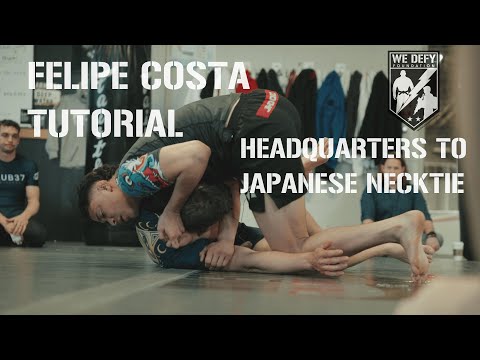
🔥🥋 Felipe Costa — known around the world as “Laranjinha” (Little Orange) — is an absolute force on the mats! 💪🍊 One…
The Japanese Necktie is a front headlock submission that emphasizes positional control and efficient weight distribution over muscular effort. Both We Defy Foundation (Felipe Costa) and Brandon McCaghren agree on the fundamental mechanics: the attacker establishes a headquarters position with legs interlocked (one leg between opponent's legs, one leg trapping the outside leg) while securing the opponent's head with a tight grip, typically an S-grip or vice grip formed by locking the hands around the head. Costa stresses the importance of head positioning—the attacker's head must face away from the opponent's body to maintain balance and prevent the defender from creating leverage to escape. Both instructors emphasize trapping the opponent's foot to prevent hip movement and escape. The submission culminates in a hip drive: McCaghren describes it as a scooping motion where the hip drives in and rotates upward, while Costa characterizes it as the hips walking forward across the opponent's head, creating a choke through body weight rather than arm strength. McCaghren adds that if the grip is missed or the opponent escapes to their knees, the position can transition into alternative submissions like the Darce choke or vice grip variations. Both instructors agree that maintaining chest contact with the opponent's triceps and keeping weight on the head—rather than dispersed across the body—is critical for submission completion.
Сформировано на основе 2 инструкторов
Учебных курсов по этой технике пока нет.
Войдите, чтобы предложить курс.
Риск травмы для человека, к которому применяется техника
Combines blood choke and neck crank mechanics — the dual-attack nature means even imperfect application can force a tap from pain; risk of cervical spine injury if the cranking component is applied aggressively
Уровень мастерства, необходимый для надёжного выполнения техники
Разрешена ли техника по основным соревновательным правилам
BJJ World — Japanese Necktie Technical Analysis
BJJ World — Is The Japanese Necktie The Tightest BJJ Choke Ever? (bjj-world.com) || Evolve MMA — How To Do The Japanese Necktie (evolve-mma.com) || Jits Magazine — Submission History: Origins of Head and Arm Choke (jitsmagazine.com)
Standard katakana transliteration of Western martial arts terminology (外来語) — used in Japanese MMA, boxing, and BJJ communities
Naming history — [1] Jits Magazine — Submission History documenting simultaneous development by Aoki, Glover, Drysdale
[2] BJJ World — Japanese Necktie technical analysis and history
Competition — Matheus Nicolau vs Bruno Rodrigues, UFC Fight Night 77 (2015)
arm length for deep threading, understanding of front headlock mechanics
longer arms for deeper choke penetration
biceps, forearms, hip flexors, core
According to Brandon McCaghren, it's not just about hip pressure and squeezing—the critical difference is turning your body so your head passes his back and your grip turns toward the ceiling. Just driving the hip alone probably only works half the time, but combining hip pressure with proper body positioning and the turn creates the actual submission.
Felipe Costa teaches that you need to catch the head and lock your hands together in an S-grip, with your bottom hand's palm pointing up and fingers closed. Make sure your chest goes on top of his triceps once you have the head, and keep slight space by using your arm to clear his stiff arm first.
Felipe Costa emphasizes that trapping the foot prevents your opponent from moving their leg and escaping, and any effort they use to push against you only tires them out while you maintain control.
Felipe Costa stresses that as you fall on your shoulder to finish, keep your leg between his legs and lock it. This prevents him from moving his body away and getting up, which is essential to securing the tap.
The Japanese necktie is a front headlock choke that combines blood choke compression with neck crank mechanics, executed by threading one arm under the opponent's arm and around their head (similar to a D'Arce grip), stepping over the opponent's leg, and falling to the shoulder while closing the elbows in a scissor-like fashion. Despite its name, the technique is not traditionally Japanese — it was named by 10th Planet Jiu-Jitsu representatives after seeing Shinya Aoki perform it in training around 2007.
Developed simultaneously by multiple practitioners in the early 2000s. Shinya Aoki (Japanese MMA fighter) called it the 'World Choke.
IBJJF: разрешён — Legal at all belt levels, gi and no-gi — chokes are the safest submission cat…; IJF: разрешён — Legal (shime-waza) — strangulation techniques are one of three permitted subm…; ADCC: разрешён — Legal; Unified MMA: разрешён — Legal — choke submissions are among the most common finishes in MMA; FIAS Sport Sambo: запрещён — All chokes prohibited in Sport Sambo; FIAS Combat Sambo: разрешён — Legal
Оценка опасности 7/10. Combines blood choke and neck crank mechanics — the dual-attack nature means even imperfect application can force a tap from pain; risk of cervical spine injury if the cranking component is applied aggressively
Стандартная цепочка подготовки: Establish Front Headlock → Thread the Arm → Secure Modified Vice Grip → Step Over Opponent's Leg → Fall to Far Shoulder → Drive Hips In.
Стандартные контрприёмы: Posture Up Early — before the grip is secured, posture prevents the arm thread / Hand-Fight — strip the threading arm before it locks around the head / Roll Toward Attacker — relieve rotational pressure by rolling into the choke direction / Defend the Front Headlock — the best defense is not giving up the head position in the first place.
Распространённые варианты: Standard Japanese necktie (classic arm thread with leg step-over and shoulder drop); Peruvian necktie (related technique using S-grip under chin with leg over o…); D'Arce choke (same arm threading but different finishing mechanics with…); Anaconda choke (related front headlock cousin, rolls to opposite side).
First UFC Japanese necktie finish: Matheus Nicolau vs. Bruno Rodrigues, UFC Fight Night 77, November 7, 2015, Round 3 at 3:27.
Основные ошибки, на которые стоит обратить внимание: Not threading the arm deep enough — insufficient depth prevents the scissor action from generating compression / Not stepping over the leg — this is what distinguishes the Japanese necktie from the D'Arce; without it, finishing is… / Falling to the wrong side — must fall to the far shoulder, not the near side / Not closing elbows in scissor fashion — the elbows must pass each other to maximize compression.
Standard Japanese Necktie также известен как Japanīzu Nekutai, Japanese Necktie, World Choke, Lazy D'Arce, Box Choke.