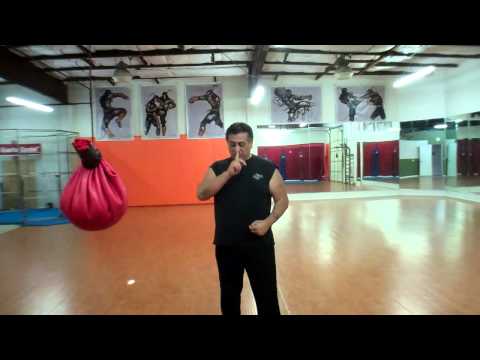
Power Punching: Centerline Striking Power
0
Power Line Punch·BareFisted
http://www.OldStyleMuayThai.com In this video I go over why you need to strike across the center line of the body with …
Перевод: Power line punch — 'power line' refers to Dempsey's concept of the optimal straight-line alignment from shoulder through fist that maximises force transmission
The Power Line Punch is Jack Dempsey's concept of optimal structural alignment during a punch — an imaginary straight line running from the shoulder joint, through the elbow, wrist, and knuckles, along which 100% of the body's punching force is transmitted without any structural leakage or misdirection. [1] Dempsey identified the power line as the second fundamental principle of punching (after the falling step), arguing that even perfect body-weight transfer is wasted if the arm structure deviates from this line at the moment of impact. [1] The power line applies to ALL punches — jabs, crosses, hooks, and uppercuts — but manifests differently in each: for a straight punch, the power line runs straight forward from the shoulder through an extended arm; for a hook, it runs from the shoulder to the elbow (which is the striking surface at hook range); for an uppercut, it runs vertically from the shoulder through a vertically aligned forearm. [1] The critical insight is that ANY deviation from the power line — a bent wrist, an elbow that flares outward, a shoulder that drops — creates a 'leak' where force is absorbed by the misaligned joint rather than transmitted to the target. [1] Dempsey estimated that a 15° deviation from the power line at the wrist alone could reduce impact force by 30-40%, because the wrist joint absorbs the misdirected force component through hyperextension or lateral deviation. [1] The Power Line concept has been validated by modern biomechanical research: Walilko et al. (2008) found that 'effective mass' — the proportion of body mass behind the punch at impact — varies significantly with skeletal alignment, confirming Dempsey's observation that structural alignment determines how much body weight actually reaches the target. [2] The Power Line Punch is not a separate technique from other punches but a PRINCIPLE that makes all punches more powerful when applied correctly. [1]
Jack Dempsey described the Power Line in Chapter 9 of Championship Fighting (1950), placing it as the second principle of punching after the Falling Step. [1] Dempsey's insight was that the human arm contains multiple joints (shoulder, elbow, wrist, fingers), each of which can 'leak' force if not properly aligned — and that the difference between a knockout punch and a harmless one is often not power but alignment. [1] He observed that many strong fighters punch weakly because their structural alignment is poor, while some smaller fighters hit disproportionately hard because their alignment is perfect — the body weight reaches the target instead of being absorbed by their own joints. [1] The Power Line concept parallels similar principles in other martial arts: karate's kime (focus of the entire body at the moment of impact through correct structural alignment), Wing Chun's centreline theory (attacking along the body's structural axis for maximum efficiency), and traditional Chinese martial arts' emphasis on whole-body connection (yi qi li — intention, energy, and force unified along a single line). [1],[3] Modern sports science has confirmed the principle: Lenetsky et al. (2015) found that 'effective mass' — the amount of body mass behind the fist at impact — is primarily determined by skeletal alignment, not muscular effort. [2]
The Power Line is arguably the most universally applicable concept in striking martial arts: it makes EVERY punch harder without requiring additional speed, strength, or conditioning. [1] A fighter who masters the Power Line alignment produces consistently harder impacts from the same body weight, meaning they cross the knockout threshold more frequently. [1] Dempsey's 52 knockouts in 83 fights against opponents who were often larger and stronger demonstrates the principle's effectiveness — Dempsey's power came primarily from alignment (Power Line) and timing (Falling Step + Jolt), not from exceptional size or muscular strength. [1] The concept is equally applicable in MMA, kickboxing, karate, and any striking martial art. [1]
The Power Line is not a discrete technique with specific competition results, but a principle that underlies ALL successful punching across ALL striking martial arts. Every knockout in boxing, MMA, karate, and kickboxing history was produced by a punch that, at the moment of impact, had correct power line alignment. The principle is invisible to spectators but measurable by sports scientists.
Изображений для этой техники пока нет.
Войдите, чтобы предложить изображение.
http://www.OldStyleMuayThai.com In this video I go over why you need to strike across the center line of the body with …
Most people today punch like modern boxers — but that’s not how bare knuckle fighters did it. Before gloves (or “muffler…
The Power Line Punch is a striking technique rooted in bare-knuckle boxing history that emphasizes delivering force through a vertical fist aligned with the pinky-side knuckles. According to Sifu Adam Willis, historical bare-knuckle boxers—whose methods influenced Jack Dempsey's coaches—landed strikes using the bottom three knuckles along the pinky line, a technique mirrored in Wing Chun practice. This alignment prevents boxer's fracture, which occurs when punchers miss the pinky-line alignment and strike with misaligned knuckles. BareFisted's John Sabrano complements this technical foundation by explaining that the Power Line Punch works through crossing the opponent's centerline—an imaginary vertical axis from head to groin—to transfer maximum body weight into the strike. Sabrano demonstrates that punching parallel to this centerline prevents the striker from being pushed backward and creates a triangular structural geometry that amplifies force. Both instructors agree on the biomechanical principle: proper alignment and centerline positioning generate superior power compared to lateral or glancing strikes. Sabrano emphasizes the psychological and tactical advantage of centerline attacks, noting that strikes along the body's vital organs (eyes, solar plexus, spine) psychologically disturb opponents more than peripheral strikes. The technique requires deliberate practice to internalize, whether through drop-stepping variations or diagonal approaches, making it essential for developing knockout power in bare-knuckle contexts.
Сформировано на основе 2 инструкторов
Учебных курсов по этой технике пока нет.
Войдите, чтобы предложить курс.
Риск травмы для человека, к которому применяется техника
The Power Line principle does not change the danger of the punch itself, but it dramatically increases the force delivered to the target by eliminating structural waste — a power-line-aligned punch hits 30-50% harder than the same punch thrown with poor alignment, meaning the knockout threshold is crossed more frequently. [1]
Уровень мастерства, необходимый для надёжного выполнения техники
Разрешена ли техника по основным соревновательным правилам
Championship Fighting (Dempsey, 1950)
description: [1] Dempsey 1950 Ch.9
Standard katakana transliteration of Western martial arts terminology (外来語) — used in Japanese MMA, boxing, and BJJ communities
description: [1] Dempsey 1950 Ch.9
The Power Line does NOT require any special physical attributes — it is a principle of ALIGNMENT accessible to every body type
proprioception (awareness of joint positions), wrist stability, ability to check alignment through mirror work or coach feedback
by eliminating structural waste, a properly aligned punch requires less muscular effort for the same impact force
The power line punch travels along the body's natural structural alignment — the power chain from the ground through the legs, hips, torso, and arm. Dempsey's Championship Fighting emphasizes that all real punching power comes from this kinetic chain, not arm strength. (Dempsey, Championship Fighting)
Crossing the center line allows you to transfer maximum body weight into your target, creating significantly more power behind your strike. According to BareFisted, this also creates a triangle structure which is the strongest structural formation, and targets vital organs like the eyes, solar plexus, and spine that run down the center line.
BareFisted recommends throwing the punch slightly diagonal and keeping your fist, wrist, forearm, and body in structural alignment. You should step with your body weight dropping into the punch like a fencer or sword fighter, ensuring your fist is in line with your foot drop as you strike across center line.
Sifu Adam Williss explains that bare knuckle boxers punched through the bottom three knuckles (the pinky line) rather than the traditional top two knuckles, as this was the safest way to protect the hand and wrist without wraps or gloves while still delivering power.
The Power Line Punch is Jack Dempsey's concept of optimal structural alignment during a punch — an imaginary straight line running from the shoulder joint, through the elbow, wrist, and knuckles, along which 100% of the body's punching force is transmitted without any structural leakage or misdirection. Dempsey identified the power line as the second fundamental principle of punching (after the falling step), arguing that even perfect body-weight transfer is wasted if the arm structure deviates from this line at the moment of impact.
Jack Dempsey described the Power Line in Chapter 9 of Championship Fighting (1950), placing it as the second principle of punching after the Falling Step. Dempsey's insight was that the human arm contains multiple joints (shoulder, elbow, wrist, fingers), each of which can 'leak' force if not properly aligned — and that the difference between a knockout punch and a harmless one is often not power but alignment.
Unified MMA: разрешён — Legal striking technique; WBC/Boxing: разрешён — Legal — punches are the core technique of boxing; WKF: разрешён — Legal, jodan/chudan punch scores 1 point (yuko) — controlled contact required; Kyokushin: ограничен — Body punches legal at full power, head punches banned; WT: ограничен — Punches to trunk only (1 point), punches to head banned; ITF: разрешён — Legal — hand techniques to head and body both permitted; WAKO: разрешён — Legal in Full Contact and Low Kick formats; K: разрешён — 1/GLORY — Legal — full power punches to head and body; IFMA: разрешён — Legal
Оценка опасности 8/10. The Power Line principle does not change the danger of the punch itself, but it dramatically increases the force delivered to the target by eliminating structural waste — a power-line-aligned punch hits 30-50% harder than the same punch thrown with poor alignment, meaning the knockout threshold is crossed more frequently.
Стандартная цепочка подготовки: This is a PRINCIPLE applied to all punches, not a standalone technique with its own setup chain. The Power Line is applied during: Falling Step → Arm extends toward target → CHECK: shoulder-elbow-wrist-knuckles aligned in a single straight line → At impact, the aligned structure transmits body weight to the target → All kinetic energy flows through the power line to the fist → Maximum force is delivered with minimum structural waste.
Стандартные контрприёмы: Not applicable — the Power Line is a principle, not a technique. It cannot be countered because it is an internal qua….
Распространённые варианты: Straight punch power line (the most intuitive version: shoulder-elbow-wrist-knuckles…); Hook power line (shoulder-to-elbow alignment (fist is at 90° to the forearm)); Uppercut power line (vertical alignment from shoulder through vertically orien…); Body punch power line (angled downward from shoulder to target, maintaining the …); Lead hand power line (jab) (applying the principle to the weaker hand for maximum jab…).
The Power Line is not a discrete technique with specific competition results, but a principle that underlies ALL successful punching across ALL striking martial arts. Every knockout in boxing, MMA, karate, and kickboxing history was produced by a punch that, at the moment of impact, had correct power line alignment.
Основные ошибки, на которые стоит обратить внимание: Wrist deviation — the most common and most damaging power line break: if the wrist bends (flexion, extension, or late… / Elbow flare — if the elbow points outward during a straight punch instead of staying on the power line, the force vec… / Punching with the wrong knuckles — the power line terminates at the index and middle knuckles (which sit in line with… / Dropped shoulder — if the punching shoulder drops below the plane of the power line, the force vector angles downward….
Power Line Punch также известен как Pawā Rain Panchi, Straight Power Line, Dempsey Power Line, Aligned Punch, Structural Punch.