Backfist Secrets
0
Standing Backfist·Chip Quimby & Authentic Karate Training Center
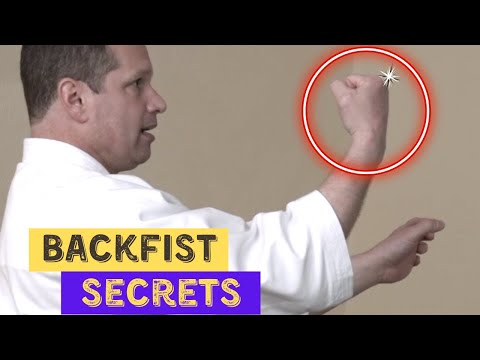
This video reviews training methodology and theory of the Backfist Strike (uraken-uchi). Taken from his video, Kanshiw…
Перевод: standing backfist
The standing backfist is the non-spinning variant of uraken uchi, delivered from a stationary stance with a snapping extension of the arm. [1] Funakoshi documented this as a fundamental Okinawan technique, typically targeting the temple or bridge of the nose from close range. [2] Nakayama described the standing backfist as one of the fastest techniques in karate, with its power derived from wrist snap rather than body rotation. [3] The technique has remained a standard component of karate and taekwondo training. [1]
The standing backfist is a non-spinning backfist from a stationary position. [1]
From karate and kung fu. [1]
Used in karate and MMA. [1]
Изображений для этой техники пока нет.
Войдите, чтобы предложить изображение.
This video reviews training methodology and theory of the Backfist Strike (uraken-uchi). Taken from his video, Kanshiw…
Учебных курсов по этой технике пока нет.
Войдите, чтобы предложить курс.
Риск травмы для человека, к которому применяется техника
Spinning/standing backfist; metacarpal fracture risk to striker
Уровень мастерства, необходимый для надёжного выполнения техники
Разрешена ли техника по основным соревновательным правилам
Muay Thai: The Art of Fighting (Yod Ruerngsa, Khun Kao Charuad & James Cartmell, 2002)
Alias sources — [1] Karate-Do Kyohan (Funakoshi, 1935) [2] Dynamic Karate (Nakayama, 1966) [3] Kukkiwon Taekwondo Textbook (Kukkiwon, 2006)
History sources — [1] The Art of Striking (Blauer, 2004) [2] Karate-Do Kyohan (Funakoshi, 1935) [3] Best Karate Vol. 3 (Nakayama, 1978)
Official karate technique names (和語/漢語)
Established Japanese martial arts naming convention — native Japanese term (和語/漢語)
Alias sources — [1] Karate-Do Kyohan (Funakoshi, 1935) [2] Dynamic Karate (Nakayama, 1966) [3] Kukkiwon Taekwondo Textbook (Kukkiwon, 2006)
History sources — [1] The Art of Striking (Blauer, 2004) [2] Karate-Do Kyohan (Funakoshi, 1935) [3] Best Karate Vol. 3 (Nakayama, 1978)
hand speed, hip rotation, wrist alignment on impact
proportional reach, strong wrists, fast-twitch shoulder muscles
deltoids, pectorals, triceps, core rotators, forearms
Каждое движение в любом боевом искусстве обладает рядом универсальных свойств. Комбинируйте параметры ниже, чтобы найти нужный инструмент или сравнить аналоги из разных стилей.
According to Chip Quimby, the key to the backfist is to stay relaxed and think of the movement as one continuous action like an ellipse, rather than waiting for your arm to stop before pulling back.
Chip Quimby explains that you can use the full face of the fist, or if whipping the backfist, you can use just the two middle knuckles like a mace or flail for concentrated striking power.
The primary target is the area where the mustache would be, just below the nose, which are crucial and dangerous points to strike; the chin and jaw also offer valid targets, with anything from the eyes down and around being technically valid.
A backfist delivered from a stationary position without spinning, using a snapping motion of the wrist and elbow to strike with the back of the knuckles.
The standing backfist is the non-spinning variant of uraken uchi, delivered from a stationary stance with a snapping extension of the arm. Funakoshi documented this as a fundamental Okinawan technique, typically targeting the temple or bridge of the nose from close range.
Unified MMA: разрешён — Legal striking technique; WBC/Boxing: разрешён — Legal — punches are the core technique of boxing; WKF: разрешён — Legal, jodan/chudan punch scores 1 point (yuko) — controlled contact required; Kyokushin: ограничен — Body punches legal at full power, head punches banned; WT: ограничен — Punches to trunk only (1 point), punches to head banned; ITF: разрешён — Legal — hand techniques to head and body both permitted; WAKO: разрешён — Legal in Full Contact and Low Kick formats; K: разрешён — 1/GLORY — Legal — full power punches to head and body; IFMA: разрешён — Legal
Оценка опасности 5/10. High — spinning/standing backfist; metacarpal fracture risk to striker
Стандартная цепочка подготовки: Assume Fighting Stance → Generate Power → Execute Strike → Recover to Guard.
Стандартные контрприёмы: Block — absorb the strike with a protective guard position / Evasion — move the target out of the strike's path / Counter-Attack — time an offensive response during the recovery phase of the strike.
Распространённые варианты: Horizontal elbow (swinging the elbow horizontally at head level); Uppercut elbow (rising elbow from below targeting the chin); Downward elbow (chopping the elbow straight down (Muay Thai sok tat)); Spinning elbow (full rotation before driving the elbow into the target).
Used in karate and MMA.
Основные ошибки, на которые стоит обратить внимание: Pushing through the target instead of snapping — the backfist must retract quickly for it to be classified correctly … / Winding up the arm before throwing, which negates the speed advantage / Hitting with the palm side of the fist or the fingers instead of the knuckle ridge / Throwing the standing backfist at full power as if it were a hook — the mechanics are different and forcing power ris….
Standing Backfist также известен как Tachi Uraken, Uraken Uchi, Standing Back Fist, Deungjumeok Chigi.