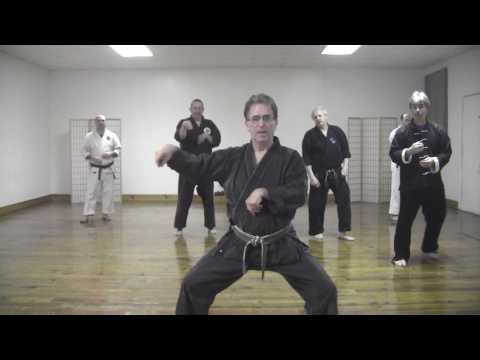
How to do the Goju Ryu Back Wrist Block!
0
Kakuto Uchi·Roger Wehrhahn
How to do the Goju Ryu Back Wrist Block! The koken uke is used in 2 of the advanced Goju Ryu Kata. The first one is San…
Перевод: crane head strike
Kakuto Uchi is a karate open-hand strike that uses the back of the bent wrist as the striking surface — the hand bends sharply downward at the wrist, exposing the bony prominence of the dorsal wrist (the scaphoid and lunate bones) as the impact point. [1] The formation resembles a crane's head with its long curved neck. [1] The strike is delivered in an upward arc — typically rising from below the opponent's guard line to strike under the chin, under the nose, or to the throat. [1] The unusual upward trajectory makes it extremely difficult to see coming, as most fighters are conditioned to defend against strikes coming from above or horizontally. [1] Kakuto uchi appears in several advanced Shotokan kata including Unsu and Sochin. [1]
Kakuto (crane head) is derived from White Crane kung fu (Bai He Quan) techniques that influenced the development of Okinawan karate. [1] The crane head formation represents the bird's curved neck and head, used in a pecking/striking motion. [1] In Shotokan karate, kakuto uchi appears in advanced kata such as Unsu (Cloud Hands) and Sochin (Strength and Calm), where it is performed as a rising strike from a low starting position. [1] The technique is closely related to the kakuto uke (bent wrist block), which uses the same formation defensively. [1]
A close-range surprise weapon that attacks from an unexpected angle — the rising trajectory from below the guard line is nearly impossible to see coming. [1] The bony wrist surface concentrates force like a hammer, and the curved arc adds momentum. Most effective against the chin, throat, and underside of the nose. Primarily a kata technique and self-defense application — not practical in sport competition. [1]
Used in WKF karate kumite (controlled contact) and Kyokushin full-contact competition. Banned in boxing, TKD, and most kickboxing rulesets. Appears in MMA where legal. [1]
Изображений для этой техники пока нет.
Войдите, чтобы предложить изображение.
How to do the Goju Ryu Back Wrist Block! The koken uke is used in 2 of the advanced Goju Ryu Kata. The first one is San…
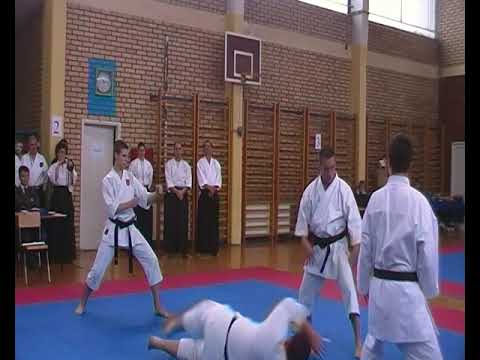
Karate club Washide is traditional Shotokan and Fudokan karate club in Belgrade, Serbia. Sensei Nenad Lukic (Karate Mast…
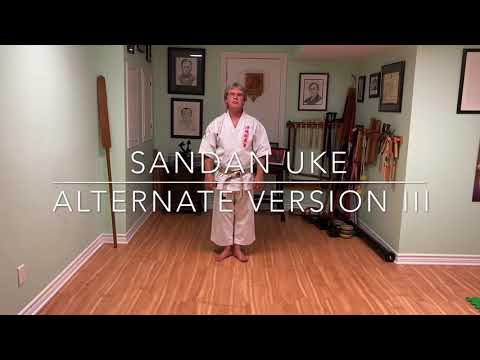
Another version of San Dan Uke but with Koken Uke, bent wrist block. Good for intermediate/advanced belts. The attacks…
The instructors provide limited coherent material on kakuto uchi specifically. Eastwind Martial Arts Virtual Dojo references kakuto (or 'koken') as a wrist-based blocking tool used in sandan uke combinations, capable of defending high, middle, and low positions while protecting the solar plexus, with emphasis on maintaining proper elbow positioning and head posture. Roger Wehrhahn's extensive Goju Ryu back wrist block instruction demonstrates kakuto application with circular hand mechanics, describing both internal (reverse) and external (outward/upward) directional variants that can interchange fluidly. Wehrhahn emphasizes the technique's reliance on continuous circular motion rather than static positioning, with the wrist maintaining relaxation despite the bending action inherent to the block. Both instructors agree that kakuto functions as a defensive tool within kata and kumite sequences, though Wehrhahn provides substantially more biomechanical detail regarding hand trajectories, timing integration with counterattacks, and the importance of elbow control. Karate Club Washide's transcript contains no intelligible technical instruction relevant to this technique.
Сформировано на основе 2 инструкторов
Учебных курсов по этой технике пока нет.
Войдите, чтобы предложить курс.
Риск травмы для человека, к которому применяется техника
The bony wrist surface striking under the chin can cause jaw fracture or knockout. Throat variant can damage the trachea.
Уровень мастерства, необходимый для надёжного выполнения техники
Разрешена ли техника по основным соревновательным правилам
Oyama, M. This Is Karate / Essentials of Karate.
[1] Oyama / Funakoshi / Nakayama — hand formation chapters, kata application (bunkai) sections for Unsu and Sochin
Official karate technique names (和語/漢語)
Established Japanese martial arts naming convention — native Japanese term (和語/漢語)
[1] Oyama / Funakoshi / Nakayama — hand formation chapters, kata application (bunkai) sections for Unsu and Sochin
strong wrist flexion to 90°, wrist bone conditioning, ability to generate power in upward arc
thick wrist bones, flexible wrist joint
wrist flexors (bent position), forearm extensors (lock), biceps (upward swing), deltoids (arc drive)
Kakuto uchi (crane head / bent wrist strike) uses the dorsal wrist bone as the striking surface in a rising arc — attacks from below the opponent's guard line. Appears in advanced kata including Unsu and Sochin. Derived from White Crane kung fu. (Oyama, This Is Karate; Nakayama, Dynamic Karate — kata bunkai sections)
According to Roger Wehrhahn, the technique flows through a four-count sequence where blocks and strikes happen together: one (initial block), two and three (block and counter-punch happen simultaneously), and four (follow-up strike). The key is to keep the movements fluid and continuous rather than separate, distinct actions.
Roger Wehrhahn emphasizes that one hand pulls inward toward the chest while the other comes up and around in circular motions—keep your elbows close to your body and don't let them flare out. The hands should stay relaxed and fluid throughout the movement; the bending is part of the initial action, but you must maintain relaxation as the hands move.
After blocking, you immediately follow up with a counter-punch or strike. Wehrhahn describes blocking down and then striking up under the face—the block and counter are linked as one continuous action rather than waiting between them.
Kakuto Uchi is a karate open-hand strike that uses the back of the bent wrist as the striking surface — the hand bends sharply downward at the wrist, exposing the bony prominence of the dorsal wrist (the scaphoid and lunate bones) as the impact point. The formation resembles a crane's head with its long curved neck.
Kakuto (crane head) is derived from White Crane kung fu (Bai He Quan) techniques that influenced the development of Okinawan karate. The crane head formation represents the bird's curved neck and head, used in a pecking/striking motion.
WKF Karate: Not permitted: запрещён — only standard fist and controlled open hand allowed; Unified MMA: Technically legal as a strike but impractical with hand wraps/gloves {src:Unified Rules of MMA, August 2025|/sources/Unified: запрещён — MMA-Rules-August-2025.pdf}; WAKO Kickboxing: Open hand/wrist strikes not permitted {src:WAKO Full Contact Rules|/sources/WAKO: запрещён — Full-Contact-Rules.pdf}; Kyokushin: Wrist strikes permitted in some bare: разрешён — knuckle formats
Оценка опасности 6/10. High — the bony wrist surface striking under the chin can cause jaw fracture or knockout. Throat variant can damage the trachea.
Стандартная цепочка подготовки: Low guard bait → opponent attacks high → rising kakuto uchi under exposed chin → Inside block (uchi uke) → same hand flows into kakuto uchi upward strike → Grab opponent's collar → pull head down → kakuto uchi rising strike to descending chin.
Стандартные контрприёмы: Lower guard — drop the chin and cover with forearms to block the rising arc / Step back — the technique requires close range and loses force at distance / Parry downward — push the rising arm back down before it reaches chin height.
Распространённые варианты: Rising kakuto (upward arc under the chin or nose); Straight kakuto (forward thrust to the throat with the wrist peak); Lateral kakuto (sideways swing to the temple); Blocking kakuto (used as a deflection technique (kakuto uke) where the ben…).
Used in WKF karate kumite (controlled contact) and Kyokushin full-contact competition. Banned in boxing, TKD, and most kickboxing rulesets.
Основные ошибки, на которые стоит обратить внимание: Insufficient wrist flexion — the striking surface is poorly defined if the bend is less than 90° / Hitting with the back of the hand instead of the wrist bone — the hand is fragile and will break / Telegraphing the upward arc — keeping the hand low before striking is essential / Using against the forehead or skull — the wrist bones cannot withstand skull-on-wrist impact.
Kakuto Uchi также известен как Kakuto Uchi, Kakuto-Uchi, Crane Head Strike, Bent Wrist Strike, Wrist Peak Strike.