HOW TO DO A SIDE KICK | TECHNIQUE TUESDAY
0
Hand-on-the-Floor Side Kick·Mark Anastacio
➢ Join the gym: www.unionmartialarts.ca ➢ Subscribe to Mark's Channel: http://bit.ly/2g5EyrD ➢ Instagram: http://bit.ly/…
Перевод: Hand-on-the-floor side kick
The Hand-on-the-Floor Side Kick is delivered with one hand touching the ground for support, maximising reach and enabling kicks from unusually low or extended positions. [1] By using the hand as an additional support point, the practitioner can extend the kicking range significantly while maintaining balance. [1] This technique appears in various martial arts including capoeira and certain karate styles that incorporate ground-level transitions. [1]
The Hand-on-the-Floor Side Kick offers tactical advantages in specific situations where a standard side kick would be less effective. [1]
Cross-style martial arts kicking tradition. [1]
An acrobatic kick variation primarily seen in demonstrations and point-fighting tournaments. Not practical in full-contact competition due to the ground recovery time required. [1]
Изображений для этой техники пока нет.
Войдите, чтобы предложить изображение.
➢ Join the gym: www.unionmartialarts.ca ➢ Subscribe to Mark's Channel: http://bit.ly/2g5EyrD ➢ Instagram: http://bit.ly/…
New to Taekwondo? Check out these three Taekwondo beginner kicks. See my other videos for more in-depth breakdowns of …
Hey, If you’ve been training Taekwondo for a few months or years, I’ve got something you’ll love. Click the link here …
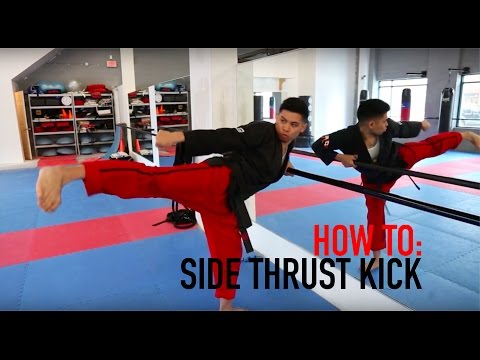
The hand-on-the-floor side kick, referred to as the side thrust kick or yup chagi, is a foundational striking technique in Taekwondo emphasizing power, precision, and balance. Mark Anastacio describes the technique as requiring a straddle or horse stance with 50/50 weight distribution, establishing a solid base before execution. The core mechanics involve lifting the knee tightly to the chest while maintaining a straight chamber (not circular like a roundhouse), then extending explosively through the target using the heel or blade of the foot. BVO Master Chong emphasizes the critical importance of the 180-degree pivot of the supporting leg during extension and recommends a diagonal knee chamber toward the opposite shoulder to maintain balance and generate power. Both instructors stress the "piercing" or "thrusting" motion—driving through the target rather than pushing it—and highlight that the supporting leg must twist out during extension to transfer body weight forward effectively. Taekwondo Guide notes the side kick's utility in sparring when thrown from the front leg with minimal rotation, contrasting it with the more powerful rear-leg version. Common execution errors identified across instructors include inadequate pivoting, toes positioned higher than heels, and over-rotation of the upper body. Weight distribution toward the kicking leg rather than the supporting leg prevents backward balance loss during high extensions.
Сформировано на основе 3 инструкторов
Учебных курсов по этой технике пока нет.
Войдите, чтобы предложить курс.
Риск травмы для человека, к которому применяется техника
Side kick variants deliver significant lateral force to the target
Уровень мастерства, необходимый для надёжного выполнения техники
Разрешена ли техника по основным соревновательным правилам
Essential Book of Martial Arts Kicks (De Bremaeker & Faige, 2010)
[1] De Bremaeker & Faige, Essential Book of Martial Arts Kicks (2010)
Requires good lateral hip flexibility
Strong core for balance
gluteus medius, hip abductors, quadriceps
Documented in De Bremaeker & Faige, Section 2.10. A capoeira-influenced side kick where one hand touches the floor for balance — allowing an extremely low body position while kicking at mid or high level. (De Bremaeker & Faige, Essential Book of Martial Arts Kicks, 2010)
A side thrust kick goes straight forward with a piercing motion, whereas a roundhouse comes around. Mark Anastacio emphasizes that you bring your knee to your chest and shoot it straight out, rather than letting your leg come around like a roundhouse.
You should hit with the blade of your foot—your heel—not the flat of your foot. Point your toes down, flex your heel, and drive straight through the target for a powerful, piercing motion.
Imagine your kick goes through the target, not stopping at it. Mark Anastacio stresses putting all your body weight into the kick so the bag thumps and bends inward; if the bag just gets pushed, you're losing power and creating only distance without real impact.
Use a straddle stance to establish your center of gravity, which differs from the forward stance used in roundhouse kicks. First establish your balance and base before executing the kick.
The Hand-on-the-Floor Side Kick is delivered with one hand touching the ground for support, maximising reach and enabling kicks from unusually low or extended positions. By using the hand as an additional support point, the practitioner can extend the kicking range significantly while maintaining balance.
The Hand-on-the-Floor Side Kick is a specialised variant of the side kick documented in cross-style kicking methodology. Side kick variations have been developed across karate, taekwondo, and kung fu traditions.
Unified MMA: разрешён — Legal striking technique; WBC/Boxing: запрещён — All kicks prohibited in boxing; WKF: разрешён — Legal, chudan (body) kick scores 2 points, jodan (head) kick scores 3 points; Kyokushin: разрешён — Legal at full power to body and head; WT: разрешён — Legal, body kick 2 points, head kick 3 points, spinning body 4 points, spinni…; WAKO: разрешён — Legal in Full Contact and Low Kick formats; K: разрешён — 1/GLORY — Legal; IFMA: разрешён — Legal — kicks are a core Muay Thai technique
Оценка опасности 6/10. Side kick variants deliver significant lateral force to the target
Стандартная цепочка подготовки: Feint or jab → Chamber → Hand-on-the-Floor Side Kick to target → Follow-up technique.
Стандартные контрприёмы: Step inside the kick range / Catch and sweep / Counter with low roundhouse.
Распространённые варианты: High hand-on-the-floor side kick (targeting head level); Mid hand-on-the-floor side kick (targeting body); Low hand-on-the-floor side kick (targeting legs).
An acrobatic kick variation primarily seen in demonstrations and point-fighting tournaments. Not practical in full-contact competition due to the ground recovery time required.
Основные ошибки, на которые стоит обратить внимание: Attempting the hand-on-the-floor side kick without sufficient side kick foundation / Poor balance during execution / Insufficient hip rotation.
Hand-on-the-Floor Side Kick также известен как Hando on za Furoa Saido Kikku, Ground-Supported Side Kick.