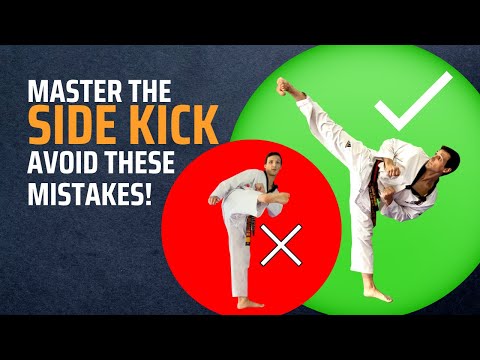
Master The Taekwondo Side Kick
0
Drop Side Kick·Taekwondo Guide
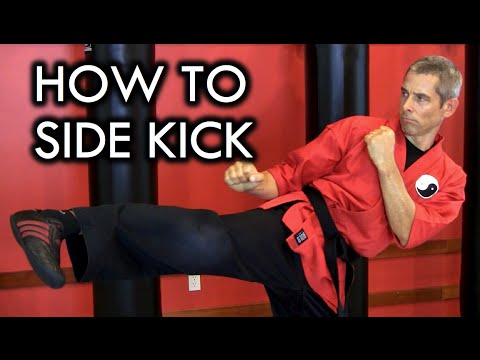
Paul Van Schoyck of Taekwondo Guide shares how to do a side kick along with common mistakes to avoid. visit: www.tkdgu…
Перевод: Drop side kick — a side kick delivered while intentionally dropping the body to the ground, attacking from a low angle that bypasses standing defences
The Drop Side Kick is a sacrifice technique where the practitioner intentionally drops their body toward the ground while simultaneously thrusting a side kick at a low or mid-level target, creating an unexpected attack angle from below the opponent's visual field. [1] The combination of the side kick's powerful linear thrust with the dropping body's angular change produces a kick that arrives from a direction standing opponents are not conditioned to defend — most defensive frameworks are calibrated for kicks coming from an upright position, not from a body that is descending toward the floor. [1] The mechanics merge the standard side kick's hip abduction and heel thrust with the Drop Front Kick's controlled descent: as the body begins its controlled fall (typically dropping the non-kicking side toward the floor), the kicking leg chambers and thrusts laterally into the target, powered by the same hip mechanics as a standing side kick but angled upward due to the body's lowered position. [1] The technique is classified alongside other drop kicks (drop front kick, drop roundhouse kick, drop back kick) as a family of sacrifice techniques where the practitioner deliberately abandons standing balance in exchange for surprise and angular advantage. [1] De Bremaeker and Faige document the Drop Side Kick as the side kick variant within this sacrifice kick family, noting its appearance in capoeira (where ground-level kicks are a core element of the art), kung fu (particularly Southern Chinese ground-transition styles), and in the modern MMA context where ground-level kicks (up-kicks) from guard have proven effective at the highest competition levels. [1] The Drop Side Kick is the most powerful of the drop kick variants because the side kick's linear thrusting mechanism generates more penetrating force than the circular trajectory of a drop roundhouse or the upward arc of a drop front kick — the heel drives straight into the target with the full structural support of the aligned leg. [1]
Ground-level side kicks appear across multiple martial arts traditions that incorporate ground transitions. [1] In capoeira, the chapa de chão (ground kick) and related techniques use lateral ground-level thrusts as standard offensive tools within the art's flowing ground-to-standing movement vocabulary. [1] Southern Chinese kung fu systems, particularly those influenced by the 'low bridge' fighting philosophy of the Hakka people, include ground-level kicking transitions in their repertoires. [1] De Bremaeker and Faige catalogued the Drop Side Kick as the side kick member of the drop kick family in their 2010 cross-style compilation, alongside the drop front kick, drop roundhouse kick, and drop back kick. [1] In modern MMA, the related concept of the up-kick from guard (kicking upward from a grounded position) has proven effective at the highest competition levels, with Anderson Silva, Cheick Kongo, and others producing finishes from ground-level kicking situations. [2]
The Drop Side Kick is the most powerful member of the drop kick family because the side kick's linear thrust mechanism generates more penetrating force than the circular or arcing trajectories of other drop kick variants. [1] Its effectiveness is situational: against a charging opponent (where the forward momentum adds to the kick's impact) or against a standing opponent who has not trained to defend ground-level attacks, the technique produces clean impacts on undefended targets. [1] The primary limitation is the post-kick vulnerability: the kicker is on the ground after execution. In MMA (where ground transitions are standard), this is manageable; in striking-only competition or self-defence (where being grounded is dangerous), the recovery must be immediate. [1],[2]
Capoeira ground-level kicking + Southern Chinese ground transitions + traditional sacrifice techniques → catalogued as cross-style technique by De Bremaeker & Faige (2010). [1]
Drop kicks are uncommon in modern point competition due to the risk of ending up grounded. In MMA, related ground-level side kicks have been used in UFC competition. In capoeira, ground-level lateral kicks are standard and frequently scored. In Kyokushin knockdown tournaments, dropping techniques occasionally appear as surprise attacks.
Изображений для этой техники пока нет.
Войдите, чтобы предложить изображение.
Paul Van Schoyck of Taekwondo Guide shares how to do a side kick along with common mistakes to avoid. visit: www.tkdgu…
►Click here for my Kicking Basics Course! http://www.senseiando.com/kicking-basics-course/ Bad side kicks... you see t…
The drop side kick, as taught across instructional sources, emphasizes biomechanical alignment and full-body rotation as critical to both power generation and injury prevention. Ando Mierzwa and Taekwondo Guide agree fundamentally on core mechanics: the support foot must pivot approximately 180 degrees on the ball of the foot, the kicking leg should extend with the heel leading (not the blade), and the entire body must stack in alignment from heel through hip to shoulder at the moment of impact. Both instructors stress that insufficient pivot and misalignment create vulnerability to counterattack and injury. Mierzwa frames the technique through the principle of loading force along joints rather than across them, advocating a three-point alignment (heel, buttocks, torso) and offering three timing strategies for the pivot—pre-pivot, mid-kick pivot, or impact-moment pivot. Taekwondo Guide emphasizes the "stomp" analogy for chamber mechanics, the Y-shaped upper body position to protect the head, and the necessity of returning the kick on the same line in patterned forms (poomse). Both sources warn against common errors: inadequate base foot rotation, forward head position, and blade-first contact. The instructors diverge slightly in emphasis: Mierzwa prioritizes defensive structural integrity and personal body awareness, while Taekwondo Guide additionally addresses sparring-specific head protection and form-scoring requirements.
Сформировано на основе 2 инструкторов
Учебных курсов по этой технике пока нет.
Войдите, чтобы предложить курс.
Риск травмы для человека, к которому применяется техника
The Drop Side Kick retains much of the standard side kick's power because the structural alignment (heel-knee-hip) is maintained during the drop. When targeting the knee, it can cause ligament damage. When targeting the midsection, it can cause winding. The primary danger is to the KICKER: ending up on the ground after the kick creates vulnerability to ground-and-pound in MMA or stomps in self-defence. The side kick's linear thrust is the most powerful component of any drop kick variant.
Уровень мастерства, необходимый для надёжного выполнения техники
Разрешена ли техника по основным соревновательным правилам
Essential Book of Martial Arts Kicks (De Bremaeker & Faige, 2010)
description: [1] De Bremaeker 2010 pp.86-87
Standard katakana transliteration of Western martial arts terminology (外来語) — used in Japanese MMA, boxing, and BJJ communities
description: [1] De Bremaeker 2010 pp.86-87
Requires body control during the lateral fall — the descent must be controlled, not a collapse
Good core strength (obliques) to maintain the side kick's structural alignment during the asymmetric descent
Upper body strength for the support-hand landing
Quick recovery ability (explosive push-up from the ground to return to standing)
Comfort with ground transitions (wrestlers, BJJ players, capoeiristas adapt faster)
Standard side kick flexibility
The key to a powerful side kick is making a full pivot with your support foot. Ando Mierzwa emphasizes that you must turn your support foot completely so force runs along your foot rather than across it, and ensure your body has turned fully at the moment of impact.
Kick with your heel, not the blade of your foot. Ando Mierzwa explains that your heel should dig straight into the target like you're throwing a spear, with bone and muscle aligned behind it—similar to stomping on the ground.
Your base foot should pivot approximately 180 degrees on the ball of your foot, and you cannot half-turn it. The Taekwondo Guide stresses that most people make the mistake of only partially turning the base foot, which compromises the entire technique.
Your body should act as one unit with a straight line running from your heel to your shoulder, and your upper body should lay back to take your head out of danger while allowing your hip to roll over. The Taekwondo Guide notes that a common mistake is letting your bottom push out while your upper body breaks away from your lower body.
The Drop Side Kick is a sacrifice technique where the practitioner intentionally drops their body toward the ground while simultaneously thrusting a side kick at a low or mid-level target, creating an unexpected attack angle from below the opponent's visual field. The combination of the side kick's powerful linear thrust with the dropping body's angular change produces a kick that arrives from a direction standing opponents are not conditioned to defend — most defensive frameworks are calibrated for kicks coming from an upright position, not from a body that is descending toward the floor.
Ground-level side kicks appear across multiple martial arts traditions that incorporate ground transitions. In capoeira, the chapa de chão (ground kick) and related techniques use lateral ground-level thrusts as standard offensive tools within the art's flowing ground-to-standing movement vocabulary.
Unified MMA: разрешён — Legal striking technique; WBC/Boxing: запрещён — All kicks prohibited in boxing; WKF: разрешён — Legal, chudan (body) kick scores 2 points, jodan (head) kick scores 3 points; Kyokushin: разрешён — Legal at full power to body and head; WT: разрешён — Legal, body kick 2 points, head kick 3 points, spinning body 4 points, spinni…; WAKO: разрешён — Legal in Full Contact and Low Kick formats; K: разрешён — 1/GLORY — Legal; IFMA: разрешён — Legal — kicks are a core Muay Thai technique
Оценка опасности 6/10. The Drop Side Kick retains much of the standard side kick's power because the structural alignment (heel-knee-hip) is maintained during the drop. When targeting the knee, it can cause ligament damage. When targeting the midsection, it can cause winding. The primary danger is to the KICKER: ending up on the ground after the kick creates vulnerability to ground-and-pound in MMA or stomps in self-defence. The side kick's linear thrust is the most powerful component of any drop kick variant.
Стандартная цепочка подготовки: Establish standing side kicks to condition the opponent to defend at standing height → Opponent calibrates defence for standing-level side kicks → Feint a standing attack or wait for the opponent to advance → Begin controlled lateral descent (non-kicking side drops toward the ground) → During the descent, chamber and thrust the side kick laterally/upward → The kick arrives from below the opponent's guard → Heel impacts the lead knee, thigh, or midsection → Immediately: (a) push off the ground hand and return to standing, OR (b) transition to guard position → Continue fighting from the recovered position.
Стандартные контрприёмы: Step back — retreating as the opponent drops takes the target out of the kick's range / Downward stomp — attacking the dropping opponent's body as they descend / Top control — if the kick misses and the opponent is grounded, immediately establishing top position (mount, side con… / Lateral movement — stepping to the side avoids the side kick's linear thrust.
Распространённые варианты: Forward Drop Side Kick (dropping while moving toward the opponent, the kick impac…); Backward Drop Side Kick (dropping while retreating, kicking laterally at the advan…); Lateral Drop Side Kick (dropping directly to the side, the most natural direction…); Spinning Drop Side Kick (adding a spin to the drop for rotational power (extremely…); Drop Side Kick to the knee (targeting the standing opponent's knee joint for maximum …); Drop Side Kick to the body (targeting the midsection from a lowered position, useful …).
Drop kicks are uncommon in modern point competition due to the risk of ending up grounded. In MMA, related ground-level side kicks have been used in UFC competition.
Основные ошибки, на которые стоит обратить внимание: Collapsing rather than controlling the fall — the descent must be CONTROLLED; an uncontrolled collapse produces an un… / Losing the side kick's structural alignment — the heel-knee-hip line must be maintained even during the drop; a bent … / Not protecting the head during the descent — at minimum one hand should be positioned to break the fall; face-first c… / No recovery plan — attempting the drop without a plan for returning to standing or transitioning to guard leaves the ….
Drop Side Kick также известен как Doroppu Saido Kikku, Dropping Side Kick, Sacrifice Side Kick, Falling Side Kick, Ground-Level Side Kick.