Street Fighting Techniques - How to Throw Knee & Side Kick - Muay Thai Kickboxing
0
Double Side Kick·MixedMartialArtsHQ.com
#1 Best Selling 'Success Conditioning Program' available now at http://www.mixedmartialartshq.com/mental-training/mental…
Перевод: double side kick
The Double Side Kick is an advanced technique where the fighter delivers two side kicks in rapid succession or simultaneously to different heights or directions. [1] In Taekwon-Do, the first kick typically targets low (knee or thigh) while the second targets mid or high (ribs or head). [1] In Wing Chun, a variation involves simultaneous double kicks to both sides. [2] The technique requires exceptional balance and hip flexibility, as the fighter must chamber, extend, retract, and re-chamber rapidly while maintaining structural integrity on one leg. [1]
The Double Side Kick appears in TKD competition as an advanced scoring technique and in Wing Chun as a simultaneous double kick from the wooden dummy form. [1],[2] It represents different martial arts philosophies — TKD uses sequential double kicks for scoring, while Wing Chun uses simultaneous kicks for overwhelming an opponent's structure. [2]
Practiced in Taekwondo (yi-jung yop chagi) and karate. TKD lineage: General Choi Hong Hi → ITF system. [1]
Commonly used in WT Taekwondo Olympic competition and ITF tournament sparring. Also appears in WKF karate kumite and kickboxing. [1]
Изображений для этой техники пока нет.
Войдите, чтобы предложить изображение.
#1 Best Selling 'Success Conditioning Program' available now at http://www.mixedmartialartshq.com/mental-training/mental…
Raymond Daniels made this kick famous in kickboxing and karate combat — the stepping sidekick into the jumping back side…
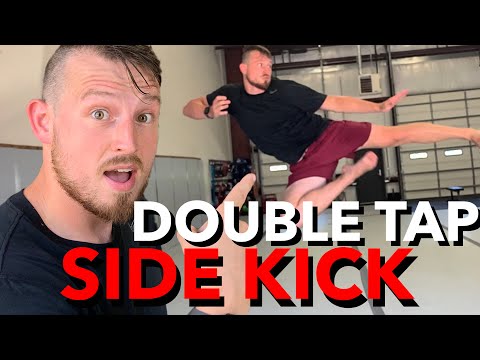
If you want to throw some fancy spinning stuff like Raymond Daniels, the double tap side kick (or butterfly kick, tornad…
The double side kick, popularized by champion martial artist Raymond Daniels, is a two-part striking combination that sequences a stepping side kick followed immediately by a jumping back side kick. According to 1STIMPACT, the technique functions as both an offensive tool and a positioning device—the first kick serves to plant the fighter's weight and shift momentum forward while simultaneously creating a deceptive target for the opponent, while the second kick delivers the primary strike from an elevated position. Sensei Seth emphasizes the linear precision challenge: unlike circular spinning techniques with larger margins of error, the double side kick demands exact timing because both kicks travel straight, requiring minimal positional deviation. He recommends progressive drilling starting with a simple footwork exchange (placing the non-dominant foot back, jumping, switching feet) before advancing to the full combination at speed. Both 1STIMPACT and Sensei Seth stress that the first kick need not land with full power—it functions as a "touch" or "gauge" to assess distance and frame the opponent, with power concentrated in the second kick. MixedMartialArtsHQ.com provides complementary detail on fundamental side kick mechanics: proper hip rotation, heel extension toward ribs or solar plexus, and controlled recovery to avoid overextension. All three instructors note the technique's effectiveness lies in its speed when properly drilled and its capacity to surprise opponents expecting continued pressure after the initial strike.
Сформировано на основе 3 инструкторов
Учебных курсов по этой технике пока нет.
Войдите, чтобы предложить курс.
Риск травмы для человека, к которому применяется техника
Individual kicks are standard side kick power. Speed and variety of targets are the weapons.
Уровень мастерства, необходимый для надёжного выполнения техники
Разрешена ли техника по основным соревновательным правилам
Choi, H.H. (1999). Condensed Encyclopedia of Taekwon-Do. IFT.
[1] Choi, Condensed Encyclopedia of Taekwon-Do (1999)
[2] 116 Wing Chun Dummy Techniques
[1] Choi, Condensed Encyclopedia of Taekwon-Do (1999)
[2] 116 Wing Chun Dummy Techniques
exceptional balance on one leg, rapid hip abduction for re-chambering, flexibility
hip abductors (double chamber), quadriceps, core (balance)
No, according to Sensei Seth, you should 'touch' with the first kick rather than striking with full force. This allows you to gauge distance and keep your opponent in place, preventing either of you from being knocked away, which is the most common problem beginners face with this technique.
According to Sensei Seth, you should put your non-dominant foot on the back first, jump up, and switch so your dominant leg goes second. This allows you to deliver maximum power with your stronger leg on the finishing kick.
Sensei Seth recommends not touching and using knee momentum to pull your body up if you want to come higher, while touching works better if you want to cover more distance or frame your opponent. Not touching also avoids the risk of your foot getting disrupted mid-air.
Yes, according to Sensei Seth, you can perform the double side kick as a wheel kick, which has a wider margin for error since you don't have to hit straight on—anything in between the optimal range can still make contact.
The Double Side Kick is an advanced technique where the fighter delivers two side kicks in rapid succession or simultaneously to different heights or directions. In Taekwon-Do, the first kick typically targets low (knee or thigh) while the second targets mid or high (ribs or head).
The Double Side Kick appears in TKD competition as an advanced scoring technique and in Wing Chun as a simultaneous double kick from the wooden dummy form. It represents different martial arts philosophies — TKD uses sequential double kicks for scoring, while Wing Chun uses simultaneous kicks for overwhelming an opponent's structure.
Unified MMA: Legal: разрешён — standard striking technique; WKF Karate: Legal: разрешён — controlled contact required; WT Taekwondo: Legal: разрешён — kicks are primary scoring technique; WAKO Kickboxing: Legal: разрешён — full contact permitted; IFMA Muay Thai: Legal: разрешён — all strikes permitted
Оценка опасности 5/10. Moderate — individual kicks are standard side kick power. Speed and variety of targets are the weapons.
Стандартная цепочка подготовки: First kick to the thigh → opponent drops guard → second kick to the head → Jab-cross then double side kick while opponent is shelled up → Against the cage.
Стандартные контрприёмы: Close distance after the first kick — jam the second / Step offline — exit the kicking line / Low kick the standing leg — exploit the one-leg balance.
Распространённые варианты: Sequential double (first low, second high from same leg); Same-level double (both kicks at same height for maximum damage); Wing Chun simultaneous (both legs kick sideways at once); Alternating legs (left side kick then right side kick with a hop).
Commonly used in WT Taekwondo Olympic competition and ITF tournament sparring. Also appears in WKF karate kumite and kickboxing.
Основные ошибки, на которые стоит обратить внимание: Losing balance after the first kick / Not re-chambering fully before the second kick — reduces power / Both kicks at the same height — predictable and easy to block / Dropping the hands between kicks — vulnerable to counter-punches.
Double Side Kick также известен как Nidan Yoko Geri, Simultaneous Double Side Kick, Two-Direction Side Kick, Yi-jung Yop Chagi.