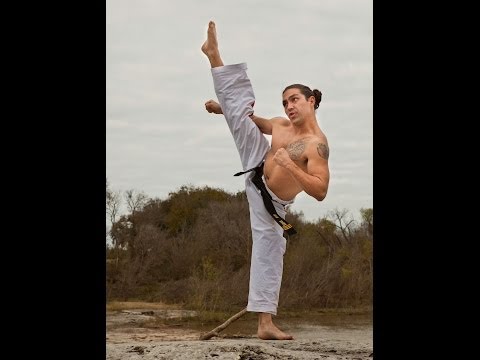
Roundhouse Kick Tutorial by Master Paul Rana
0
Heel Roundhouse Kick·Prana Master's Academy - Martial Arts & Yoga
Roundhouse Kick Tutorial by Master Paul Rana of Prana Martial Arts. -3 Styles of Foot Positioning -Low, Mid and High R…
Перевод: Kakato (踵) = heel, Mawashi (回し) = turning/round, Geri (蹴り) = kick — a roundhouse kick striking with the heel instead of the shin or instep
The Heel Roundhouse Kick is a roundhouse kick variant that strikes with the heel instead of the shin or instep, concentrating the kick's circular force onto a small, hard, bony surface for maximum penetrating impact. [1] In the standard roundhouse kick, the striking surface is either the instep (top of the foot, common in karate and taekwondo) or the shin (tibial bone, standard in Muay Thai) — both relatively broad surfaces that distribute impact over a wide area. [1] The Heel Roundhouse changes the striking surface to the calcaneus (heel bone), which is the largest, densest bone in the foot and presents a concentrated impact area of approximately 3-4 cm² — roughly half the surface area of the instep and one-quarter the surface area of the shin. [1] This concentration of force produces a penetrating, drilling impact that is particularly effective against the solar plexus and liver, where the narrow heel can dig deeper into the body cavity than the broader shin or instep. [1] The heel is presented by pulling the toes back (dorsiflexion) and driving the heel through the target in a circular trajectory — the mechanical execution is identical to a standard roundhouse in terms of hip rotation, chambering, and leg extension, but the ankle position at the moment of impact is dorsiflexed rather than plantarflexed. [1] De Bremaeker and Faige document the Heel Roundhouse as a specialised variant for targeting the solar plexus and liver, noting that the heel's concentrated surface area produces a qualitatively different impact sensation: recipients describe it as a 'stabbing' or 'drilling' feeling rather than the broad 'slapping' impact of a shin roundhouse. [1] The technique requires careful ankle positioning — the dorsiflexion must be aggressive enough to present the heel as the primary contact point, but not so extreme that the ankle buckles under the rotational force of the kick. [1]
The heel (kakato) is one of the classical striking surfaces documented in traditional karate, listed alongside the ball of the foot (tshusoku/koshi), the instep (haisoku), and the sword foot (sokuto). [1],[2] Gichin Funakoshi documented the heel as a striking surface in Karate-Do Kyohan (1935), noting its use in both front kicks (kakato geri) and in certain roundhouse and side kick applications. [2] The specific application of the heel to the roundhouse kick trajectory represents a cross-pollination of the heel-strike concept (traditionally associated with front kicks and axe kicks) with the roundhouse kick's circular delivery. [1] De Bremaeker and Faige catalogued the Heel Roundhouse as Section 3.13 in their 2010 compilation, identifying it as a specialist variant for penetrating body targets. [1] The technique's practical value has been recognised in modern MMA, where fighters occasionally use the heel roundhouse to the body for its deeper penetrating quality against opponents who routinely absorb shin roundhouses without difficulty. [3]
The Heel Roundhouse is a specialist technique whose value lies in its concentrated impact surface: against body targets (solar plexus, liver, floating ribs), the heel penetrates deeper into the body cavity than the broader shin or instep, producing a more intense physiological response at the same force level. [1] The technique is most effective against opponents who have conditioned their bodies to absorb standard shin roundhouses — the different contact surface produces a qualitatively different sensation that conditioning does not address. [1] The primary limitation is that the heel presents a smaller margin for error in targeting: a shin roundhouse that misses by 2 inches still impacts effectively, but a heel roundhouse that misses by 2 inches may contact with the ankle or sole instead, reducing effectiveness. [1]
The Heel Roundhouse is used as a specialist body-targeting weapon in full-contact karate and kickboxing. In Kyokushin competition, the heel roundhouse to the solar plexus is an effective knockout technique. The technique's concentrated impact is particularly valued against body-conditioned opponents who absorb standard shin kicks without difficulty.
Изображений для этой техники пока нет.
Войдите, чтобы предложить изображение.
Roundhouse Kick Tutorial by Master Paul Rana of Prana Martial Arts. -3 Styles of Foot Positioning -Low, Mid and High R…
Учебных курсов по этой технике пока нет.
Войдите, чтобы предложить курс.
Риск травмы для человека, к которому применяется техника
The heel's concentrated impact surface produces deeper penetration into body targets than shin or instep roundhouses. When targeting the solar plexus, the heel can cause severe diaphragm spasm (winding). When targeting the liver, the concentrated impact at the intercostal gap produces a more intense liver-shot response. When targeting the floating ribs, the narrow heel can fracture individual ribs more effectively than the broader shin. The heel's bone density means the kicker's foot is less likely to be injured than with an instep kick. [1]
Уровень мастерства, необходимый для надёжного выполнения техники
Разрешена ли техника по основным соревновательным правилам
Essential Book of Martial Arts Kicks (De Bremaeker & Faige, 2010)
description: [1] De Bremaeker 2010 pp.130-131, [2] Funakoshi 1973
Mixed Japanese-Western terminology — combines traditional Japanese terms with katakana loanwords
description: [1] De Bremaeker 2010 pp.130-131, [2] Funakoshi 1973
Requires strong tibialis anterior (dorsiflexor) muscles to maintain aggressive dorsiflexion under impact
Standard roundhouse kick hip flexibility and rotation
Proprioceptive awareness of heel positioning during the kick
Ankle stability to prevent collapse on contact
Accessible to all body types once the dorsiflexion control is mastered
Pivoting protects your knee by distributing force away from your kneecap, stacks your hips for better power transfer, and allows you to strike through the target effectively. Master Paul Rana emphasizes that without pivoting, all the force goes directly into your kneecap, which can cause injury.
You should strike with your shin whenever possible. If you're barefooted, avoid hitting with the top of your foot since there are many small bones in the instep that can break easily; however, with pads or shoes on, you have more flexibility in your striking surface.
Keep your leg loose and relaxed like nunchucks until the moment of strike, then pop your hips and snap the shin through the target. Master Paul Rana explains that this looseness allows your leg to snap when it comes around, maximizing the whipping power of the kick.
The higher you want to kick, the more you need to lean back and pivot strongly on the ball of your foot. This increased pivot and backward lean are essential to maintain proper form and balance at higher target heights.
The Heel Roundhouse Kick is a roundhouse kick variant that strikes with the heel instead of the shin or instep, concentrating the kick's circular force onto a small, hard, bony surface for maximum penetrating impact. In the standard roundhouse kick, the striking surface is either the instep (top of the foot, common in karate and taekwondo) or the shin (tibial bone, standard in Muay Thai) — both relatively broad surfaces that distribute impact over a wide area.
The heel (kakato) is one of the classical striking surfaces documented in traditional karate, listed alongside the ball of the foot (tshusoku/koshi), the instep (haisoku), and the sword foot (sokuto). Gichin Funakoshi documented the heel as a striking surface in Karate-Do Kyohan (1935), noting its use in both front kicks (kakato geri) and in certain roundhouse and side kick applications.
Unified MMA: разрешён — Legal striking technique; WBC/Boxing: запрещён — All kicks prohibited in boxing; WKF: разрешён — Legal, chudan (body) kick scores 2 points, jodan (head) kick scores 3 points; Kyokushin: разрешён — Legal at full power to body and head; WT: разрешён — Legal, body kick 2 points, head kick 3 points, spinning body 4 points, spinni…; WAKO: разрешён — Legal in Full Contact and Low Kick formats; K: разрешён — 1/GLORY — Legal; IFMA: разрешён — Legal — kicks are a core Muay Thai technique
Оценка опасности 7/10. The heel's concentrated impact surface produces deeper penetration into body targets than shin or instep roundhouses. When targeting the solar plexus, the heel can cause severe diaphragm spasm (winding). When targeting the liver, the concentrated impact at the intercostal gap produces a more intense liver-shot response. When targeting the floating ribs, the narrow heel can fracture individual ribs more effectively than the broader shin. The heel's bone density means the kicker's foot is less likely to be injured than with an instep kick.
Стандартная цепочка подготовки: Establish standard shin or instep roundhouse kicks to condition the opponent's defensive response → Opponent develops a routine block or check calibrated to the standard impact → Switch to the Heel Roundhouse: same chamber, same rotation, but dorsiflex the ankle at extension → The heel contacts the target instead of the shin/instep → The concentrated impact penetrates deeper, causing greater pain and disruption → Follow up while the opponent is reacting to the unexpected impact quality.
Стандартные контрприёмы: Elbow block — dropping the elbow to the ribs intercepts the heel (though the concentrated impact may still cause fore… / Step back — retreating out of roundhouse range / Check with the shin — standard Muay Thai shin check / Low kick counter — attacking the standing leg during the roundhouse.
Распространённые варианты: Heel roundhouse to solar plexus (the primary application, targeting the soft tissue at the…); Heel roundhouse to liver (targeting the right side (against orthodox opponent), whe…); Heel roundhouse to head (elevating the kick to head level with heel contact (requi…); Lead leg heel roundhouse (faster delivery from the front leg for close-range applic…); Heel roundhouse to the arm (targeting the opponent's blocking arm to cause deep bruis…); Heel roundhouse to the thigh (using the concentrated heel against the outer thigh for a…).
The Heel Roundhouse is used as a specialist body-targeting weapon in full-contact karate and kickboxing. In Kyokushin competition, the heel roundhouse to the solar plexus is an effective knockout technique.
Основные ошибки, на которые стоит обратить внимание: Insufficient dorsiflexion — if the ankle is not aggressively dorsiflexed, the instep contacts the target instead of t… / Contact with the Achilles tendon — if the foot is dorsiflexed TOO much, the Achilles tendon (posterior to the heel) c… / Ankle collapse on impact — weak dorsiflexor muscles (tibialis anterior) allow the ankle to buckle back to plantarflex… / Using against hard targets — the heel is structurally strong but the ankle's dorsiflexed position under rotational fo….
Heel Roundhouse Kick также известен как Kakato Mawashi Geri, Heel Mawashi Geri, Heel Round Kick, Heel-First Roundhouse, Penetrating Roundhouse.