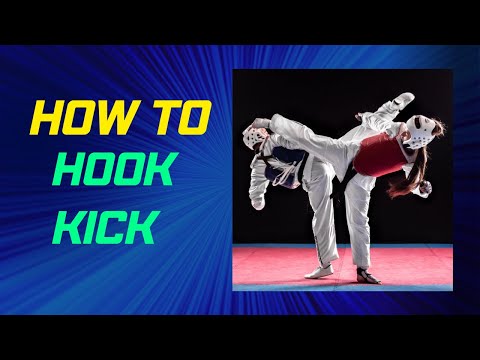
How to do the Taekwondo Hook kick: A step-by-step guide.
0
Hooked Hook Kick·Taekwondo Guide
Paul Van Schoyck of Taekwondo Guide gives a step by step breakdown on how to do the Taekwondo hook kick. Visit www.tkdg…
Перевод: Hooked hook kick
The Hooked Hook Kick features an exaggerated hooking motion at the end of the arc, wrapping around the opponent's guard to strike the back of the head or neck. [1] The deep hook action pulls the foot further around the target than a standard hook kick. [1]
Offers specific tactical advantages over the standard hook kick in appropriate situations. [1]
Cross-style martial arts kicking tradition; documented in kick compendiums. [1]
Primarily a training, demonstration, and point-fighting technique. Rarely seen in full-contact MMA or kickboxing due to acrobatic risk and telegraphing. Appears occasionally in TKD and point-fighting karate tournaments. [1]
Изображений для этой техники пока нет.
Войдите, чтобы предложить изображение.
Paul Van Schoyck of Taekwondo Guide gives a step by step breakdown on how to do the Taekwondo hook kick. Visit www.tkdg…
Yea, what the title says.
The hooked hook kick is a fundamental striking technique recognized across taekwondo and tricking disciplines for its versatility and tactical importance. Taekwondo Guide emphasizes that the hook kick, alongside the sidekick and roundhouse, provides complete attack vectors, making it essential for unpredictable offensive strategy. The technique begins with lifting the leg straight (mimicking a side stretch motion) before hooking the foot across the body's back side. Taekwondo Guide stresses a critical timing principle: the leg must be locked straight at impact, with the knee hook occurring after contact—not before. Strike surfaces include the heel, flat of the foot, or cupped foot position, with the medial longitudinal arch offering electronic scoring advantages in competition. Power derives from glute engagement, practiced initially with low kicks before progressing to higher heights. A tight, compact arc increases both power and landing accuracy. SykoDragon approaches the hook kick from a tricking perspective, describing it as a stabilizing transition tool between tricks. The kick originates from a side kick chamber at 45 degrees, extending outward before opening the hips and pulling inward. SykoDragon notes variations in striking surface—heel versus pointed toes at 90 degrees—and emphasizes that spinning hook kicks require exceptional hip mobility and spin quality. Both instructors agree on the importance of chamber control, hip positioning, and deliberate practice at slow speeds to develop proper mechanics before adding speed.
Сформировано на основе 2 инструкторов
Учебных курсов по этой технике пока нет.
Войдите, чтобы предложить курс.
Риск травмы для человека, к которому применяется техника
Hook Kick variant with standard striking power
Уровень мастерства, необходимый для надёжного выполнения техники
Разрешена ли техника по основным соревновательным правилам
Essential Book of Martial Arts Kicks (De Bremaeker & Faige, 2010)
[1] De Bremaeker & Faige, Essential Book of Martial Arts Kicks (2010)
Requires solid hook kick foundation
Good balance and coordination
Documented in De Bremaeker & Faige, Section 5.2 (ushiro mawashi kakegeri in karate, nakka tshagy in TKD). A hook kick with an exaggerated hooking action — the heel loops further around the target for maximum wrap-around contact. (De Bremaeker & Faige, Essential Book of Martial Arts Kicks, 2010, p. 181)
Your leg should be locked straight at the point of impact with the target, and only then do you hook your knee. You should not hook your knee before hitting the target—that's backwards. According to Taekwondo Guide, keeping this principle in mind is essential as you develop the kick.
You can chamber the kick and position yourself straight next to the target, then hook the foot across. Alternatively, you can start with a chamber, kick out in the side kick position, and then hook your foot—this is a quicker variation but more advanced, according to Taekwondo Guide.
The hook kick, along with the sidekick and roundhouse kick, gives you access to each attack vector. With the sidekick you can go straight toward your opponent, and with the roundhouse and hook kicks you can come from each horizontal direction, according to Taekwondo Guide.
Hold onto something stable like a wall and practice the kick while maintaining a clean knee chamber and a tight arc. Taekwondo Guide advises against swinging your kick out loosely and emphasizes keeping the motion controlled during this isolation drill.
The Hooked Hook Kick features an exaggerated hooking motion at the end of the arc, wrapping around the opponent's guard to strike the back of the head or neck. The deep hook action pulls the foot further around the target than a standard hook kick.
The Hooked Hook Kick is a specialised variant documented in cross-style kicking methodology. It represents an advanced development of the standard hook kick.
Unified MMA: разрешён — Legal striking technique; WBC/Boxing: запрещён — All kicks prohibited in boxing; WKF: разрешён — Legal, chudan (body) kick scores 2 points, jodan (head) kick scores 3 points; Kyokushin: разрешён — Legal at full power to body and head; WT: разрешён — Legal, body kick 2 points, head kick 3 points, spinning body 4 points, spinni…; WAKO: разрешён — Legal in Full Contact and Low Kick formats; K: разрешён — 1/GLORY — Legal; IFMA: разрешён — Legal — kicks are a core Muay Thai technique
Оценка опасности 6/10. Hook Kick variant with standard striking power
Стандартная цепочка подготовки: Feint → Hooked Hook Kick → Follow-up combination.
Стандартные контрприёмы: Step inside range / Block and counter / Low kick to support leg.
Распространённые варианты: High variant; Mid variant; Low variant.
Primarily a training, demonstration, and point-fighting technique. Rarely seen in full-contact MMA or kickboxing due to acrobatic risk and telegraphing.
Основные ошибки, на которые стоит обратить внимание: Attempting without solid hook kick foundation / Poor balance / Insufficient power generation.
Hooked Hook Kick также известен как Fukkudo Fukku Kikku, Tight Hook Kick, Deep Hook Kick.