The Complete Guide to The Stab Kick - Mae Geri - Front Kick (Pro Striking Breakdown)
0
Front Leg Front Kick·Pro Striking
You can support the channel and access extra Breakdowns and Tutorials on the Pro Striking Patreon here: www.patreon.com/…
Перевод: sliding front kick
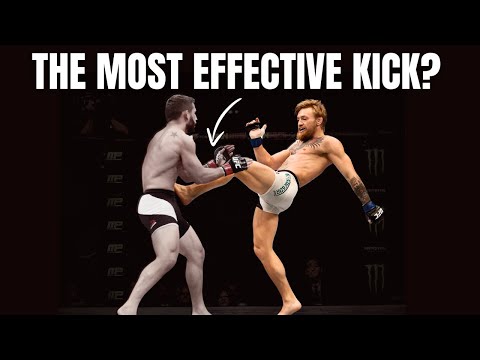
The Front Leg Front Kick is a fast front kick delivered with the lead leg by sliding the rear foot forward to close distance before launching the kick. [1] The rear leg slides forward without moving the upper body to avoid telegraphing, creating a momentary crossed-leg position before the formerly front leg chambers and kicks. [1] This technique emphasizes speed over power — the reduced distance traveled means less hip rotation but a faster delivery that catches opponents before they can react. [1] It can function as a stop-kick against advancing opponents or as a range-closer when combined with offensive combinations. [1]
The front leg front kick is practiced across multiple karate styles and taekwondo under various names. In Shotokan karate it is called surikonde mae geri (sliding front kick), while Shorinji-ryu kenkokan uses the terms oigeri and okurigeri. [1] Taekwondo refers to it as ahp-bal ahp-chagi, and Sankukai karate and Shorinji kempo use the term jun geri. [1]
The front leg front kick sacrifices power for speed and surprise. [1] It is particularly effective as a range-management tool to maintain distance or as a stop-kick against aggressive opponents. In MMA, the lead leg front kick to the body (teep) is one of the most frequently used techniques for distance control. [1]
Practiced across karate (surikonde mae geri), Taekwondo, and Muay Thai (teep). Documented in De Bremaeker & Faige (2010). [1]
Frequently used in MMA (UFC, ONE Championship, Bellator), kickboxing (GLORY, K-1), and Muay Thai (Lumpinee, Rajadamnern). One of the most commonly thrown kicks in professional striking competition. [1]
Изображений для этой техники пока нет.
Войдите, чтобы предложить изображение.
You can support the channel and access extra Breakdowns and Tutorials on the Pro Striking Patreon here: www.patreon.com/…
Учебных курсов по этой технике пока нет.
Войдите, чтобы предложить курс.
Риск травмы для человека, к которому применяется техника
Less power than rear leg version but faster delivery. Low risk of serious injury in sport contexts.
Уровень мастерства, необходимый для надёжного выполнения техники
Разрешена ли техника по основным соревновательным правилам
De Bremaeker, M. & Faige, R. (2010). Essential Book of Martial Arts Kicks. Tuttle Publishing.
[1] De Bremaeker & Faige, Essential Book of Martial Arts Kicks (2010), Section 1.4, pp. 21-22
Official karate technique names (和語/漢語)
Established Japanese martial arts naming convention — native Japanese term (和語/漢語)
[1] De Bremaeker & Faige, Essential Book of Martial Arts Kicks (2010), Section 1.4, pp. 21-22
timing, hip flexibility for chambering
long legs for range advantage
hip flexors, quadriceps, core stabilizers
Your toes should be pointing up and curled back to keep them in a strong position for impact. According to Pro Striking, the idea is to target the ball of the foot, so think about coming up onto your tiptoes while standing to protect your toes.
Pro Striking advises aiming for the opponent's chin, solar plexus, liver, or lower abdomen depending on the distance and positioning. The key is to select an opening based on your opponent's reactions to previous feints.
Pro Striking emphasizes that you should quickly retract your leg back to your fighting stance as fast as possible, unless you're advancing into further combinations. If kicking with your rear leg, bring it back behind you; if kicking with your lead leg, you can land forward.
According to Pro Striking, the front kick doesn't telegraph much and is difficult for the opponent to defend because it comes up in the frontal plane without hip rotation, allowing the fighter to remain more balanced than with a round kick. Even if the leg is caught, a strong hamstring can help you escape.
The Front Leg Front Kick is a fast front kick delivered with the lead leg by sliding the rear foot forward to close distance before launching the kick. The rear leg slides forward without moving the upper body to avoid telegraphing, creating a momentary crossed-leg position before the formerly front leg chambers and kicks.
The front leg front kick is practiced across multiple karate styles and taekwondo under various names. In Shotokan karate it is called surikonde mae geri (sliding front kick), while Shorinji-ryu kenkokan uses the terms oigeri and okurigeri.
Unified MMA: Legal: разрешён — standard striking technique; WKF Karate: Legal: разрешён — controlled contact required; WT Taekwondo: Legal: разрешён — kicks are primary scoring technique; WAKO Kickboxing: Legal: разрешён — full contact permitted; IFMA Muay Thai: Legal: разрешён — all strikes permitted
Оценка опасности 4/10. Moderate — less power than rear leg version but faster delivery. Low risk of serious injury in sport contexts.
Стандартная цепочка подготовки: Jab-cross combination to occupy hands → slide forward and front kick to body → Feint jab → front leg front kick to face → As counter.
Стандартные контрприёмы: Side step — move laterally to avoid the linear kick / Catch and sweep — catch the kicking leg and sweep the standing leg / Low kick counter — attack the standing leg as the kick is launched.
Распространённые варианты: Static stop-kick (delivered without sliding to halt an advancing opponent); Penetrating version (ball of foot driven through the target); Upward version (instep snaps upward to chin or groin); Combined with shoot (front kick stops opponent, followed by double-leg takedow…).
Frequently used in MMA (UFC, ONE Championship, Bellator), kickboxing (GLORY, K-1), and Muay Thai (Lumpinee, Rajadamnern). One of the most commonly thrown kicks in professional striking competition.
Основные ошибки, на которые стоит обратить внимание: Moving the upper body forward during the slide, telegraphing the kick / Taking too long a slide, giving the opponent time to react / Not chambering the knee high enough after the slide / Leaning back excessively during the kick, reducing power further.
Front Leg Front Kick также известен как Surikonde Mae Geri, Oigeri, Okurigeri, Ahp-bal Ahp-Chagi, Jun Geri.