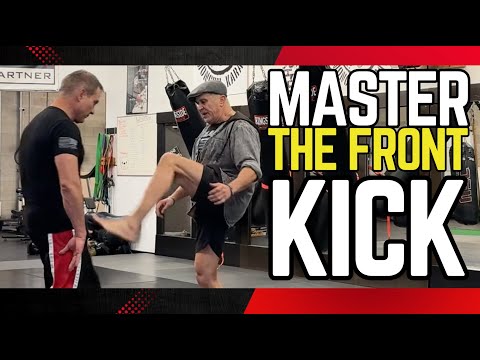
Master The Front Kick In 3 Minutes GUARANTEED
0
Drop Front Kick·Glove Up
🔥 The NEW GLOVE UP App is LIVE! 🔥 Unlock elite striking skills and drills, bag workouts and NEVER BEFORE SEEN seminars…
Перевод: Drop front kick — a front kick delivered while intentionally dropping the body toward the ground, using the controlled fall to create an unexpected attack angle from below
The Drop Front Kick is a front kick delivered while the practitioner intentionally drops their body toward the ground, creating an unexpected low-angle attack that bypasses standing defences by striking from below the opponent's visual field. [1] As the kicker's body descends in a controlled fall, the kicking leg extends forward and upward, striking with the ball of the foot while the body is in mid-descent — the kick arrives from an angle that standing opponents are not conditioned to defend because conventional kicks come from an upright position. [1] The technique is classified as a 'sacrifice' kick because the practitioner deliberately abandons their standing base to execute the strike, accepting the trade-off of ending up on the ground in exchange for the element of surprise and the unique attack angle. [1] De Bremaeker and Faige categorise the Drop Front Kick alongside other drop kicks (drop side kick, drop roundhouse kick, drop back kick) as a family of techniques derived from capoeira, kung fu, and traditional martial arts systems that incorporate ground-level transitions into their fighting methodology. [1] The kick is most effective as a counter: when the opponent charges forward aggressively, the kicker drops below their attack line while simultaneously firing the front kick upward into the opponent's exposed midsection or face — the opponent's own forward momentum carries them into the ascending kick while the kicker's body drops safely below the opponent's strikes. [1] In MMA, ground-level kicks (up-kicks) from the guard position use similar mechanics, though those are delivered from an already-grounded position rather than from a deliberate drop. [2] The Drop Front Kick represents the broader martial arts principle that changing levels — moving between standing and ground-level fighting — creates confusion and openings that fixed-height fighting cannot achieve. [1]
Drop kicks — techniques that intentionally sacrifice standing balance to attack from ground level — appear across multiple martial arts traditions that incorporate ground transitions into their fighting systems. [1] Capoeira, the Brazilian martial art developed by enslaved Africans, includes numerous ground-level kicking techniques (including the rasteira, meia lua de compasso, and queda de rins) that share the Drop Front Kick's principle of attacking from unexpected heights. [1] Chinese kung fu systems, particularly those from Southern China (which emphasise low stances and ground transitions), include falling kicks in their repertoires. [1] In the modern context, the Drop Front Kick was catalogued by De Bremaeker and Faige as one of 89 fundamental kicks across all styles, noting its cross-cultural presence and its tactical value as a surprise weapon. [1] In MMA, the related concept of the up-kick (kicking from the bottom guard position) has produced numerous finishes, demonstrating that ground-level kicking can be fight-ending even in professional competition. [2]
The Drop Front Kick's effectiveness is primarily based on surprise: the dramatic height change (from standing to ground level) disrupts the opponent's defensive framework, which is calibrated for standing-height attacks. [1] The technique is most effective in its first use within a fight — once the opponent has seen it, they become wary of the level change and the surprise element is reduced. [1] The backward drop variant (dropping away from an advancing opponent while kicking upward) is the highest-percentage application because the opponent's forward momentum carries them into the ascending kick. [1] The primary limitation is the post-kick vulnerability: the kicker is on the ground after the technique, which is advantageous in grappling-based rule sets (MMA, where the kicker can transition to guard) but disadvantageous in striking-only competition and self-defence scenarios (where the kicker should ideally return to standing immediately). [1],[2]
Capoeira ground-level kicking tradition + Chinese kung fu ground transitions + traditional martial arts sacrifice techniques → catalogued as a cross-style fundamental kick by De Bremaeker & Faige (2010). [1]
Drop kicks are relatively rare in modern competition due to the risk of ending up on the ground. In MMA, the related up-kick from guard has produced multiple UFC stoppages. In capoeira competition (jogo), ground-level kicks are standard and frequently scored. In Kyokushin full-contact karate, dropping techniques occasionally appear as surprise attacks.
Изображений для этой техники пока нет.
Войдите, чтобы предложить изображение.
🔥 The NEW GLOVE UP App is LIVE! 🔥 Unlock elite striking skills and drills, bag workouts and NEVER BEFORE SEEN seminars…
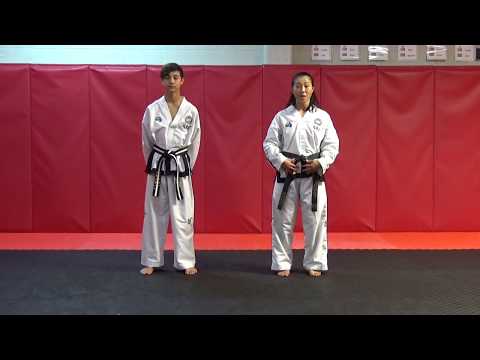
6th Dan black belt Chrisitne Young demonstrates the front snap kick technique and application with 1st Dan black belt Na…
The drop front kick is a fundamental striking technique executed from the front leg, emphasizing a snapping motion with primary focus on knee control and hip positioning. Both TMAANZ and Glove Up instructors agree on core mechanics: the attacking tool is the ball of the foot, the knee initiates the movement and should remain still during extension, and proper hip alignment is essential. TMAANZ emphasizes targeting precision, with low kicks aimed at the belly button and mid-level kicks directed at the solar plexus, stressing that beginners commonly err by kicking below the belt. The instructor notes the importance of aiming the ball of the foot forward on a horizontal plane rather than upward, and maintaining proper foot extension during retraction. Glove Up's David Dice prioritizes hip mechanics, instructing that hips must be squared to the target rather than angled, enabling proper force transfer and preventing lateral instability. Dice demonstrates that the kick is primarily a quad-hamstring snap similar to a jab extension, cautioning that knee motion during the kick results in upward trajectory. Both sources acknowledge that proper execution delivers significant impact despite its appearance of minimal effort. The key distinction is TMAANZ's detailed target anatomy versus Glove Up's emphasis on foundational mechanical efficiency and hip-driven power generation.
Сформировано на основе 2 инструкторов
Учебных курсов по этой технике пока нет.
Войдите, чтобы предложить курс.
Риск травмы для человека, к которому применяется техника
The Drop Front Kick has moderate power because the kick must compensate for the body's descent — the kicker cannot fully commit body weight forward (as in a standing kick) because the body is falling downward. However, the element of surprise means the kick often lands on an undefended target, partially compensating for the reduced power. The primary danger is to the KICKER: landing on the ground after the kick creates vulnerability to ground-and-pound in MMA or stomps in self-defence situations. [1]
Уровень мастерства, необходимый для надёжного выполнения техники
Разрешена ли техника по основным соревновательным правилам
Essential Book of Martial Arts Kicks (De Bremaeker & Faige, 2010)
description: [1] De Bremaeker 2010 pp.48-50
Standard katakana transliteration of Western martial arts terminology (外来語) — used in Japanese MMA, boxing, and BJJ communities
description: [1] De Bremaeker 2010 pp.48-50
Requires body control during the fall — the descent must be controlled, not a collapse
Good core strength to maintain the kick's trajectory during the descent
Upper body strength for controlling the landing (hands contacting the ground)
Ability to recover to standing quickly after the kick
Good ground awareness for transitioning to guard if recovery is not immediate
Practitioners comfortable with ground transitions (wrestlers, BJJ players, capoeiristas) adapt to this technique faster
Many beginners think hinging front kicks don't do damage because they feel light at slow speed, but the issue is often that your knee is still in motion when you kick, causing the kick to travel upward rather than straight. According to Glove Up instructors, you need to pop your knee up first, then extend it straight forward so it goes 'boom right straight in' rather than up.
Keep your hips square and your base foot pointing straight—not on an angle—because it's hard to square your hips when your foot's angled. Glove Up emphasizes that when your hips are square and base foot is straight, you can drive your hip in with power; if your base foot is on an angle, you lose that ability.
Aim the ball of your foot at the solar plexus (the soft area between the rib cage at belly button height), not lower toward the bladder area. TMAANZ notes this is a very sensitive vital spot, and a strong front snap kick with the ball of the foot to the solar plexus can end the match.
Point the ball of your foot forward and your toes back so the ball reaches the target on a horizontal line—not flat with the ball pointing upward. TMAANZ emphasizes this is a common beginner mistake where the foot is too flat and the ball angles up instead of forward.
The Drop Front Kick is a front kick delivered while the practitioner intentionally drops their body toward the ground, creating an unexpected low-angle attack that bypasses standing defences by striking from below the opponent's visual field. As the kicker's body descends in a controlled fall, the kicking leg extends forward and upward, striking with the ball of the foot while the body is in mid-descent — the kick arrives from an angle that standing opponents are not conditioned to defend because conventional kicks come from an upright position.
Drop kicks — techniques that intentionally sacrifice standing balance to attack from ground level — appear across multiple martial arts traditions that incorporate ground transitions into their fighting systems. Capoeira, the Brazilian martial art developed by enslaved Africans, includes numerous ground-level kicking techniques (including the rasteira, meia lua de compasso, and queda de rins) that share the Drop Front Kick's principle of attacking from unexpected heights.
Unified MMA: разрешён — Legal striking technique; WBC/Boxing: запрещён — All kicks prohibited in boxing; WKF: разрешён — Legal, chudan (body) kick scores 2 points, jodan (head) kick scores 3 points; Kyokushin: разрешён — Legal at full power to body and head; WT: разрешён — Legal, body kick 2 points, head kick 3 points, spinning body 4 points, spinni…; WAKO: разрешён — Legal in Full Contact and Low Kick formats; K: разрешён — 1/GLORY — Legal; IFMA: разрешён — Legal — kicks are a core Muay Thai technique
Оценка опасности 5/10. The Drop Front Kick has moderate power because the kick must compensate for the body's descent — the kicker cannot fully commit body weight forward (as in a standing kick) because the body is falling downward. However, the element of surprise means the kick often lands on an undefended target, partially compensating for the reduced power. The primary danger is to the KICKER: landing on the ground after the kick creates vulnerability to ground-and-pound in MMA or stomps in self-defence situations.
Стандартная цепочка подготовки: Establish standing attacks (jab, cross, front kick from standing) to condition the opponent to defend at standing height → Opponent calibrates their defence for standing-level attacks → Feint a standing attack or wait for the opponent to advance → Begin controlled body descent → During the descent, fire the front kick upward toward the opponent's midsection or chin → The kick arrives from below the opponent's guard → Kick impact → Immediately: (a) recover to standing by pushing off the ground, OR (b) transition to closed guard/butterfly guard to prevent the opponent from establishing top control.
Стандартные контрприёмы: Step back — retreating as the opponent drops takes the target out of the kick's upward range / Downward strike — attacking the dropping opponent as they descend (the body is committed to the fall and cannot chang… / Leg stomp — stomping on the grounded opponent's legs after the kick misses / Top pressure — if the kick misses and the opponent is grounded, immediately establishing top control (mount, side con….
Распространённые варианты: Forward Drop Front Kick (dropping while moving forward aggressively, the kick stri…); Backward Drop Front Kick (dropping while retreating, using the kick as a counter ag…); Side Drop Front Kick (dropping laterally while kicking forward, creating a diag…); Spinning Drop Front Kick (adding a spin to the drop for additional rotational force…); Drop Twin Front Kick (delivering two successive front kicks during a single con…).
Drop kicks are relatively rare in modern competition due to the risk of ending up on the ground. In MMA, the related up-kick from guard has produced multiple UFC stoppages.
Основные ошибки, на которые стоит обратить внимание: Dropping too fast and losing control of the kick's aim — the descent must be CONTROLLED; a panicked collapse produces… / Not extending the kick fully during the drop — the kicking leg must achieve near-full extension before the body reach… / Failing to protect the head during the descent — one or both hands should be positioned to break the fall; face-plant… / No recovery plan — attempting the drop kick without a plan for returning to standing (or transitioning to guard) leav….
Drop Front Kick также известен как Doroppu Furonto Kikku, Dropping Front Kick, Ground Front Kick, Sacrifice Front Kick, Falling Front Kick.