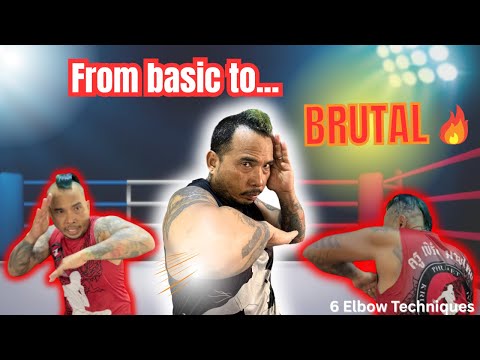
Master These 6 Muay Thai Elbows (Beginner to Advanced Guide)
0
Standard Sok Ngat·Kru Bird Muay Thai·Added by Admin
Learn 6 essential Muay Thai elbow techniques — from beginner fundamentals to advanced fight applications. In this video,…
Перевод: standard uppercut elbow
The Standard Sok Ngat executes the classical Thai uppercut elbow, where the fighter drops the striking arm to the side, bends the knees slightly, and then drives upward through the legs and hips to launch the elbow point into the underside of the opponent's chin. [1] The motion is compact and explosive, with the elbow traveling the shortest possible distance to maximise speed and minimise telegraph. [1],[2] The standard Sok Ngat is frequently used as a counter in the clinch when an opponent reaches for a collar tie or attempts to control the head. [2],[3]
The standard sok ngat. [1]
A Muay Thai elbow. [1]
Used in Muay Thai. [1]
Изображений для этой техники пока нет.
Войдите, чтобы предложить изображение.
Learn 6 essential Muay Thai elbow techniques — from beginner fundamentals to advanced fight applications. In this video,…
Учебных курсов по этой технике пока нет.
Войдите, чтобы предложить курс.
Риск травмы для человека, к которому применяется техника
Rising elbow; targets chin from below
Уровень мастерства, необходимый для надёжного выполнения техники
Разрешена ли техника по основным соревновательным правилам
Muay Thai: The Art of Fighting (Yod Ruerngsa, Khun Kao Charuad & James Cartmell, 2002)
Alias sources — [1] Muay Thai Unleashed (Delp, 2006) [2] Muay Thai: The Art of Fighting (Kraitus & Kraitus, 1988) [3] Muay Thai: A Living Legacy (Vail, 2014)
Effectiveness sources — [1] Muay Thai: The Art of Fighting (Kraitus & Rennehan, 2002)
Standard katakana transliteration of Western martial arts terminology (外来語) — used in Japanese MMA, boxing, and BJJ communities
Alias sources — [1] Muay Thai Unleashed (Delp, 2006) [2] Muay Thai: The Art of Fighting (Kraitus & Kraitus, 1988) [3] Muay Thai: A Living Legacy (Vail, 2014)
Effectiveness sources — [1] Muay Thai: The Art of Fighting (Kraitus & Rennehan, 2002)
leg drive, upward hip thrust, tight vertical alignment
shorter reach fighters effective at inside range
quadriceps, glutes, deltoids, biceps, core
Stepping forward is essential for proper elbow technique because it ensures you have good balance and allows your whole body to generate power together. According to Kru Bird Muay Thai, if you don't step forward, you'll rely only on your arm and body positioning, which causes you to lose balance and makes it difficult to recover.
Kru Bird Muay Thai recommends using your thumb to touch your chest as a technique check to ensure your position isn't missed. This helps you remember to keep your guard up and prevent losing your defensive position during the strike.
When you turn and throw an elbow, your shoulder and body must move together as one unit, not just your elbow alone. Kru Bird Muay Thai emphasizes that moving only your elbow causes you to lose balance and makes it hard to return to your guard.
Kru Bird Muay Thai recommends starting with a simple alternating pattern—left, right, left, right—to build muscle memory and make it easy to remember, then gradually add combinations. Practicing this way helps you control your footwork and elbow together so you won't feel rushed during execution.
The Standard Sok Ngat executes the classical Thai uppercut elbow, where the fighter drops the striking arm to the side, bends the knees slightly, and then drives upward through the legs and hips to launch the elbow point into the underside of the opponent's chin. The motion is compact and explosive, with the elbow traveling the shortest possible distance to maximise speed and minimise telegraph.
The standard Sok Ngat has been trained in Muay Thai camps throughout Thailand for generations as one of the essential elbow strikes in the art's repertoire. Its effectiveness in clinch fighting has made it a signature technique of many Thai champions.
Unified MMA: разрешён — Legal — all elbow strikes permitted; WBC/Boxing: запрещён — All elbow strikes prohibited in boxing; WKF: запрещён — Elbow strikes not a legal technique in sport karate; Kyokushin: запрещён — Elbow strikes prohibited; WT: запрещён — Prohibited; ITF: запрещён — Prohibited; WAKO: запрещён — Prohibited in all kickboxing formats; K: запрещён — 1/GLORY — Prohibited — key difference from Muay Thai; IFMA: разрешён — Legal — elbows are a core Muay Thai weapon (art of eight limbs)
Оценка опасности 7/10. Very High — rising elbow; targets chin from below
Стандартная цепочка подготовки: Assume Fighting Stance → Generate Power → Execute Strike → Recover to Guard.
Стандартные контрприёмы: Block — absorb the strike with a protective guard position / Evasion — move the target out of the strike's path / Counter-Attack — time an offensive response during the recovery phase of the strike.
Распространённые варианты: Standard uppercut (rising punch from below targeting the chin); Short uppercut (compact version for clinch range); Body uppercut (targeting the solar plexus with the rising punch); Lead uppercut (using the lead hand for a faster, less-telegraphed rising…).
Used in Muay Thai.
Основные ошибки, на которые стоит обратить внимание: Not pulling the opponent into the elbow — the hand control is what makes the sok ngat devastating / Driving with the arm only, ignoring the legs and hips / Opening the arm angle during the upward drive — keep the fist locked to the shoulder / Missing the chin and hitting the chest or shoulder — aim precisely for the point of the chin.
Standard Sok Ngat также известен как Sutandādo Sōku Ngatto, Standard Rising Elbow, Standard Uppercut Elbow, Sok Ngat Technique.