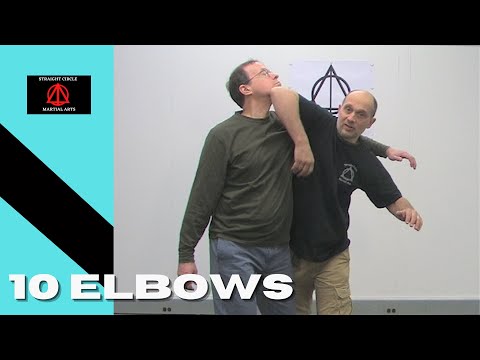
10 Elbow Strikes
0
Slashing Elbow·Straight Circle Martial Arts
10 variations of elbows you may not know.
Перевод: slashing elbow (Sok Tee)
The Slashing Elbow subfamily covers horizontal elbows executed with an emphasis on a cutting or raking action, where the point of the elbow slices across the opponent's skin rather than delivering blunt concussive force. [1] The slashing motion involves a slight upward or downward angle within the generally horizontal plane, allowing the sharp tip of the olecranon to open cuts on the forehead, brow ridge, or cheekbone. [1],[2] In Muay Thai, the slashing elbow is used strategically to produce bleeding that impairs the opponent's vision or leads to a stoppage by the ringside physician. [2],[3]
The slashing elbow developed within Muay Thai as fighters discovered that a raking horizontal trajectory produced lacerations more reliably than a blunt-force strike. [1] This approach became a strategic tool in Thai stadium fights, where cuts could lead to point deductions for the bleeding fighter or stoppages that favoured the cutter. [2],[3]
The slashing elbow cuts diagonally across the opponent's face. [1]
From Muay Thai's sok tee. [1]
Used in Muay Thai and MMA. [1]
Изображений для этой техники пока нет.
Войдите, чтобы предложить изображение.
10 variations of elbows you may not know.
Учебных курсов по этой технике пока нет.
Войдите, чтобы предложить курс.
Риск травмы для человека, к которому применяется техника
Slashing elbow; primary laceration-causing strike in Muay Thai
Уровень мастерства, необходимый для надёжного выполнения техники
Разрешена ли техника по основным соревновательным правилам
Muay Thai: The Art of Fighting (Yod Ruerngsa, Khun Kao Charuad & James Cartmell, 2002)
Alias sources — [1] Muay Thai: The Art of Fighting (Kraitus & Kraitus, 1988) [2] Muay Thai Unleashed (Delp, 2006) [3] WBC Muay Thai Rules (2014)
Effectiveness sources — [1] Muay Thai Unleashed (Delp, 2006)
Standard katakana transliteration of Western martial arts terminology (外来語) — used in Japanese MMA, boxing, and BJJ communities
Alias sources — [1] Muay Thai: The Art of Fighting (Kraitus & Kraitus, 1988) [2] Muay Thai Unleashed (Delp, 2006) [3] WBC Muay Thai Rules (2014)
Effectiveness sources — [1] Muay Thai Unleashed (Delp, 2006)
hip rotation power, rear foot pivot, full kinetic chain coordination
reach advantage, strong hips for power transfer
glutes, obliques, pectorals, triceps, deltoids
Каждое движение в любом боевом искусстве обладает рядом универсальных свойств. Комбинируйте параметры ниже, чтобы найти нужный инструмент или сравнить аналоги из разных стилей.
The circular nature of the slashing elbow means it tends to come back to you by default, so if you're slightly off or your opponent moves, you'll miss. According to Straight Circle Martial Arts, you must stay very close to where you can contract the strike rather than throwing from too far away.
Straight Circle Martial Arts emphasizes that you want to expand completely through your opponent by opening up your body and arm, which works well even when your opponent is slightly close or starts to lean into you.
Rather than coming straight down stiffly, drop your hip all the way through the strike as you come through your opponent. According to Straight Circle Martial Arts, this hip drop gives you significantly more power than striking without it.
Straight Circle Martial Arts recommends positioning yourself behind your opponent and getting behind his foot before striking. This positioning ensures he doesn't just get hit—he'll fall as you make contact.
The Slashing Elbow subfamily covers horizontal elbows executed with an emphasis on a cutting or raking action, where the point of the elbow slices across the opponent's skin rather than delivering blunt concussive force. The slashing motion involves a slight upward or downward angle within the generally horizontal plane, allowing the sharp tip of the olecranon to open cuts on the forehead, brow ridge, or cheekbone.
The slashing elbow developed within Muay Thai as fighters discovered that a raking horizontal trajectory produced lacerations more reliably than a blunt-force strike. This approach became a strategic tool in Thai stadium fights, where cuts could lead to point deductions for the bleeding fighter or stoppages that favoured the cutter.
Unified MMA: разрешён — Legal — all elbow strikes permitted; WBC/Boxing: запрещён — All elbow strikes prohibited in boxing; WKF: запрещён — Elbow strikes not a legal technique in sport karate; Kyokushin: запрещён — Elbow strikes prohibited; WT: запрещён — Prohibited; ITF: запрещён — Prohibited; WAKO: запрещён — Prohibited in all kickboxing formats; K: запрещён — 1/GLORY — Prohibited — key difference from Muay Thai; IFMA: разрешён — Legal — elbows are a core Muay Thai weapon (art of eight limbs)
Оценка опасности 7/10. Very High — slashing elbow; primary laceration-causing strike in Muay Thai
Стандартная цепочка подготовки: Close Distance → Hip Rotation → Strike with Elbow Point.
Стандартные контрприёмы: Lean Back — pull the head out of elbow range to avoid the short-range strike / Clinch Tie-Up — close to body-to-body range to smother elbow strikes / Push Kick (Teep) — maintain distance to prevent elbow range from being established.
Распространённые варианты: Standard cross (rear-hand straight punch with full hip rotation); Counter cross (pull counter) (leaning back to avoid the jab, firing the cross as a counter); Step-in cross (stepping forward with the punch for added reach and power); Body cross (targeting the solar plexus or liver with the straight rea…).
Used in Muay Thai and MMA.
Основные ошибки, на которые стоит обратить внимание: Slashing too vertically, turning it into a downward elbow, or too horizontally, making it a standard horizontal elbow / Not committing to the hip rotation — the slash needs the full body behind it / Using the mid-forearm for the slash instead of the last two inches of the elbow / Slashing from too far away where the opponent is out of range.
Slashing Elbow также известен как Sōku Tī, Sok Tee, Cutting Elbow, Raking Elbow.