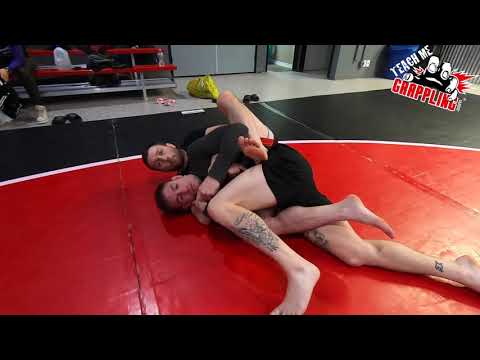
Getting the Hooks on a Tight TURTLE!!! Seatbelt Series - 2
0
Seatbelt Turtle·TeachMeGrappling Coach Brian
PLEASE Click this link to SUPPORT the TeachMeGrappling Channel!!! https://www.patreon.com/TeachMeGrappling or https:/…
Перевод: seatbelt turtle
The Seatbelt Turtle subfamily covers the attacking position where the top fighter controls the turtled opponent from behind using the seatbelt grip (over-under arm configuration from behind). [1] The seatbelt provides strong upper body control that facilitates hook insertion for full back control. [1],[2] From seatbelt turtle, the attacking fighter works to insert hooks, establish a body triangle, or flatten the opponent to achieve full rear mount. [2],[3]
Seatbelt turtle uses the seatbelt grip (over-under on the torso) to control the opponent from behind the turtle, preparing for back take. [1]
Seatbelt control on turtle was systematised in BJJ back attack methodology. [1]
Seatbelt turtle control is commonly used in BJJ and MMA competition. [1]
Изображений для этой техники пока нет.
Войдите, чтобы предложить изображение.
PLEASE Click this link to SUPPORT the TeachMeGrappling Channel!!! https://www.patreon.com/TeachMeGrappling or https:/…
Учебных курсов по этой технике пока нет.
Войдите, чтобы предложить курс.
Риск травмы для человека, к которому применяется техника
Turtle is a defensive shell position; vulnerable to back takes and chokes
Уровень мастерства, необходимый для надёжного выполнения техники
Разрешена ли техника по основным соревновательным правилам
Mastering Jujitsu (Renzo Gracie & John Danaher, 2003)
Alias sources — [1] IBJJF Rules (2024) [2] Jiu-Jitsu University (Ribeiro, 2008) [3] Mastering Jujitsu (Gracie & Danaher, 2003)
Effectiveness sources — [1] Jiu-Jitsu University (Ribeiro, 2008)
Official Kodokan ground technique classification system
Mixed Japanese-Western terminology — combines traditional Japanese terms with katakana loanwords
Alias sources — [1] IBJJF Rules (2024) [2] Jiu-Jitsu University (Ribeiro, 2008) [3] Mastering Jujitsu (Gracie & Danaher, 2003)
Effectiveness sources — [1] Jiu-Jitsu University (Ribeiro, 2008)
base stability, heavy hips, ride ability
heavier build with strong hips for pressure
hip adductors, core, glutes, quadriceps
Каждое движение в любом боевом искусстве обладает рядом универсальных свойств. Комбинируйте параметры ниже, чтобы найти нужный инструмент или сравнить аналоги из разных стилей.
Coach Brian recommends controlling their hand and threatening the choke to force extension, then capitalize on the moment their knee comes up to insert your hook. If they stay balled up, you won't be able to get the hooks, so extension is key to the position.
Keep your foot deep in the crotch area as a shallow hook initially to control the ankle and prevent knee bar escapes, then work on getting your first hook in. Coach Brian notes that wrestlers put the hook all the way in, but that can be dangerous in BJJ against opponents rolling for knee bars.
Drop your knee inside and cave in on the side to control their body, keeping close enough to maintain position. Once there, look for the two hooks—if they're balled up, use hip escape and extension to open up their base before attempting to insert the hooks.
Use your hips to defend against their takedown attempts and stuff their head down so they can't drive forward to their feet. Walk around them while maintaining the seatbelt, and drop to your side to control their movement as they try to return to their knees.
The Seatbelt Turtle subfamily covers the attacking position where the top fighter controls the turtled opponent from behind using the seatbelt grip (over-under arm configuration from behind). The seatbelt provides strong upper body control that facilitates hook insertion for full back control.
The seatbelt control from behind the turtle is a standard BJJ technique for transitioning from turtle attack to full back control. It represents the primary pathway from turtle dominance to the highest-scoring position in grappling (back control).
IBJJF: разрешён — Legal — common transitional position; IJF: ограничен — Legal position but extended turtle without attacking penalized for non-combat…; ADCC: разрешён — Legal; Unified MMA: разрешён — Legal; UWW: разрешён — Legal — bottom position, opponent works to turn/pin; FIAS Sport Sambo: разрешён — Legal
Оценка опасности 3/10. Moderate — turtle is a defensive shell position; vulnerable to back takes and chokes
Стандартная цепочка подготовки: Pass the Guard → Settle Weight → Control Arms → Threaten Submissions.
Стандартные контрприёмы: Bridge (Upa) — explosive hip elevation to off-balance the top player / Elbow-Knee Escape (Shrimp) — create space by driving elbow to knee and hip-escaping / Frame — establish forearm frames to prevent the top player from settling weight.
Распространённые варианты: Low mount (hips heavy on the opponent's belly, grapevines in for sta…); High mount (knees under the armpits, arms isolated for submissions); S-mount (one knee high under the armpit, other leg across for arm …); Technical mount (one leg hooked, one knee posted, modified for back-take t…).
Seatbelt turtle control is commonly used in BJJ and MMA competition.
Основные ошибки, на которые стоит обратить внимание: Not locking the seatbelt hands together — the hands must connect for the grip to be effective / Placing the over arm on the wrong side — the over arm goes on the side you want to take the opponent down to / Not driving the opponent to the ground from seatbelt — the seatbelt should immediately lead to taking the opponent to… / Reaching for hooks before establishing the seatbelt — the seatbelt comes first; hooks follow.
Seatbelt Turtle также известен как Shītoberuto Kame, Seatbelt on Turtle, Harness Turtle Control, Back-of-Turtle Seatbelt.