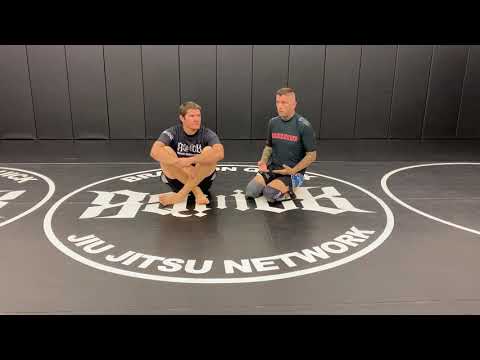
How to use chest pressure to take the back
0
Chest Pressure North-South·Brandon Quick·Added by Admin
This is one of my favorite Back Retention Drills www.BQuickJJ.com
Перевод: chest pressure north-south
The Chest Pressure North-South maximises the pinning pressure of the north-south position by driving the sternum directly into the opponent's sternum or diaphragm, using bodyweight to compress the bottom fighter's breathing. [1] The chest-to-chest pressure is the primary control mechanism in north-south, making breathing difficult for the bottom fighter and reducing their ability to generate the movement needed to escape. [1],[2] Effective chest pressure north-south requires proper weight distribution and hip positioning. [2],[3]
Chest pressure north-south maximises chest-to-chest weight distribution to exhaust the opponent and prevent escapes. [1]
Chest pressure north-south is a control-focused variant developed in BJJ. [1]
Used in BJJ and MMA competition for exhaustion-based control. [1]
Изображений для этой техники пока нет.
Войдите, чтобы предложить изображение.
This is one of my favorite Back Retention Drills www.BQuickJJ.com
Учебных курсов по этой технике пока нет.
Войдите, чтобы предложить курс.
Риск травмы для человека, к которому применяется техника
Top positions enable pressure and striking; rib compression risk under heavy pressure
Уровень мастерства, необходимый для надёжного выполнения техники
Разрешена ли техника по основным соревновательным правилам
Mastering Jujitsu (Renzo Gracie & John Danaher, 2003)
Alias sources — [1] Jiu-Jitsu University (Ribeiro, 2008) [2] Mastering Jujitsu (Gracie & Danaher, 2003) [3] Mastering Jujitsu (Gracie & Danaher, 2003)
Effectiveness sources — [1] Jiu-Jitsu University (Ribeiro, 2008)
Mixed Japanese-Western terminology — combines traditional Japanese terms with katakana loanwords
Alias sources — [1] Jiu-Jitsu University (Ribeiro, 2008) [2] Mastering Jujitsu (Gracie & Danaher, 2003) [3] Mastering Jujitsu (Gracie & Danaher, 2003)
Effectiveness sources — [1] Jiu-Jitsu University (Ribeiro, 2008)
body awareness, stability, control of weight distribution
athletic build with good proprioception
core, hips, legs for base stability
According to Brandon Quick, you want to get behind your opponent's triceps and push in on your toes while getting higher in the mount, then turn into the pressure—this fundamental movement works for transitions to arm bars or S-mount positions.
Yes, Brandon Quick explains that from side control you can get behind your opponent's shoulder and chest, then push in hard with your arms free until they turn slightly, allowing you to step into a back-taking position.
Brandon Quick emphasizes pushing to force your opponent's hip grip one way or another—either your belly puts their arm around or they plant it defensively—while using your hands as little as possible.
The Chest Pressure North-South maximises the pinning pressure of the north-south position by driving the sternum directly into the opponent's sternum or diaphragm, using bodyweight to compress the bottom fighter's breathing. The chest-to-chest pressure is the primary control mechanism in north-south, making breathing difficult for the bottom fighter and reducing their ability to generate the movement needed to escape.
Chest pressure north-south represents the fundamental north-south control technique, emphasising the same chest-to-chest compression that makes judo's kami-shiho-gatame an effective pin. It is the standard north-south control taught in both judo and BJJ.
IBJJF: разрешён — Legal, mount scores 4 points — highest-scoring position; IJF: разрешён — Legal, osaekomi (pin) — 10-19 seconds scores waza-ari, 20 seconds scores ippon; ADCC: разрешён — Legal, mount scores 2 points; Unified MMA: разрешён — Legal dominant position; UWW: разрешён — Legal, back exposure scores points, pin ends match by fall; FIAS Sport Sambo: разрешён — Legal, pin scores points
Оценка опасности 3/10. Moderate — top positions enable pressure and striking; rib compression risk under heavy pressure
Стандартная цепочка подготовки: Achieve Position → Stabilize → Maintain → Attack.
Стандартные контрприёмы: Bridge (Upa) — explosive hip elevation to off-balance the top player / Elbow-Knee Escape (Shrimp) — create space by driving elbow to knee and hip-escaping / Frame — establish forearm frames to prevent the top player from settling weight.
Распространённые варианты: Standard variation (primary positioning for control and attack); Offensive variation (configured for submission or striking opportunities); Transitional variation (positioned for quick movement to the next position); Defensive variation (prioritising stability and control over attack).
Used in BJJ and MMA competition for exhaustion-based control.
Основные ошибки, на которые стоит обратить внимание: Not relaxing the body weight — tension reduces the pressure; relax and let gravity do the work / Keeping the legs too close — sprawl the legs back and wide for maximum forward drive / Not controlling the opponent's arms — free arms allow framing and escape / Staying in chest pressure north-south indefinitely — use the exhaustion to set up submissions or transitions.
Chest Pressure North-South также известен как Mune Appaku Nanboku, Chest-to-Chest North-South, Heavy North-South, Pressure NS.