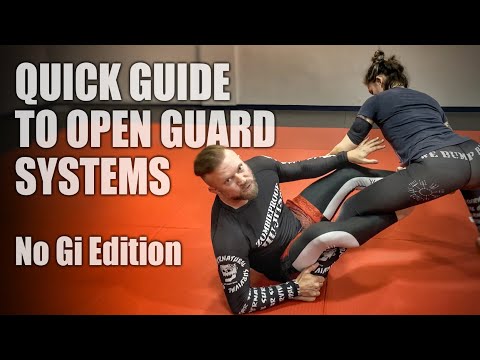
Quick Guide to Open Guard Systems | No Gi Edition
0
Open Guard·Knight Jiu-Jitsu
Hundreds more class instruction videos at Patreon.com/KnightJiuJitsu If you have any confusion on where, when and how t…
Перевод: Open guard
Open guard encompasses all guard positions where the bottom player's legs are NOT locked around the opponent, instead using feet on hips, hooks on legs, grips on sleeves/collars, and dynamic hip movement to control distance and create offensive opportunities. [1] Open guard sacrifices the tight control of closed guard for greater mobility, a wider attack repertoire, and the ability to play at longer range — making it both more versatile and more technically demanding. [1],[2] The open guard revolution began in the 1990s with Ricardo De La Riva's outside hook guard and exploded through the 2000s–2010s with innovations like spider guard, lasso guard, X-guard, worm guard, and berimbolo, creating a vast and ever-expanding universe of specialised positions. [2],[3] Modern competition BJJ at the highest levels is dominated by open guard exchanges, with competitors building entire careers around mastery of a single open guard variation. [3]
While open guard concepts existed in earlier BJJ, the open guard revolution began with Ricardo De La Riva in the late 1980s–1990s, who developed the outside hook guard that bears his name. [1] The 2000s saw explosive innovation: Marcelo Garcia revolutionised butterfly and X-guard, the Mendes brothers developed berimbolo from reverse De La Riva, and spider/lasso guard became dominant in gi competition. [1],[2] The 2010s brought Keenan Cornelius's lapel/worm guard, further expanding the open guard universe. [2],[3] Today, open guard innovation continues to be the primary driver of BJJ's technical evolution. [3]
Open guard is the dominant guard type in modern competition BJJ — the majority of matches at black belt are contested from various open guard positions rather than closed guard. [1] Marcelo Garcia won 5 IBJJF World Championships and 4 ADCC titles primarily through butterfly guard sweeps and back takes from open guard. [2] The Mendes brothers' berimbolo system from De La Riva/reverse De La Riva guard produced multiple World Championship titles. [3]
Изображений для этой техники пока нет.
Войдите, чтобы предложить изображение.
Hundreds more class instruction videos at Patreon.com/KnightJiuJitsu If you have any confusion on where, when and how t…
Учебных курсов по этой технике пока нет.
Войдите, чтобы предложить курс.
Риск травмы для человека, к которому применяется техника
Moderate — open guard is relatively safe but slightly more dangerous than closed guard because the legs are not locked; risk of being stacked, leg-dragged, or having legs pinned during passing attempts; in MMA, open guard allows more ground-and-pound than closed guard
Уровень мастерства, необходимый для надёжного выполнения техники
Разрешена ли техника по основным соревновательным правилам
The Guard (Ed Beneville & Joe Moreira, 2003)
Description sources — [1] Jiu-Jitsu University (Ribeiro, 2008) [2] The Guard (Beneville & Moreira, 2003) [3] X-Guard (Garcia, 2008)
History sources — [1] Ricardo De La Riva competition record [2] Marcelo Garcia career [3] Keenan Cornelius worm guard development
Description sources — [1] Jiu-Jitsu University (Ribeiro, 2008) [2] The Guard (Beneville & Moreira, 2003) [3] X-Guard (Garcia, 2008)
History sources — [1] Ricardo De La Riva competition record [2] Marcelo Garcia career [3] Keenan Cornelius worm guard development
hip mobility (constant movement), grip endurance (maintaining control connections), flexibility (inversions for guard retention)
long legs (more reach for hooks and control), flexible hips, quick reactions
hip flexors (scooting, inverting), core (rotation and guard retention), forearms (grip fighting), adductors (hooking)
Каждое движение в любом боевом искусстве обладает рядом универсальных свойств. Комбинируйте параметры ниже, чтобы найти нужный инструмент или сравнить аналоги из разных стилей.
Headquarters (HQ) is a top control / pre-pass position in modern Brazilian Jiu-Jitsu where the standing or kneeling top player parks one shin across the bottom player's near hip with the foot hooked behind their far hip — converting the bottom player's open guard or De La Riva guard into a stalled, controlled checkpoint from which multiple guard passes (knee cut, leg drag, smash pass, long step) become available. [1,2] The position was popularised by Rafael Mendes and the Atos lineage as the central hub of their guard-passing system: rather than committing to a specific pass on entry, the top player establishes Headquarters first, neutralises the bottom player's primary attacks (berimbolo, single-leg, leg lasso), and then chooses the pass that fits the moment. [1,3] The defining structural detail is the shin alignment — the lead shin runs across the bottom player's hipline and traps the lower body, while the trailing leg posts wide for base. [1]
Rubber Guard uses extreme leg flexibility to control the opponent from closed guard by placing the foot behind the opponent's head, creating a platform for submissions and sweeps without relying on gi grips. [1]
Open guard encompasses all guard positions where the legs are not closed around the opponent — spider guard, lasso guard, De La Riva, reverse De La Riva, and others. Modern BJJ competition is dominated by open guard play. (Ribeiro, Jiu-Jitsu University)
Knight Jiu-Jitsu explains that if your opponent pushes to the inside, you can swap to a secondary tripod sweep, or transition to a single leg X guard. If they continue to push out of single leg X, you have additional options available to keep them engaged.
According to Knight Jiu-Jitsu, you place one leg under your opponent's first leg from the hip position, then pull their hands to the floor to get them balanced before executing the sweep.
Open guard encompasses all guard positions where the bottom player's legs are NOT locked around the opponent, instead using feet on hips, hooks on legs, grips on sleeves/collars, and dynamic hip movement to control distance and create offensive opportunities. Open guard sacrifices the tight control of closed guard for greater mobility, a wider attack repertoire, and the ability to play at longer range — making it both more versatile and more technically demanding.
While open guard concepts existed in earlier BJJ, the open guard revolution began with Ricardo De La Riva in the late 1980s–1990s, who developed the outside hook guard that bears his name. The 2000s saw explosive innovation: Marcelo Garcia revolutionised butterfly and X-guard, the Mendes brothers developed berimbolo from reverse De La Riva, and spider/lasso guard became dominant in gi competition.
IBJJF: разрешён — Legal — guard is fundamental to BJJ, sweeps from guard score 2 points; IJF: ограничен — Guard pulling penalized as non-combativity — groundwork from guard permitted …; ADCC: разрешён — Legal, guard pull penalized -1 point in points portion; Unified MMA: разрешён — Legal — no penalty for playing guard; FIAS Sport Sambo: разрешён — Legal
Оценка опасности 3/10. Low-moderate — open guard is relatively safe but slightly more dangerous than closed guard because the legs are not locked; risk of being stacked, leg-dragged, or having legs pinned during passing attempts; in MMA, open guard allows more ground-and-pound than closed guard
Стандартная цепочка подготовки: Establish Open Guard → Manage Distance → Create Angle → Off-Balance → Attack → Retain Guard.
Стандартные контрприёмы: Grip Stripping — systematically removing the guard player's grips eliminates their control framework / Standing Passes (Toreando) — standing up and throwing the legs to pass at speed / Pressure Passes — driving forward with heavy chest pressure to flatten the guard player / Leg Drag — gripping and dragging one leg across the body to clear the passing lane.
Распространённые варианты: De La Riva guard (outside hook on the opponent's lead leg with same-side co…); Spider guard (feet on the opponent's biceps with sleeve grips; creates …); Butterfly guard (seated with both feet hooked inside the opponent's thighs…); X-guard (underneath the opponent with legs forming an X around one…); Lasso guard (wrapping the leg around the opponent's arm from spider gu…); Reverse De La Riva (inside hook on the opponent's lead leg; sets up berimbolo…); Single-leg X (ashi garami) (controlling one leg with both legs in an X configuration;…); Worm guard (using the opponent's lapel threaded around their leg as a…).
Open guard dominates modern IBJJF and ADCC competition, with the majority of black belt matches featuring open guard exchanges. Multiple World Champions have built careers on specific open guard variations.
Основные ошибки, на которые стоит обратить внимание: Lying flat on the back in open guard — open guard requires constant hip movement and being on one hip; flat = getting… / Allowing the opponent to control both legs simultaneously — if the passer pins both legs to one side, the pass is ess… / Reaching with arms instead of using legs — the legs are stronger and longer; overuse of arms in open guard leads to f… / Playing the same guard against every passer — different passers require different guards; a pressure passer requires ….
Open Guard также известен как Ōpun Gādo, Open Guard, Distance Guard, Non-Closed Guard.