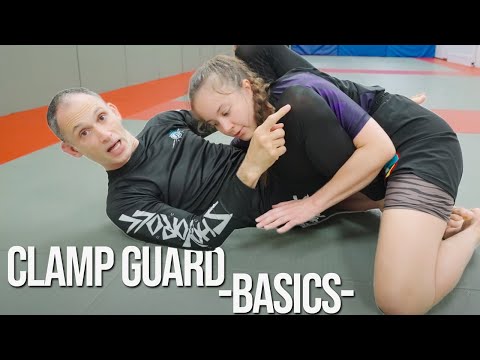
Grace Learns Clamp Guard Basics w Sensei Glick
0
Clamp Guard·Shintaro Higashi
The Clamp Guard is super effective in Judo AND BJJ Works in Gi AND No Gi Great crossover dynamic technique to control yo…
Перевод: clamp guard
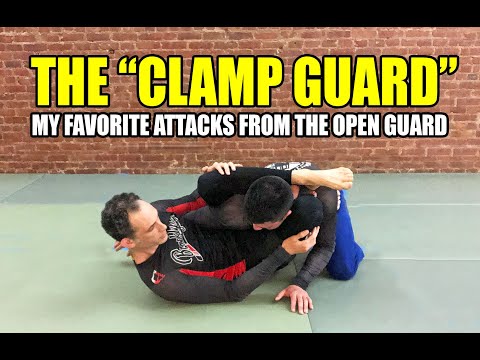
The clamp guard is a closed guard sub-position where the guard player controls the inside space between the opponent's arms with their legs, lying on their hip (not flat) with the inside knee blocking the opponent from smashing down and the outside knee pushing the opponent's shoulder toward their head. [1] Part of John Danaher's New Wave Jiu-Jitsu closed guard system, the clamp creates a 'closed circuit of reinforced wedges' providing maximum control for offensive attacks. [2] Giancarlo Bodoni (2x ADCC champion) released 'Forging the Guard: Mastering Foundations of the Clamp' and Adam Wardzinski released 'Clamp Guard Engineering,' both through BJJ Fanatics.
Provides maximum control from closed guard with clear attack chains to omoplata and triangle. Used at the highest levels of no-gi competition by Danaher system practitioners. [1]
John Danaher's New Wave Jiu-Jitsu system. Popularized by Giancarlo Bodoni (2x ADCC champion) and Adam Wardzinski.
Giancarlo Bodoni: 2x ADCC champion using Danaher closed guard system including clamp.
Изображений для этой техники пока нет.
Войдите, чтобы предложить изображение.
The Clamp Guard is super effective in Judo AND BJJ Works in Gi AND No Gi Great crossover dynamic technique to control yo…
2 Attacks from the Clamp: the "clamp guard" is one of Mr. Danaher’s many innovations - an incredibly effective open guar…
Hi everyone, my name is Gordon Ryan. This is a look into my life. If you enjoy it, watch it. If you hate it, watch it. I…
The clamp guard is a leg-based defensive and offensive position designed to manage distance and pressure when a top opponent drives forward aggressively. According to Shintaro Higashi and Brian Glick, the position is established through sequential hip escapes and frames: the bottom player creates space by moving their hips laterally, performs knee-elbow escapes to advance one knee to the opponent's hip, then places a second knee in front of the opponent's shoulder while hooking the top leg over it—either pinching the knees or placing the heel across the top leg. Higashi emphasizes that this configuration solves the core problem of being flattened, allowing the bottom player to move their head away and create distance despite forward pressure. Glick adds that the clamp is particularly valuable when transitioning from seated positions (like butterfly guard) after the opponent advances and flattens the bottom player, detailing precise hip angle and frame mechanics to slip the knee inside. Both instructors agree the position functions defensively by blocking forward advancement with the front knee while the top leg prevents the opponent from pulling away and posturing. Offensively, both describe the clamp as a platform for submissions: Higashi mentions the plata and triangle as follow-up attacks, while Glick focuses on an armbar variation involving elbow-to-elbow positioning and a modified triangle finish, emphasizing how the position's leg control forces opponent responses and creates openings for multiple submissions.
Сформировано на основе 2 инструкторов
Учебных курсов по этой технике пока нет.
Войдите, чтобы предложить курс.
Риск травмы для человека, к которому применяется техника
Positional control with no inherent joint stress or choke
Уровень мастерства, необходимый для надёжного выполнения техники
Разрешена ли техника по основным соревновательным правилам
New Wave Jiu Jitsu: Closed Guard (Danaher, 2022)
[1] Danaher — New Wave Closed Guard system
[2] Bodoni and Wardzinski — dedicated clamp instructionals
Standard katakana transliteration of Western martial arts terminology (外来語) — used in Japanese MMA, boxing, and BJJ communities
[1] Danaher — New Wave Closed Guard system
[2] Bodoni and Wardzinski — dedicated clamp instructionals
understanding of closed guard frames and wedge mechanics, hip mobility
hip adductors, core, shoulders
Start by performing knee-elbow escapes, bringing your knee first to your opponent's hip while moving your head back and away from them to reduce pressure on your upper body. After a second knee-elbow escape, position your knee to begin the clamp position.
Turn your hips to the side and create a frame on your partner's shoulder, slipping your knee inside in front of the shoulder. Keep your back off the mat and your body turned to the side rather than flat, and go elbow-to-elbow with your partner to maintain tension.
Use your heel to hold onto them and retract your leg, which transitions you into a trap triangle finish where you move your partner's arms out to complete the submission.
The clamp guard is a closed guard sub-position where the guard player controls the inside space between the opponent's arms with their legs, lying on their hip (not flat) with the inside knee blocking the opponent from smashing down and the outside knee pushing the opponent's shoulder toward their head. Part of John Danaher's New Wave Jiu-Jitsu closed guard system, the clamp creates a 'closed circuit of reinforced wedges' providing maximum control for offensive attacks.
Modern BJJ innovation from John Danaher's New Wave Jiu-Jitsu closed guard system. Popularized by Giancarlo Bodoni and Adam Wardzinski through BJJ Fanatics instructionals.
IBJJF: разрешён — Legal — guard is fundamental to BJJ, sweeps from guard score 2 points; IJF: ограничен — Guard pulling penalized as non-combativity — groundwork from guard permitted …; ADCC: разрешён — Legal, guard pull penalized -1 point in points portion; Unified MMA: разрешён — Legal — no penalty for playing guard; FIAS Sport Sambo: разрешён — Legal
Оценка опасности 2/10. Low — positional control with no inherent joint stress or choke
Стандартная цепочка подготовки: Establish closed guard → Break opponent's posture → Hip out to one side → Inside knee blocks smash → Outside knee drives shoulder toward head → Arm covers trapped arm → Hand reinforces outside knee → Threaten omoplata or triangle.
Стандартные контрприёмы: Posture up forcefully — break the wedge alignment / Strip the reinforcing hand — break the closed circuit / Stack the guard player — drive weight forward to collapse the wedges / Stand up in guard — remove the hips from the opponent's control.
Распространённые варианты: Standard clamp (the basic Danaher system configuration); Clamp to omoplata (primary attack chain); Clamp to triangle choke (the omoplata threat sets up the triangle); Clamp to back take (transition from the controlled position).
Giancarlo Bodoni: 2x ADCC champion using Danaher closed guard system including clamp.
Основные ошибки, на которые стоит обратить внимание: Lying flat instead of on the hip — must be on the side for proper wedge alignment / Not reinforcing the outside knee with the hand — breaks the closed circuit / Allowing the opponent's head to rise over your head — lose posture control / Not threatening attacks — the clamp is a control position that must lead to submissions.
Clamp Guard также известен как Kuranpu Gādo, Clamp Guard, Clamp Position, Danaher Clamp.