A Basic De La Riva Sweep
0
De La Riva Sweep·Tarik BJJ
🔗 Links: Follow me on Instagram for more jiu-jitsu content: https://www.instagram.com/tarik_bjj/ Discover top-qualit…
Перевод: De La Riva sweep
The De La Riva Sweep subfamily covers sweeps from the De La Riva guard, where the guard player hooks one leg around the opponent's lead leg from the outside while controlling the ankle of that leg. [1] The DLR guard provides powerful off-balancing capability because the hook and ankle control can stretch the opponent's base and manipulate their posture. [1],[2] DLR sweeps include direct sweeps (pulling the opponent over the hook), baby bolo variations (mini-inversion sweeps), and transitions to berimbolo back takes. [2],[3]
De La Riva sweeps are among the most effective open guard sweeps in gi BJJ, using the signature DLR hook (foot hooked behind the opponent's lead leg from the outside) to control distance and create sweeping angles. [1] The DLR guard is one of the most widely used open guard systems in competition BJJ. [1],[2]
The De La Riva guard and its sweeps were developed by Ricardo De La Riva in the 1980s in Rio de Janeiro. [1] De La Riva began using the hooking guard in competition to neutralise larger opponents' passing pressure. [1] The guard system was further developed by his students and became one of the most influential guard innovations in BJJ history. [2]
Изображений для этой техники пока нет.
Войдите, чтобы предложить изображение.
🔗 Links: Follow me on Instagram for more jiu-jitsu content: https://www.instagram.com/tarik_bjj/ Discover top-qualit…
SALE SALE SALE OVER 50% OFF – BOX SET – ALL 4 COURSES 50% OFF CLICK HERE – https://bit.ly/2lAOHmp • The Blue Belt Sup…
Учебных курсов по этой технике пока нет.
Войдите, чтобы предложить курс.
Риск травмы для человека, к которому применяется техника
Sweeps reverse position from bottom; moderate impact on landing for top player
Уровень мастерства, необходимый для надёжного выполнения техники
Разрешена ли техника по основным соревновательным правилам
Advanced Brazilian Jiu-Jitsu Techniques (Marcelo Garcia, 2011)
Alias sources — [1] Common abbreviation in BJJ community [2] Named after Ricardo De La Riva [3] Brazilian Portuguese name
Effectiveness sources — [1] Brazilian Jiu-Jitsu: Theory and Technique (Renzo Gracie & Royler Gracie, 2001) [2] Jiu-Jitsu University (Saulo Ribeiro, 2008)
Standard katakana transliteration of Western martial arts terminology (外来語) — used in Japanese MMA, boxing, and BJJ communities
Alias sources — [1] Common abbreviation in BJJ community [2] Named after Ricardo De La Riva [3] Brazilian Portuguese name
Effectiveness sources — [1] Brazilian Jiu-Jitsu: Theory and Technique (Renzo Gracie & Royler Gracie, 2001) [2] Jiu-Jitsu University (Saulo Ribeiro, 2008)
timing, hip power, off-balancing skill
strong hips and active legs for sweeping leverage
hip flexors, glutes, quadriceps, core rotators
Каждое движение в любом боевом искусстве обладает рядом универсальных свойств. Комбинируйте параметры ниже, чтобы найти нужный инструмент или сравнить аналоги из разных стилей.
The Baby Bolo Sweep is a De La Riva guard sweep that uses a small inversion (a 'mini-berimbolo') to off-balance and sweep the opponent without committing to a full berimbolo back-take rotation. [1] The guard player hooks the DLR, initiates a small inversion by pulling the hips over the shoulders, but instead of completing the full berimbolo spin, uses the partial inversion to off-balance the opponent and come up on top for the sweep. [1,2] The baby bolo is effective because it uses the berimbolo's off-balancing power without requiring the full inversion that can be risky against experienced opponents. [2,3]
The Standard De La Riva Sweep executes the fundamental DLR guard sweep by using the DLR hook to stretch and off-balance the opponent backward, controlling the ankle of the hooked leg while pulling the opponent forward with the upper body grip, then sweeping them over the hook. [1] The guard player extends the DLR hook to push the opponent's leg away, breaking their base, while simultaneously pulling the upper body forward with a collar or belt grip. [1,2] The combination of the push on the leg and the pull on the upper body creates a rotational force that tips the opponent over. [2,3]
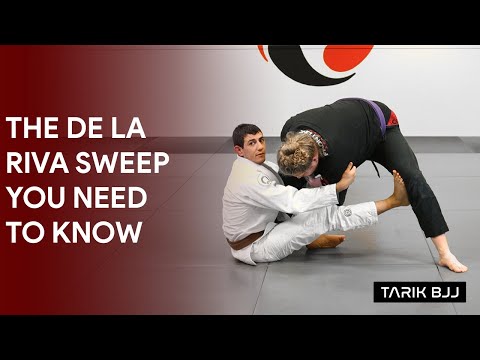
The foot hooking the inside of your opponent's thigh is crucial—it helps turn their knee slightly to the side, which is essential for setting up the sweep. Tarik BJJ emphasizes that this foot placement is what initiates the directional change needed for the technique to work.
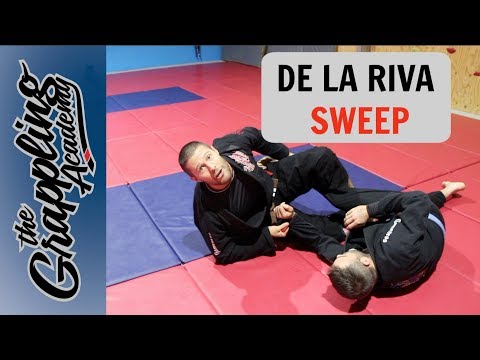
No—The Grappling Academy instructor advises against getting greedy and going for passes right away. Instead, establish a solid position with a cross-face grip and control before attempting to complete your pass.
Break their grip first before proceeding with your sweep setup. The Grappling Academy emphasizes maintaining control of the grips throughout the technique.
The De La Riva Sweep subfamily covers sweeps from the De La Riva guard, where the guard player hooks one leg around the opponent's lead leg from the outside while controlling the ankle of that leg. The DLR guard provides powerful off-balancing capability because the hook and ankle control can stretch the opponent's base and manipulate their posture.
The De La Riva guard was developed and named after Ricardo De La Riva, who used this guard innovatively in competition in the 1980s and 1990s. The position revolutionised open guard play and spawned an entire family of techniques including the berimbolo.
Unified MMA: разрешён — Legal defensive/transitional technique; IBJJF: разрешён — Legal; IJF: разрешён — Legal; ADCC: разрешён — Legal; UWW: разрешён — Legal; FIAS Sport Sambo: разрешён — Legal
Оценка опасности 3/10. Moderate — sweeps reverse position from bottom; moderate impact on landing for top player
Стандартная цепочка подготовки: Control Grips → Off-Balance → Execute Sweep → Follow to Top.
Стандартные контрприёмы: Base and Posture — maintain wide base and upright posture to resist the sweep / Grip Strip — break controlling grips before the sweep can be loaded / Back Step — retreat the leg being attacked to remove the sweep fulcrum.
Распространённые варианты: Standard sweep (primary off-balancing and reversal technique from the guard); Combination sweep (chaining two sweep directions to catch the opponent's adj…); Counter sweep (sweeping as the opponent initiates a guard pass attempt); Competition sweep (optimised for point-scoring in tournament settings).
Ricardo De La Riva himself used the guard extensively in competition in the 1980s-90s. The De La Riva guard and its sweeps have since become one of the most commonly used guard systems in IBJJF World Championship competition at all belt levels.
Основные ошибки, на которые стоит обратить внимание: Playing DLR without the far ankle grip — the ankle grip is essential for controlling the opponent's base / Hooking too shallow — the DLR hook must be deep behind the knee for maximum leverage / Lying flat on the back in DLR — maintain active hips and an angled body / Not using the non-hooking foot — the free foot should be on the opponent's hip or bicep for control.
De La Riva Sweep также известен как Dera Hība Suīpu, DLR Sweep, De La Riva Guard Sweep, Guarda De La Riva.