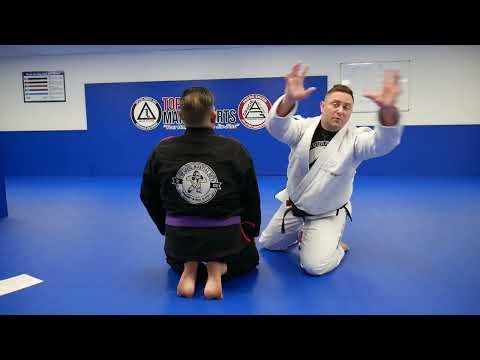
lesson 3 guillotine, kimura, and sweeps
0
Standard Kimura Sweep·Top Level Jiu-Jitsu·Added by Admin
guillotine, kimura, and sweeps
Перевод: kimura sweep
The kimura sweep uses a figure-four (double wristlock) grip from closed guard to off-balance and sweep the opponent, exploiting the 'double trouble' principle — threatening the shoulder lock forces the opponent to defend, creating the opening for a sweep. [1] Named after Masahiko Kimura's defeat of Helio Gracie (1951), the grip was systematized as a complete sweeping and control platform by David Avellan's 'Kimura Trap System' (2012). [2] It is one of the first sweep-submission combinations taught in BJJ.
One of the highest-percentage sweep-submission combinations from closed guard. The dilemma between sweep and submission makes it extremely difficult to defend both simultaneously. [1]
Kimura grip named after Masahiko Kimura (1951). Sweep application systematized by David Avellan (2012).
Used extensively at all belt levels in IBJJF competition as a fundamental closed guard sweep.
Изображений для этой техники пока нет.
Войдите, чтобы предложить изображение.
guillotine, kimura, and sweeps
Учебных курсов по этой технике пока нет.
Войдите, чтобы предложить курс.
Риск травмы для человека, к которому применяется техника
Very low danger as a sweep — the grip can transition to a 7/10 shoulder lock submission if the opponent refuses to concede the sweep
Уровень мастерства, необходимый для надёжного выполнения техники
Разрешена ли техника по основным соревновательным правилам
David Avellan — The Kimura Trap System (2012)
[2] Avellan — Kimura Trap System formalization
BJJ World — Why The Kimura Sweep Is The Best BJJ Sweep (bjj-world.com) || David Avellan — The Kimura Trap System (2012) || Kingz — BJJ Kimura Complete Guide (kingz.com)
Standard katakana transliteration of Western martial arts terminology (外来語) — used in Japanese MMA, boxing, and BJJ communities
[1] BJJ World — kimura sweep mechanics and application
[2] Avellan — Kimura Trap System formalization
grip strength for figure-four, hip mobility for bridging
hip flexors, glutes, forearms, biceps
No, you should avoid sitting straight up toward your knees. Instead, you want to be turning as you come up, which helps control your opponent's arms during the sweep.
Your hand that goes behind you should be placed on your hand (not your elbow) and centered on your body as much as possible—roughly aligned with a line through your nose and groin. This hand positioning on your hip helps generate proper mechanics.
As your opponent pushes in, scoot your body over to get off the tracks, which jacks his arm out to the side and allows you to trap his leg. You should grab his wrist, feed through the arm, and grab your own wrist to secure the position.
Use your body rotation, not your arms. Turn your body to try to touch your elbow to the ground—it's your body doing the work, not arm pressure pushing up.
The kimura sweep uses a figure-four (double wristlock) grip from closed guard to off-balance and sweep the opponent, exploiting the 'double trouble' principle — threatening the shoulder lock forces the opponent to defend, creating the opening for a sweep. Named after Masahiko Kimura's defeat of Helio Gracie (1951), the grip was systematized as a complete sweeping and control platform by David Avellan's 'Kimura Trap System' (2012).
The kimura grip is named after Masahiko Kimura's defeat of Helio Gracie (1951). The sweep application evolved naturally in BJJ.
Unified MMA: разрешён — Legal defensive technique; IBJJF: разрешён — Legal — escapes and sweeps are fundamental to BJJ, sweep from bottom scores 2…; IJF: разрешён — Legal; ADCC: разрешён — Legal, sweep scores 2 points (4 from mount/back); FIAS Sport Sambo: разрешён — Legal; FIAS Combat Sambo: разрешён — Legal
Оценка опасности 2/10. Very low danger as a sweep — the grip can transition to a 7/10 shoulder lock submission if the opponent refuses to concede the sweep
Стандартная цепочка подготовки: Secure Figure-Four Grip → Break Posture → Hip Bump → Complete the Sweep → Transition.
Стандартные контрприёмы: Post the free hand wide — prevent the off-balancing / Sit back to break posture control / Circle the trapped arm to break the grip / Stack the guard player.
Распространённые варианты: Hip bump kimura sweep (hip bump creates the off-balancing moment); Half guard kimura rollover (from bottom half guard); Butterfly guard kimura (elevator sweep with kimura grip); Squirrel lock variation (from bottom side control using kimura grip to create a sc…).
Used extensively at all belt levels in IBJJF competition as a fundamental closed guard sweep.
Основные ошибки, на которые стоит обратить внимание: Not breaking posture before attempting the sweep — the opponent must be off-balanced first / Releasing the grip during the sweep — maintain the figure-four throughout the transition / Not bridging explosively enough — the sweep requires commitment and hip drive / Attempting the sweep without controlling the opponent's posting hand — they will simply post and resist.
Standard Kimura Sweep также известен как Kimura Suīpu, Kimura Sweep, Kimura Grip Sweep, Double Wristlock Sweep.